By
By 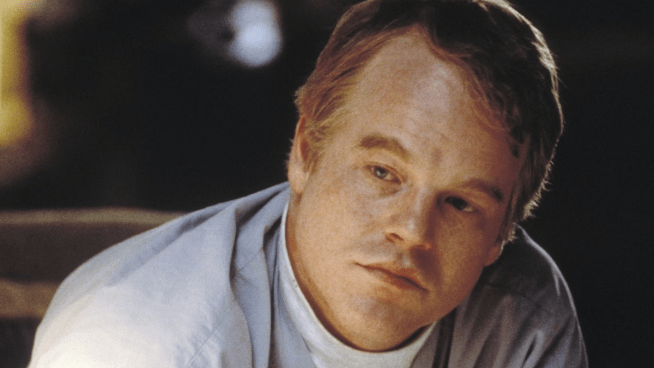
A wonderfully elegiac, formally strange, and beautifully poetic tale of beginnings and endings led by an all-star cast, defined by the push and pull of either divine fate or random chance as it touches the lives of a constellation of broken families. A more-than-three-hour ensemble drama that all takes place over one night shouldn’t feel so breathless, urgent, tense. Only the particular flavor of genius that is Paul Thomas Anderson could conceive of and execute this at such a high level, with threads of death and rebirth, new beginnings, bouts of forgiveness and the power of justified rage weaving and intersecting in controlled chaos – including a prophesying kid rapper – where everything ultimately leads back to death.
It announces its terms before it introduces a single character. The prologue is a trio of tall tales about coincidence, delivered with carnival-barker relish, each one a small closed loop of horrible luck: three convicted hung men with the same name as the hill they hang on, a card-dealing scuba diver plucked out of a lake by a firefighting plane piloted by the very man whose life savings his card dealing extinguished, a troubled man falling past the window of the very shotgun blast his mother intended to scare off his father with. This was not just a matter of chance. It’s a provocation. A dare. Watch the next three hours and try to decide whether what you’re seeing is authored or accidental, whether these people are being punished by the wrath of a God with a sense of plucky, needling structure or simply barreling into one another in the Valley on some random Tuesday night with a high chance of rain. Magnolia never answers it for us, and that refusal is the engine that drives the whole provocation.
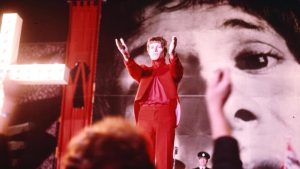
What’s underneath the coincidence is much simpler and much worse: children are what their parents did to them. Two dying men anchor the film, both of them fathers, both of them cancer-riddled, both of them looking for someone to hear a confession. Earl Partridge (Jason Robards) abandoned a wife to die alone and a boy to watch her do it, and that boy grew into Frank T.J. Mackey (Tom Cruise), a men’s-seminar demagogue selling rage as a technique – with Cruise doing the best work of his career precisely because his whole “Seduce and Destroy” mantra is so obviously scar tissue from his traumatic childhood and bearing witness to a dying mom.
Jimmy Gator (Phillip Baker Hall) has spent decades as America’s kindly quiz-show uncle while his daughter Claudia (Melora Walters) self-destructs in an apartment full of noise, unable to be in a room with a man who wants to know her. Around them: a nurse (Phillip Seymour Hoffman) who decides a stranger’s last wish is worth humiliating himself over, a trophy wife (Julianne Moore) discovering too late that she actually loved him, a boy genius (Jeremy Blackman) being strip-mined by every adult in his life, and the grown-up version of that same boy (William H. Macy), forty years later, still trying to buy affection with a mouth full of braces. “I really do have love to give. I just don’t know where to put it.” That’s the whole movie diluted down to one repeated refrain, delivered from its saddest, most washed up character.
And it moves. Elswit’s camera never stops – whip pans, corridors, that gliding push through the studio like the film itself is late for something – while Jon Brion’s score keeps a low hum of dread under scenes where nothing has technically gone wrong yet. Aimee Mann meanwhile provides Magnolia its entire living, breathing nervous system; the film is arguably a song cycle beset by monologues, and PTA has said as much. Which is why it can do what it does two hours in.
Because two hours in, the movie stops being. And just vibes.
“Wise Up” starts under Claudia, alone, and then she sings it. And then the cut takes us to Jim, and he sings it. And Donnie, and Phil, and Linda in the back of the ambulance, and Jimmy in the wreck of his living room, and finally Earl, barely conscious, mouthing it into an oxygen mask. Nobody can hear anybody. They are scattered across the Valley in seven separate rooms and they are all in the same key. On paper it’s an absurdist idea – the kind of thing you’d expect to be laughed off the screen – and instead it lands as the single most emotionally naked passage in American film of that decade.
Oddly, the closest thing to it in the twenty-six years since is the juke-joint sequence in Sinners – another film willing to stop dead so a room full of people can be transfigured by a song, and the film PTA beat out for Best Picture at this year’s Oscars. Which is its own small joke, given that the Academy of 1999 couldn’t find room for Magnolia on the ballot at all.
It works because it isn’t a fantasy sequence or a flourish; it’s a straight up aria. Opera has always understood that there’s a point past which people can only sing, and PTA gets his ensemble there and lets them. It’s not going to stop ’til you wise up. Seven people receiving the same instruction and not one of them able to follow it.
It also does something sneakier: it teaches you that PTA will break the third-wall of his film when the feeling demands it. Having watched his ensemble break out into song, strung across the Valley like beads of condensation, you can’t credibly object to what falls out of the sky twenty minutes later.
The frogs are chance and fate and justice and death. Their rain is cruel and destructive but also the harbinger of great change. Cosmic intervention given physical form, exploding to the pavement below. Exodus 8:2 says: “If you refuse to let them go, I will send a plague of frogs on your whole country”. The phrase has been hiding in plain sight the entire film – on a placard, a game board, a poster, a forecast – and the plague arrives on cue for a set of characters who have refused, over and over, to let each other go. They arrive with the casualness of rain; the incidental indifferent of a passing weather cycle. Something truly unimaginable after the something as percentage-wise predictable as forecasted rain.
The frogs save the life of one regret-struck father by accident while marking the passing the other. They knock a man scaling a telephone pole mid-atonement for his sins. It sends a gun from the sky into the hands of a rule-following cop (John C. Reilly) who needs desperately to understand the nuance between black-and-white and right-and-wrong. Their meeting is no accident and it likely saves them both. That grace and randomness turn out to be indistinguishable from the ground floor circles back to the film’s opening moments. Whether the frogs be coincidence or biblical may depend on where your viewing of Magnolia finds you, but they are an undeniably electric amphibian coup de grâce.
What’s remarkable is that after all that apocalypse, the film ends on the smallest possible gesture. Reilly’s cop sits in a bedroom and says he’s willing to try. A woman who has spent three hours snorting lines, unable to look at anyone directly, looks directly at us. Because in a world where it can rain frogs, nothing that already happened gets to be the last word. And Magnolia – a film obsessed with the idea that the past is never finished with you – cuts to black on the exact instant somebody decides to try anyway.
For more reviews, interviews, and featured articles, be sure to:
Follow Silver Screen Riot on Letterboxd
Follow Silver Screen Riot on Facebook
Follow Silver Screen Riot on Twitter
Follow Silver Screen Riot on BlueSky
Follow Silver Screen Riot on Substack
The post Why It Rains Frogs In PTA’s ‘MAGNOLIA’ appeared first on Silver Screen Riot.