By
By 
This article contains spoilers for Lanterns season 1 episode 1.
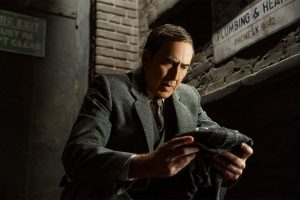
At the start of the pilot episode of Lanterns, a young John Stewart watches a television interview with Hal Jordan, the first human member of the Green Lantern Corps. Jordan talks a little about being a space cop, but for the most part, he focuses on the quality that makes him a suitable choice to join the Corps: his absolute lack of fear. The interview sets the model for the rest of the episode, in which Hal trains the adult John by mentioning a few details about the power ring and the importance of willpower, but leaves a lot of the sci-fi points unexplained.
Given that Lanterns wants to appeal to a broad audience, the choice makes sense. The average HBO viewer will have an easier time accepting a True Detective-style gritty mystery with weird elements than it will a space opera. But those wanting more of the sci-fi stuff might come away frustrated that Lanterns only mentions strange aliens without really explaining who they are. If you want more alien fun, but don’t want to pour through decades of Green Lantern comics, be without fear: we’re here to explain it all.
Guardians of the Universe
In the pilot episode, the central tension between Hal and John comes down to the fact that the ring chose Hal when Abin Sur crashed on Earth (more on that in a moment) and that the Guardians of the Universe chose John. Devoted DCU fans might recall that we’ve heard reference to the Guardians before, when Guy Gardner confronted Superman midway through the latter’s first movie. In short, the Guardians are the founders of the Green Lantern Corps, immortal aliens determined to bring goodness into the galaxy.
The Guardians originally hail from the planet Maltus, a peaceful world where its inhabitants discovered immortality and devoted themselves to scientific exploration. However, when a Maltusan called Krona wanted to witness the origin of the universe, he inadvertently introduced evil into the world. As penance, a group of Maltusans sought to contain the evil and protect potential victims, going through several methods before creating the Green Lantern Corps.
That description makes the Guardians sound wise and benevolent, which is more or less how they were portrayed in the first years following their introduction in Green Lantern #1 (1960) by John Broome and Gil Kane. However, over the years, the Guardians have revealed themselves to be easily blinded by their own hubris and given to manipulation. In the comics, both Hal and John regularly butt heads with their bosses, which means that Hal’s skepticism in the show is well-founded.
Green Lantern Corps
As part of their mission, the Guardians divided the known universe into 3600 space sectors, covering all of space except for the lawless Vega System. Each sector is patrolled by at least one Green Lantern, generally a native of the sector who is selected according to the following criteria: the ring-wielder must be fearless, they must be honest, and they must be nearby when the previous Lantern dies or has their status revoked. After selection, the new Lanterns are then brought to Oa, the headquarters of the Green Lantern Corps. There, they receive basic training—most often by the surly Lantern Kilowog—and then are paired with a more experienced Lantern.
In the pilot for Lanterns, the Hal-o-Gram makes a point of saying that Lanterns aren’t trained by people from their own sector, something that makes sense for the show, but isn’t part of comic book canon. In fact, current comic book canon states that each sector should have at least two Lanterns, if not more.
In addition to those who remain in their sector, there are also other, higher-echelons of Lanterns. Traditionally, a select elite group of Lanterns serve as the Honor Guard, stationed on Oa to go on extraordinary missions. Recently, Grant Morrison introduced Alpha Lanterns, a sort of internal affairs of the Green Lantern Corps, who police the police. And then there are the members of The Corpse, the black ops arm of the Corps that does the Guardians’ dirty work.
If that’s not enough, the past 20 years of Green Lantern stories have saw the addition of other Corps, separate from the Green Lanterns, but with similar power sets. The arch-enemy Sinestro formed the Sinestro Corps or the Yellow Lantern Corps, who channel the ability to create fear instead of willpower through their rings. The Star Sapphires use love, while the Blue Lanterns channel hope, and Red Lanterns use their rage. Lanterns doesn’t seem interested in exploring these other Corps, but it’s hard to believe at least one of them won’t be mentioned at some point in the series.
Abin Sur
Outside of Hal and John, the most important member of the Green Lantern Corps for the purposes of Lanterns is one we never see on screen. Hal Jordan became Green Lantern after the death of Abin Sur, the previous Green Lantern of sector 2814, the space sector that includes our solar system. Hal’s description in the pilot more or less matches the canonical events from the comics: Abin Sur crash lands on Earth, sends a beacon to choose a replacement, summons Hal Jordan to him, and promptly dies, leaving Hal to figure it all out.
But there’s much more to Abin Sur than just dying, which may have ramifications for Lanterns. Red-skinned and bald-headed, Abin Sur comes from the planet Ungara and became the Green Lantern of sector 2814 around 150 years ago. He served with distinction, and even worked with an ancestor of Hal Jordan, before eventually training Sinestro, who would, in turn, train Hal.
For all Abin Sur did well during his life, there was always a question hanging over his tenure: why did he fly a ship when his ring allowed for space travel? The best answer came in the story “Tygers” by Alan Moore and Kevin O’Neill, published in 1986’s Tales of the Green Lantern Corps Annual #2.
In that story, Abin Sur visits the Hellish planet Ysmault, where he encounters the demonic Qull of the Five Inversions. Qull offers a series of prophecies, which Abin Sur finds himself believing the more they came true. So when Qull predicts that his ring will fail him when he needs it most, open the door for the eventual downfall of the entire Corps, Abin Sur laughs it off, but begins flying via ship instead of using his ring. Ironically, Abin Sur’s dependence on his ship leads to him crash-landing and his ultimate death, a moment of fear that results in his end.
Lanterns seems to be going in a slightly different direction, but the basics are the same: Abin Sur crashes on Earth and gave Jordan the ring. Where we go from there remains to be seen.
Lanterns airs new episodes every Sunday at 9 p.m. on HBO and HBO Max.
The post Lanterns: Guardians of the Universe, Abin Sur, and the Green Lantern Corps Explained appeared first on Den of Geek.