By
By 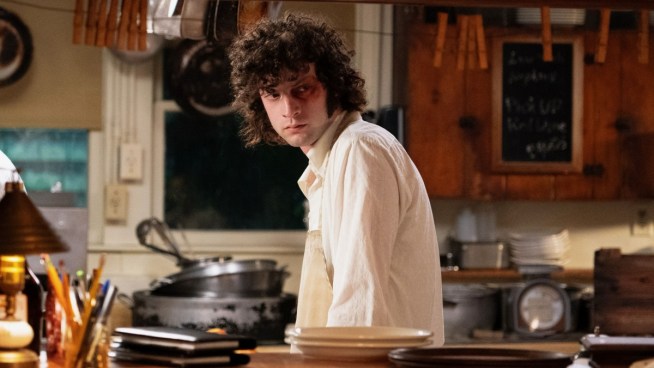
It’s 1975 and oysters and lobster rolls are evidently considered fast food. Or perhaps still a thing of the future. During the summer break between semesters at Vassar College, a young Tony Bourdain (Dominic Sessa) finds himself chasing a girl (Emilia Jones) to Provincetown, Mass after failing to land the prestigious fellowship he’s already told everyone he got. But Tony’s penchant for deception runs deeper than his sense of shame, and he shows up to the sleepy beach village with a pocket full of cash stolen from his parents and some harebrained scheme to shuck his way out of the seaside hammock he’s crashing on and into his crush’s bed. Entitled, cocksure, and problematic, the aspiring writer and certified jejune scumbag gets a quick lesson in salty Massachusetts humility after getting a little too drunk, a little too handsy with a waitress at The Flagship (where he’ll eventually work), and subsequently beaten up and robbed. Deservedly so.
His subterfuge is paradoxical. Sure, he didn’t land the fellowship. And yeah, he may not currently be writing a book. But to quote Henry Miller, “Writing, like life itself, is a voyage of discovery.” To become a writer isn’t always about writing. Many writers describe the periods between actually putting pen to paper – research, if you want to call it that, or more simply life – as equally important to the creative process. Ironically, it’s only when Tony gives himself fully over to becoming a chef that he begins the journey toward becoming one of America’s most celebrated writers and voices.
[READ MORE: Our review of ‘The Holdovers‘ directed by Alexander Payne and starring Dominic Sessa]
Writer-director Matthew Johnson (of the under-seen and under-sung techno-black comedy Blackberry) wisely fixates on this one transformative summer, eschewing the cradle-to-grave summarization so common to biopics of Important Men. This story isn’t Bourdain’s throat-clearing biography so much as his internal transition from Tony to Anthony. His Bildungsroman. Or coming-of-age story, for those who don’t seek to impress with their verbosity. A bad habit the braggadocios Tony has picked from his perennially unimpressed, scholarly mother.
By shrinking the aperture, Johnson uncovers something far more intimate, and much larger emotionally. Rather than reducing Bourdain to a series of career milestones, Tony becomes a confidential character study about the nature of assuming an identity. One far less interested in documenting the complicated but widely admired pillar he became than understanding the uncertain young man still figuring out who he wanted to be and why.
Dominic Sessa follows up his knockout debut in The Holdovers with yet another remarkable lead performance here. The tall, shaggy 23-year old kid simply has that inimitable “it” factor. If the eventual body of his work delivers on the promise of its beginning, he will inevitably become one of the defining actors of his generation. Emilia Jones, as Tony’s love interest Nancy, gives a quieter but equally captivating performance. At one point Tony asks her to take the author photo for his fake book, explaining that he likes the way he sees himself when she looks at him. And you feel that chemistry: the way he transforms in her gaze, fleshed out by the delicate intimacy of their performances.
The supporting cast is equally remarkable. Following up his turn in Tuner, Leo Woodall makes another impressive appearance as Sal, the exact breed of underbelly restaurant worker Bourdain would later immortalize in Kitchen Confidential. He’s a creature of pure Id, fueled by pilfered beers, open-air blow , and an insatiable appetite for whatever vice presents itself next. Quick with a punch and even quicker to chase after the next woman and notch himself onto her record, Sal tempts Tony to indulge in his base instincts. He’s a dark spell with undeniable charm. A sin eater.
[READ MORE: Our review of ‘Tuner‘ directed by Daniel Roher and starring Leo Woodall]
The restaurant’s owner and head chef, played by Antonio Banderas, lives in humble opposition. Having graduated from the Culinary Institute of America, worked in Michelin-starred kitchens, and once dreamed of opening a celebrated restaurant of his own, he instead finds calm contentment running a greasy seafood shack staffed by coked-up loafers and mildly patronized by summer tourists. He prays for the immortal souls of his employees and laments them taking the lords name in vain but only asks that they show up on time. It’s an incredibly soulful, deeply centered performance, one of the finest of Banderas’ long and illustrious career, and one that should firmly place him in serious Oscar consideration – if not frontrunner status.
These two competing figures become the metaphorical angel and devil on Tony’s shoulder, pulling him toward darkness and light, two opposing visions of the man he could become. Sal represents appetite without consequence, chasing every impulse the moment it appears. A dog chasing car tires. The Chef embodies something fundamentally more tranquil: humility, patience, and the peace that comes from choosing the kind of life you’d be proud to let define you. Throughout Tony, Bourdain can’t seem to simply choose between them. At this junction in life, he needs the push and pull of both. The reckless abandon and the peace of purpose. Sometimes coming across a fork in the road is the only thing that drives you forward.
That same confidence that colors the performances and the impact of the script is baked into every layer of Tony‘s production. Johnson and cinematographer Michael Bauman immerse audiences in a grainy, sun-bleached 1970s that feels genuinely lived in rather than nostalgically recreated. The film has texture. You can taste the salt in the air. The kitchens feel hot, greasy, and overworked. Bar tops feel beer-sticky. It isn’t interested in delivering the overpolished version of a crowd-pleasing Hollywood biopic so much as transporting us into the ordinary spaces we’ve all frequented where this version of this man was actually forged. The score from Jay McCarrol sings, perfectly punctuating the film’s subtle emotional swells without ever tipping into sentimentality or saccharine excess. Together, it’s a beautiful reflection of what Tony does so well: charting the slow, often uncomfortable process of transformation, humility, and learning to live with your demons, even if you never fully conquer them.
Tony understands something Anthony Bourdain himself would spend the rest of his life articulating: great stories rarely come from success. They emerge from the seedy underbelly of our service. They erupt from failure, humiliation, shame, underpaid work, stove burns, excessive substance use, and the people who quietly enter our lives and reshape us when we least expect it. Tony arrives in Provincetown pretending to be a writer. He leaves having become someone who someday will have something worth writing about. Anthony cooks.
CONCLUSION: One of the finest films of 2026, Matthew Johnson’s ‘Tony’ is a masterful exploration of one man’s search for meaning and the demons we must continue to stave off to find that meaning – even if it’s not exactly faithful to Bourdain’s memoir from which it’s plucked. The entire cast is excellent but Antonio Banderas may finally (and deservedly) win his Oscar for his turn here.
A
For more reviews, interviews, and featured articles, be sure to:
Follow Silver Screen Riot on Letterboxd
Follow Silver Screen Riot on Facebook
Follow Silver Screen Riot on Twitter
Follow Silver Screen Riot on BlueSky
Follow Silver Screen Riot on Substack
The post ‘TONY’ Cooks appeared first on Silver Screen Riot.