By
By 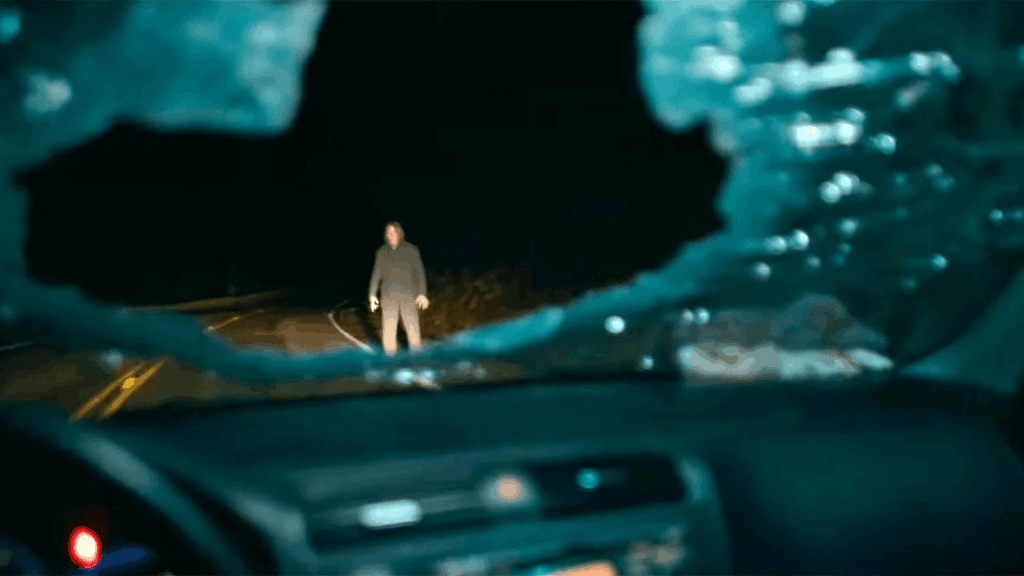
Passenger (2026) starts well. In fact, it starts well enough to make the rest of the film feel even more disappointing.
Within the first few minutes, director André Øvredal builds a legitimately effective jump scare. It’s the kind of opening that makes you sit up and assume the filmmaker knows what they’re doing. Unfortunately, everything is downhill from there.
The story follows Maddie (Lou Llobell) and Tyler (Jacob Scipio), a young couple several weeks into a “van life” adventure. After stopping at the scene of a fatal accident, they discover that they have picked up an unwanted supernatural companion. A demonic entity known as the Passenger begins following them from one location to the next, determined to isolate and eventually kill them.
It’s a serviceable premise. Road trips already carry a certain vulnerability. You are moving through unfamiliar places, sleeping in a vehicle, and placing an enormous amount of trust in roads and strangers. For a short time, Passenger understands this. The film is at its best when it strips away the mythology and leaves Maddie alone with the feeling that something is wrong.
The most effective sequence takes place in a parking lot. Maddie leaves a building and begins walking toward the camper van. When she turns away and looks back, the van seems farther away than it was before. She keeps walking, but the distance does not close.
This scene works because it attacks our basic trust in space. When that simple relationship breaks down, Maddie can no longer rely on her senses or her understanding of the physical world. The parking lot becomes an impossible space with no visible exit.
Passenger (2026)
There is a modest philosophical idea buried here. We move through the world with the assumption that perception gives us reliable information. We do not normally question whether distance, direction, or movement will suddenly stop working. The Passenger becomes frightening when it disrupts those assumptions. Maddie is not just lost. She is trapped in a world that no longer follows the rules required for her to orient herself within it.
The sequence gets even better once she finally reaches the camper van. The van should represent safety. It is familiar, enclosed, and locked. More importantly, it is her home for the time being. Yet the entity remains just as dangerous inside as it was outside.
For a few minutes, the film turns the entire promise of van life against its protagonists. Their symbol of freedom becomes a prison. Mobility no longer offers an escape because the Passenger can travel with them. The supposedly protective boundary between home and the outside world has disappeared. These moments almost make Passenger worth watching. Almost.
The problem is that you have to slog through a great deal of bad writing and pointless exposition to reach them. The screenplay is determined to explain the monster’s origins, motivations, symbols, religious associations, and preferred method of selecting victims. We hear about the Hobo Code, disappearances along the highway, the rules of traveling at night, St. Christopher, demonic folklore, and mysterious markings left on vehicles. None of these ideas is necessarily bad on its own. Together, however, they become gobbledygook.
The more the characters explain the Passenger, the less frightening it becomes. An unknown figure appearing beside a road can be almost anything. It might be a ghost, a demon, a hallucination, or something for which the characters have no conceptual framework. Once the screenplay turns it into a bundle of rules and mythology, the entity starts to feel less like an intrusion from outside ordinary reality and more like a villain from a horror franchise nobody asked for.
Passenger (2026)
This is a common mistake. Some filmmakers assume that unexplained events will frustrate viewers, so they add scenes in which characters discover an old book, search the internet, or meet someone who already understands the evil.
As I noted in my review of The Headless Woman, a film can create confusion without drowning the audience in tedious explanations. Ambiguity is not poor storytelling.
Passenger refuses to have any trust in uncertainty. It keeps adding explanations, but the explanations don’t produce clarity, just more questions. The mythology feels assembled from several familiar supernatural-horror ideas without enough thought given to how they fit together.
Melissa Leo appears as Diana, a seasoned traveler who knows more about the entity than she initially reveals. Unfortunately, Leo is largely used as an exposition machine. She is there to warn the protagonists, offer pieces of lore, and push them toward the final act. Even an actor of her caliber cannot make this material sound natural.
Maddie and Tyler are not much better developed. The film introduces tension in their relationship and suggests that Maddie is tiring of life on the road. She wants stability, while Tyler remains attracted to the fantasy of permanent movement and freedom. There is material here for a more thoughtful film about commitment, home, and the difference between escaping ordinary life and building a meaningful alternative to it.
Instead, these ideas mostly function as pauses between supernatural encounters. The couple rarely feels specific enough for their conflict to matter. They are people in a horror movie because the screenplay needs people for the monster to chase.
Lou Llobell gives the stronger performance, particularly when Maddie is left alone. Her fear during the parking-lot sequence is visceral. Jacob Scipio is fine, but Tyler is written too generically to make much of an impression. Their relationship never develops enough to give the danger an emotional cost.
The film occasionally finds another tense image or clever use of the camper van. Its cameras and confined interior create opportunities for the Passenger to appear where it shouldn’t be. Darkness outside the windows makes every reflection suspicious. There are moments when Øvredal’s direction briefly overcomes the screenplay and reminds us that he knows how to stage a scare. Then someone starts explaining the Hobo Code again.
Passenger (2026)
I had a similar problem with Devil’s Gate, another below-average horror film that forces viewers to wait through tedious explanations for the occasional interesting moment. Both films have premises that could support efficient, atmospheric horror stories. Both undermine themselves by treating exposition as a substitute for suspense.
The opening of Passenger shows how little information the film actually needs. We see an isolated road, frightened people, and a threat that does not behave according to ordinary expectations. That is enough. The scare works because we know something terrible is happening without understanding exactly what it is.
By the final act, the Passenger has accumulated so much lore that the characters are practically completing a supernatural scavenger hunt. Symbols point them toward safety, religious objects affect the entity, and the film moves toward a predictable confrontation. What began as an unsettling presence on the road becomes another by-the-books demon with conveniently discoverable weaknesses.
The Guardian’s review similarly describes the film as generic jump-scare horror weighed down by weak mythology and underdeveloped characters. That assessment is difficult to argue with. The film has a few memorable jolts, but they are isolated from one another by long stretches of uninspired storytelling.
There is very little that can be saved from Passenger. The opening jump scare works. The parking lot is genuinely unnerving. The attack inside the camper van briefly turns a familiar space into something claustrophobic and unsafe. These scenes prove that a good horror film was possible.
They also make the finished film more frustrating. Passenger did not need more lore. It needed better characters and tighter writing.
Passenger (2026) Movie Rating: ★½ out of 5
If you would still like to watch Passenger (2026), you can rent or purchase it through Amazon.
The post Passenger (2026), A Few Good Scares Lost in a Bad Story appeared first on Philosophy in Film.