By
By 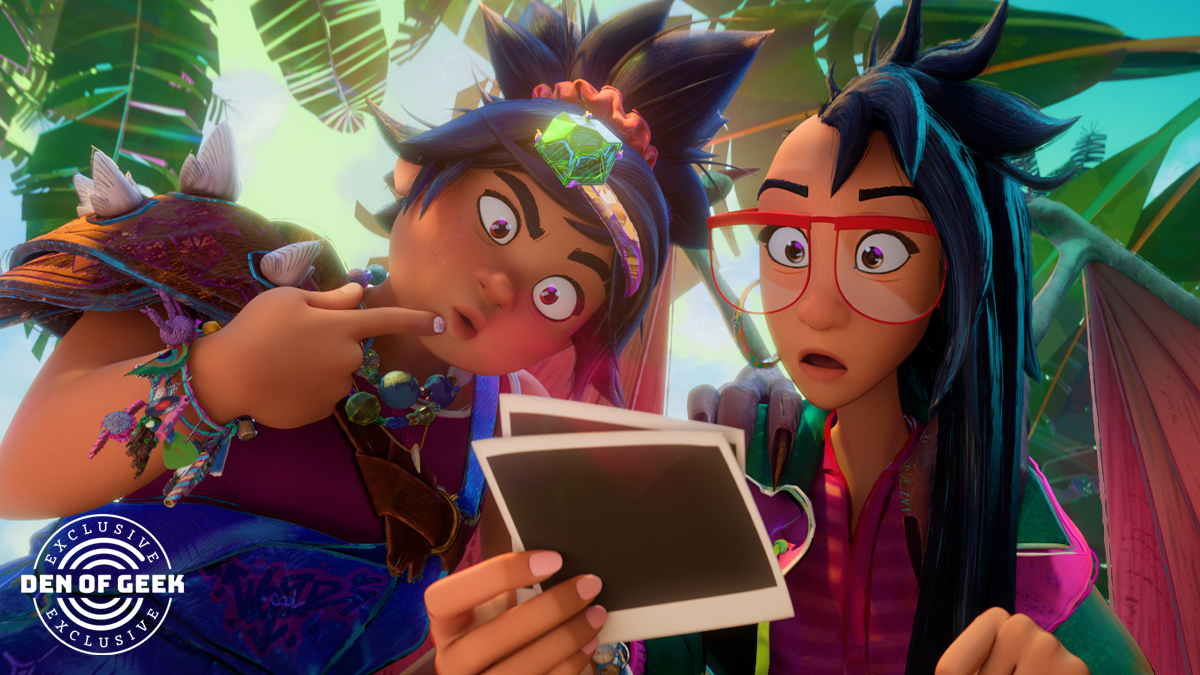
This article appears in the new issue of DEN OF GEEK magazine. Find out how you can subscribe to get the full physical copy right here!
DreamWorks Animation has transported viewers to countless magical realms since 1998 and introduced us to many aspirational friendships, from Shrek and Donkey to Hiccup and Toothless. Now they seek to do both things in the singular Forgotten Island, an original fantasy-comedy set in the 1990s Philippines and following the lives of two soon-to-be-loved besties, Jo (voiced by H.E.R.) and Raissa (voiced by Liza Soberano). Only this duo’s journey to a magical realm may cost them the friendship at the heart of the movie.
Of course friends and connection have long been the secret sauce for the makers of Forgotten Island, beginning with the writing-directing team of Joel Crawford and Januel Mercado.
“For two decades, we have put so much of ourselves into every movie we do together,” Crawford shares. “That can be just jokes, things that make us laugh, or themes about being in the moment that we both really value in our own lives.”
Crawford and Mercado have been real-life BFFs since working together as story artists on Kung Fu Panda 2. And after recently working on two sequels, The Croods: A New Age (which Crawford helmed and Mercado was head of story on) and the Oscar-nominated Puss in Boots: The Last Wish (which both co-directed), the pair was eager to take on an original project.
“We wanted to do something original, but really original in every sense of the word. So building a story around friendship, and our friendship, seemed the best place to start,” Crawford says.
That onscreen camaraderie also involves similarly creative spirits as personified by Jo, a livewire, and Raissa, a smartypants. They’re introduced as almost instant besties after bonding during a trip to the principal’s office in grade school. Jo even gives Raissa a friendship bracelet as a token of their newfound connection. Soon enough, they’re each other’s source of comfort, freedom, and security. In the totally tubular era of gifted mixtapes, they get close while imitating Arnold Schwarzenegger and Carl Weathers’ iconic Predator handshake at the video store, accidentally operating a retro jeepney, chronicling their canon moments through Polaroids, and adding matching charms on their bracelets. But most of all, they obsess over a tale from Jo’s grandmother (Dolly de Leon) about Nakali: a fantastical realm of monsters, spirits, and demons.
Magic with Authenticity
The directors drew inspiration for their heroines from the Filipino women in their own families.
“For Jo and Raissa, they are heavily inspired by the strong women in our lives, especially my sister and my cousin,” Mercado says. Even their mannerisms and features would be incorporated and used in the animation. Crawford attributes Raissa’s often irked expressions to his wife, who is Filipino. Meanwhile, Mercado’s sister’s facial scar became part of Jo’s character model. But the film is ultimately brought to life by H.E.R. and Soberano, who imbue passion and naturalism in their performances.
Forgotten Island also marks the first Western animated film to be set in the Philippines, not just for DreamWorks but for all of Hollywood. To tackle the setting, Mercado, who is Filipino-American, drew from his memory and experiences of visiting the country in the ‘90s for family vacations, growing up with Catholicism, and attending parties. He and Crawford wanted to make sure the culture was naturally illustrated, detailing its gags, lifestyle, and wardrobe without overexplaining any of it.
“It’s one of those things where [you don’t stop] the movie to say, look, this is Filipino, we got karaoke,” Crawford explains. “There is an existing world, and the audience is just invited into that party.”
Crawford can personally relate to the sense of hospitality: “I’ve felt over the course of my whole life [what it’s like] being invited in by the Filipino community and culture, with the family friends we had growing up, and then my wife after I married into the family. If you’re at a family party, it’s like ‘you’re here, you’re family!’ We want to make sure the movie treats the entire audience that same way, inviting you in so you can feel the joy and experience.”
In addition to the nostalgia, the filmmakers’ decision to set the movie in the ‘90s was motivated by the fear of being forgotten, which was much more profound in the era before digital connectivity. The setting raises emotional stakes for Jo and Raissa as their longtime friendship faces its greatest challenge: Raissa is leaving for college in the U.S., while Jo wants her to stay.
“There’s something about the ‘90s in particular where it’s about two friends who have grown up together, but now one is leaving and going off a far distance. In the ‘90s, before you had cell phones and FaceTime, it was something that felt more permanent if someone was going to go,” Crawford considers.
Universal Pictures
To Another World
On the night before Raissa’s departure, there’s natural tension and unspoken resentment between the leads, but then they discover a key that activates a portal resembling the Southeast Asian sun and are transported to Nakali.
Nakali is a gorgeous realm full of tropical terrains and day markets. It’s also filled with creatures rooted in Filipino culture, which add a liveliness to the fantasy. Here the duo encounters the mythical Raww (Dave Franco), an explosive were-dog; and Batiba (Jenny Slate), a fuzzy agoraphobic beastie who is the heroes’ only shot of getting back home. They also have to avoid the dreaded Manananggal (Lea Salonga), a vampire-like woman who can split in half. Mercado teases they’re “barely scratching the surface” of strange Filipino lore too.
Each creature incorporated was chosen to benefit the film’s themes. Mercado points out Manananggal’s ability to separate her body ties into the girls being separated. At the same time, the filmmakers took liberties with the folklore of other characters. Batiba, for example, is derived from the Batibat, a magical demon that delivers nightmares, a bit like Freddy Krueger, as Crawford enthuses. But for the film, its abilities were altered to stealing memories. Fatefully, this comes down to demanding that the girls trade the core fabric of their friendship, their memories of the prized matching bracelets, with the creature.
With Puss in Boots: The Last Wish, Mercado and Crawford introduced a fresh watercolor background that complemented the storybook backdrop. For Forgotten Island, they’re switching to maximalist mode, doubling down on the visual storytelling and dynamism in every action scene, and expanding the scope of their compositions until each frame is like a painting. They apply a dazzling manga style to their visual storytelling, matching the isekai setup of the story and the Filipino realms, which is amplified by prominent ‘90s colors (purple and teal from Jazz designs make up the film’s color palette).
Some ‘90s media and anime influenced other techniques, from split-second black-and-white dynamic action shots enhancing the epicness of set pieces to Street Fighter II as a reference for hand-drawn 2D flashback scenes. And yes, you can expect an Akira slide homage in there too. “We’re trying to get on that super cut of 30 years of Akira slides in animation!” Mercado laughs.
The film’s soundtrack also plays a huge role in the story’s emotional core, blending influences from the ‘80s and ‘90s with deep roots in Filipino and American musical culture to trace the shifting emotions of the central friendship. The needle drops don’t just authenticate the era; they amplify the exuberance the duo share with Sir Mix-a-Lot’s “Baby Got Back,” Montell Jordan’s “This Is How We Do It,” and DMX’s “Party Up (Up in Here).”
But beyond the ‘90s nostalgia and nods to Filipino artists, the film finds its voice in Jo and Raissa, quite literally, during a powerful end credits duet from H.E.R. and Liza Soberano.
“It was written from H.E.R.’s heart,” Crawford teases. “It’s like Jo and Raissa singing a song,” adds Mercado. Together, these songs don’t just accompany the story; they become key to its emotional DNA.
Forgotten Island arrives in theaters on Sept. 25.
The post Forgotten Island: Exclusive Look at DreamWorks Animation’s Return to ’90s Glory Days appeared first on Den of Geek.