By
By 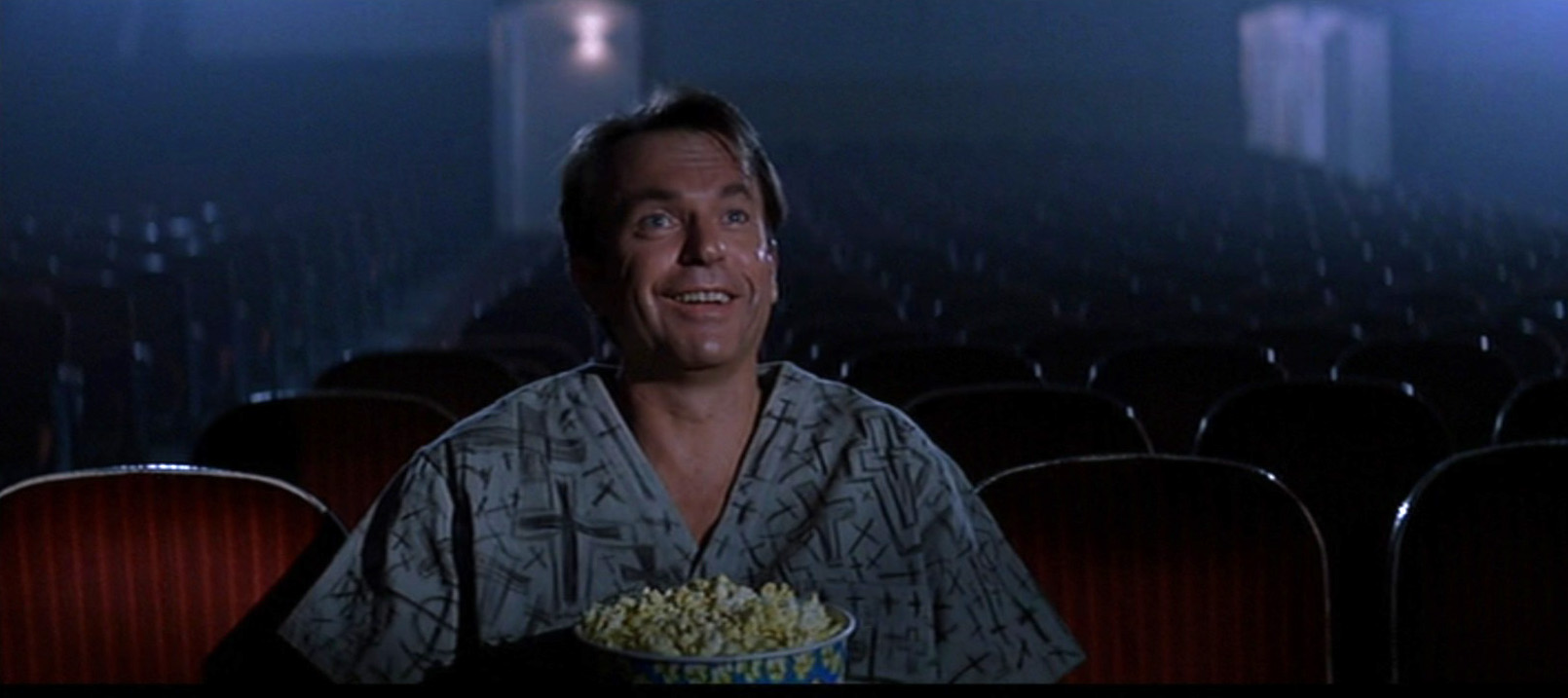
New Zealand actor Sam Neill has died at the age of 78, leaving behind an impressive filmography of memorable television and film performances. In addition to blockbusters like Jurassic Park and dramas such as The Piano, fans will surely point out his excellent work in horror movies, naming Event Horizon or Possession. But Neill’s greatest horror performance came in an oft-overlooked movie, one that everyone recognizes as great, but rarely gets the cult appreciation even afforded The Omen III.
The third part of his loose “Apocalypse Trilogy,” which also includes The Thing and Prince of Darkness, the 1994 John Carpenter movie In the Mouth of Madness takes a literary approach to the end of the world. Neill plays insurance investigator John Trent, hired by a publisher to look into the disappearance of their famed author, a Stephen King analogue called Sutter Cane. As the cynical Trent investigates further, the lines between fiction and reality blur into a Lovecraftian nightmare, leading to a mind-bending metatextual moment. Yet, the scariest thing at all is what Trent does at the end, delivering an utterly joyless, thundering laugh, played to perfection by Neill.
“You want to know about my ‘them’?” asks Trent in the first scene of In the Mouth of Madness, Neill cooly delivering the line with his smirk emphasized by his signature sharp eyebrows. When the doctor operating the mental asylum (played by the equally great and also late David Warner) responds with confusion, Trent continues, “My ‘them.’ Every paranoid schizophrenic has one; a ‘them,’ a ‘they,’ an ‘it.’ And you want to hear about my ‘them,’ don’t you?”
The coldness in Neill’s delivery of these lines contrasts with his behavior just a few moments before, when orderlies dragged a kicking and fighting Trent into the insane asylum. Once calm, Trent explains how he got there, allowing the movie to flashback to the beginning of the story. When Sutter Cane (Jürgen Prochnow) goes missing and his publisher tries to cash in the insurance policy, a skeptical Trent investigates. Trent believes that Cane and the publisher are attempting a stunt to drum up excitement for his new book, In the Mouth of Madness.
However, when Trent traces the clues to Hobb’s End, the heretofore fictional New England town at the center of all of Cane’s books, he cannot help but acknowledge the strange things around him. People transform into monsters, acts of violence occur, and time shifts wildly, all apparently according to Cane’s will. When Trent finally meets the author, Cane explains that his fans loved his work so ardently that his fiction has become truth and he’s become a god, a fact he proves by twisting reality around him.
The end of the film returns to the beginning, with Trent at the asylum. An undefined event seems to wipe out everyone else, and Trent walks free, moving out of the asylum and into the city, where he sees a movie theater with the words, “In the Mouth of Madness with John Trent” on the marquee. With popcorn in hand, Trent sits down and watches the show: In the Mouth of Madness, the same movie we just watched.
As he realizes what he’s seeing, Trent breaks out in laughter, a big boisterous chuckle, complete with snorts and guffaws. Yet, at no point does Neill allow any joy to creep in. Even before the laughter shifts to wailing, a change that occurs mere seconds before the final credits roll, Neill allows every other feeling to sneak into the laugh. He’s angry, frightened, confused, sad—anything but happy. He widens his eyes and throws back his head, acting out all of the motions of a big belly laugh.
In this one scene, Neill embodies the uncanny nature of the film. From the very beginning, Carpenter and screenwriter (and current Warner Bros. co-chair) Michael De Luca have been signaling that something’s off in the world of the film. Sometimes, those signals arrive in big, obvious ways, as when a paper boy (a pre-Anakin Hayden Christensen) transforms into an old man while peddling past Trent and his partner Styles (Julie Carmen). Other times, it’s more subtle, as when a doctor played by John Glover flashes a cheesy smile while checking Trent into the asylum.
Like The Thing and Prince of Darkness, In the Mouth of Madness scares the viewer by showing them the end of the world, a world undone by forces that cannot be named or even imagined. Those two films use more visceral imagery to achieve this effect, whether its Rob Bottin’s creature effects or nightmare-inducing video tape. In the Mouth of Madness certainly has its share of memorable visuals (“Did I ever tell you my favorite color was blue?”).
But its greatest effect is Neill himself. Neill could project skepticism with ease, just slightly turning his head so Trent could glare at a Caine superfan from the corner of his eye. He could play the anger of Trent yelling at the citizens of Hobb’s End who insisted that Caine wrote the end of all their stories. But his greatest feat occurs at the end, when Trent finally resigns himself to the falseness of the world around him, unleashing a laugh that contains no happiness, only ineffable terror.
The post How Sam Neill’s Laugh Made Cinema’s Scariest Meta Moment Even More Frightening appeared first on Den of Geek.