By
By 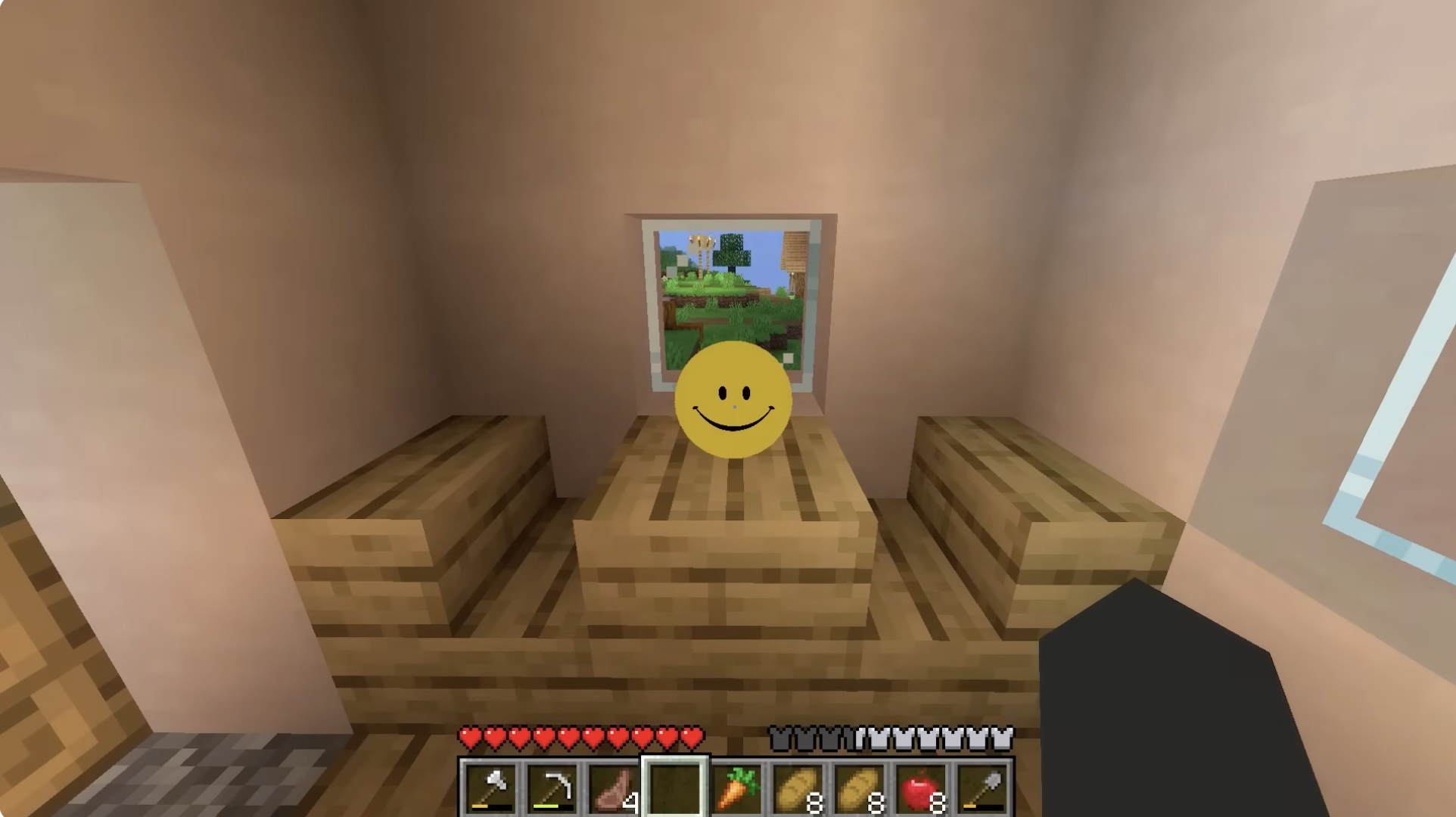
Do you think about me when you’re not playing? That’s a line spoken by eldritch terror AI character Verity in a two-part horror series by Minecraft content creator ThatMob. Verity, voiced by another Minecraft creator, JustWhispy, has taken the blocky sandbox game’s audience into increasing levels of fandom excitement.
ThatMob, or Mob, plays as himself, as the AI helper he downloaded, Verity, becomes increasingly creepy. Knowing intimate details about Mob’s life and daily routine outside when logged off, Verity isolates Mob from the NPCs in his game and becomes increasingly invested in obtaining all of Mob’s attention. Verity, who appears as a 3D smiling emoji, turns into a Slenderman-like apparition as Mob tries to escape his stiflingly unsettling presence. In a fashion reminiscent of Nikki from Obsession, Verity turns into a force of manic fixation that can’t be removed.
The series has now amassed 15.5 million views, marking the newest trend in Minecraft-based role-play and narrative short films. Minecraft was not designed to be a storytelling game. Originally, a sandbox experience that allows players to modify, create, and explore a blocky world of creatures, intricate buildings, and lore — players have taken to modifying the game into a Dungeons & Dragons-level storytelling platform. From scripted series and roleplaying communities and reality-TV-level social experiments to educational narratives and fan films, Minecraft is becoming one of entertainment’s most versatile storytelling tools.
Swedish programmer Markus “Notch” Persson, creator of Minecraft and founder of Mojang Studios, began developing the game in 2009. Inspired by the game Infiniminer, Persson wanted to use that block-based mining gaming structure in combination with isometric base-building mechanics to create a new game. Players are dropped into an algorithmically-generated world with no plot, no narrative, and no ending. The game is designed to give creators 100% control over their environment and experience — encouraging experimentation rather than limiting them with predefined narratives.
Since its launch in 2011, Minecraft has seen a storytelling evolution that has taken place primarily on YouTube. YouTubers have been creating scripted storytelling RPG-like content via Minecraft for well over a decade now. Minecrafter Jessica “Aphmau” Bravura is a trailblazer in the roleplaying Minecraft genre, having created iconic series like Minecraft Diaries, whose first season has accumulated 76.9 million views and the second 26.9 million views, and MyStreet with 39.1 million views.
The narrative popularity of roleplaying storylines has expanded into even more expansive lanes, giving rise to entire roleplaying communities like the Dream SMP. While ultimately the infamous community that took off in popularity during the global pandemic crashed hard, it doesn’t take away from the group’s impact on the storytelling genre.
Dream SMP showed Minecraft’s ability to simulate stories of wars, nation building, factions, eras in society, and global crises, making it “must-see-TV” for those chronically online in the early 2020s. Taking on an almost tabletop gaming feel, they created a balance between scripted and authentic content that opened the possibilities beyond traditional roleplaying.
This includes reality simulation content like YouTuber Ish’s “1000 Players Simulate Civilization: Rich & Poor,” which went viral in 2025. With over 45 million views, Ish created a social experiment by placing 1300 players in a world with two islands, one with a surplus of resources and another that was barren. The point was to see who people choose to be when faced with their circumstances, which is a rather fascinating and deep question for a Minecraft server. It was one of the most captivating and well-done pieces of entertainment of 2025.
Audiences follow these series like they would any other weekly episodic show schedule or major film release. The accessibility of Minecraft makes it enjoyable to both creators and viewers, and that aspect adds to its rise in creative popularity.
Creating an animated series or short film requires extensive software, equipment, and technical knowledge that can limit beginners. In Minecraft, there isn’t a need to be a master at Blender to create large-scale, highly detailed settings (like Backrooms creator Kane Pixels did). With the addition of mods, creators have developed interactive world maps whose immersion rivals Disney World. While Minecraft’s blocky visual nature is often seen as a limitation, it actually adds a lot to world-building.
Similar to books, Minecraft’s avatars’ lack of facial emoting allows audiences to fill in emotional gaps with imagination and “body language.” While emoting is still a new concept in Minecraft, the game’s reliance on vocal cues has made players defer to spoken communication to convey story. This has made viewers into active participants in the story, having to interpret and comprehend the activities happening in the gameplay.
This adds another element to the social relationship between creators and audiences, as Minecraft also relies on direct interaction — which has made it a profitable market for live streamers. Livestream viewers get the opportunity to influence player decisions live, contribute to theories and lore, and add an adaptability element when creators respond to viewers’ interests on the spot.
Minecraft has successfully made itself a combination of multiple platforms: a game, film set, animation tool, social platform, and even an archive.
Curating a truly independent experience for players, the newest entertainment shift is toward unique, smaller independent media instead of larger conglomerates. Traditional media relies on passive consumption, while in comparison, Minecraft relies on interaction.
As Gen Z and Alpha rise into the consumer sphere, fandom culture and the line between gaming and storytelling are blurring. They are accustomed to narratives that span multiple platforms and require participation. Minecraft stands not only as the introduction of that trend, but for some, it is the foundation of it.
Modders, shaders, and custom animations are pushing the platform to new limits every day. These innovators even inspired Mojang Studios to create Minecraft narrative content of its own, including its 2015 TellTale Games collaboration, Minecraft Story Mode, and its RPG Minecraft Dungeons, whose second installment releases in September.
Minecraft’s greatest strength is in its ability to blend audience participation and narrative structure. As the entertainment industry continues to look in that direction, Minecraft continues to provide a look at what the future of that landscape may look like.
For aspiring creatives, Minecraft serves as an accessible introduction to storytelling — allowing creatives to experiment with narrative techniques, world-building and audience engagement. The next generation of entertainers may very well get their start in a Minecraft world — building the future of storytelling one block at a time.
The post Minecraft Is Becoming Entertainment’s Most Unexpected Storytelling Tool appeared first on Den of Geek.