By
By 
This article contains Obsession spoilers.
In its second weekend at the American box office, Curry Barker’s absolutely sinister Obsession went up in its grosses. By 26 percent. That does not happen often with a wide release, particularly one that overperformed like this Focus Features release. Indeed, the movie blew past industry expectations when it debuted at $17.2 million last week, ahead of its now astonishing $27 million across Memorial Day weekend.
This is rarefied air for an extremely indie horror movie that cost less than $1 million to produce (Focus acquired Obsession after a TIFF bidding war last year), putting it in the company of zeitgeist-defining chillers like The Blair Witch Project in 1999 and the Paranormal Activity phenom of 2007. It also speaks to how much Barker is communing with the increasingly online moment his film’s released in.
Barker of course knows a thing or two about the digital world these days. About the same age as the twentysomething stars of his movie, the 26-year-old filmmaker made his big screen debut when Obsession went to Toronto. His previous film, Milk & Serial, released straight to YouTube, the website where Barker began learning his craft.
Beyond being among the first generation of directors who grew up on the video-sharing app, and with the interesting perspective that invites—as he told Den of Geek magazine in March, he got the idea for a “Monkey’s Paw” story from watching The Simpsons TV parody—Barker and stars Inde Navarrette and Michael Johnston grew up in a world that’s terminally online. Which goes a long way to explaining Johnston’s central and absolutely irredeemable protagonist in the film, Bear.
When Johnston’s Bear is introduced at the top of Obsession, the actor and the film appear eager to use the shorthand of an endless sea of movies, from Hollywood comedies to Sundance coming-age-dramas, while defining Bear as the prototypical “nice guy.” He sweetly dotes on and admires his best friend Nikki (Navarrette) from afar. Like everyone from Michael Cera to Michael J. Fox protags before him, Bear just has a crush on the girl next door, allegedly as much due to her personality as her appearance.
What is genuinely unsettling about the film is how thoroughly it deconstructs the nice guy fantasy, as well as the other delusions of those who entertain it, particularly in its modern online manifestation as the “lonely male.” As the original “Monkey’s Paw” short story warned, one should be careful what you wish for, which Bear finds out when he innocently wishes Nikki would “love me more than anything in the whole world” while breaking a novelty toy called “One Wish Willow.” That is an incredibly relatable mistake to any gender or orientation. What makes Obsession so mercilessly cruel to both Bear and Nikki is that Bear will spend the rest of the movie immediately recognizing the unintended evil of his wish… and choosing to do nothing to make it right.
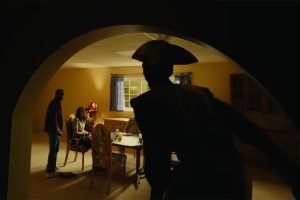
Even in the fateful sequence of “the wish,” Barker’s screenplay makes the contrast immediate, with Nikki sitting in the dim glow of the cabin lights in Bear’s car, crystal clear about the door she’s leaving open: she asks Bear if he has feelings for her or not. Like so many introverted, shy people, Bear hems and haws, and only can articulate what he claims to want when she leaves the vehicle. Yet afterward, and after his wish, Nikki returns as a shadow of her former self, literally submerged in darkness when she begins stalking Bear’s steps.
While the full nature of the horror at play is not instantly traceable, it is abundantly clear this is not the same woman Bear purports to love. And by the time he takes her to bed, she seems like a wholly different person. Bear isn’t making love to the girl of his dreams; he is just possessing a fantasy, even as it seems self-evident something otherworldly has possessed her.
Before the film’s halfway point, the full context becomes unavoidable. The dark, magical logic of Obsession reveals where the real Nikki is in the absence of her soul. When an eventually creeped out Bear calls the company behind One Wish Willow to ascertain if he can “amend” his wish—not revoke it, at first, but just make his new doll act more like his idea of Nikki—he is told by a voice on the other end of the phone that he can hear from the real Nikki right now.
It’s unclear where the “sunken place” at the heart of Obsession’s allegorical tale is located, but when Nikki picks up the line, it sounds an awful lot like fire and brimstone Hell. She is screaming.
… And Bear does nothing afterward but feel bad about it.
To be clear, Obsession confronts its protagonist with a similarly Old Testament sense of action and consequence. Like Job, his suffering and doom seems far greater than any mistake he could have made. The horror, then, of Obsession is not just the unintended consequences, but how Bear decides to react to the revelation. He is told the only way to free Nikki from the torments of Hell is to kill himself. It might not be fair for Bear, but it’s a lot less fair for the woman he purports to love to be hollowed out into a Stepford Wife sex doll.
Nevertheless, Bear attempts to carry on the charade that he is dating Nikki and might be able to find some pittance of happiness with this shell of a facade in his life and in his bed—even after the real Nikki seemingly reaches out to him through the sleeping doppelgänger’s visage to plea with him to kill her.
Not until the fantasy becomes too unbearable—too costly for the rest of his life with Shadow Nikki eventually resorting to murder—does Bear even begin to entertain doing the right thing, and all the while lamenting to anyone who will listen that it’s not fair.
Bear could be an avatar of “nice guy” tropes from the history of cinema, but his particular brand of needy, relentless self-justification strikes a different chord in 2026. He’s the bland self-pitying manifestation of an entire online culture, on YouTube and elsewhere, that would attempt to excuse bad behavior by pointing to the plight of isolated ne’er-do-wells.
The digital age has demonstrably increased a sense of isolation across all classes and genders, but recent academic studies have specifically pinpointed a gender gap, which has been classified online as “the lonely male epidemic.” According to Gallup, the past 20 years has seen the number of men feeling lonely, isolated, and abandoned rise to 25 percent among males aged 15-34 (above 18 percent of women who reported feeling lonely in the same demographics).
That increasing sense of despondency and social isolation might be on the rise, but so is the phenomenon’s use as a justification for the growing “manosphere” subculture. This is the sizable corner of the internet that not only seeks to rekindle “traditional masculine values” but also casts suspicion if not outright misogyny toward women in general, and feminism in particular. This is the corner of the internet that has seen an increase in interest in “thought leaders” who want to repeal the 19th Amendment and women’s right to vote in the U.S. They believe “household voting” is preferable where a man makes the decision for the woman. She, in turn, stays home barefoot in the kitchen to cook and raise children.
A bit like Nikki after Bear goes to work.
Shadow Nikki is in fact the ideal trad wife. She does not see friends or family, has no thoughts about herself, and lives to serve and please Bear. She just takes it to such a naked extreme that Bear cannot stand it. She is so incapable of self-autonomy that when he leaves for the day, she urinates on herself while standing haplessly in place, waiting for his return.
Navarrette gives one of the most unsettling and fearless performances the horror genre has seen this side of Toni Colette in Hereditary. She is clingy, possessive, and paranoid to a degree well past discomfort. In an interview with Rotten Tomatoes, Navarrette said she wanted to be “unfiltered and raw with the way that there’s ugly emotions that we never want to show people.”
But those aren’t truly Nikki’s emotions. They’re a construct of what Bear thought he wanted: a body and an emotional foil that would adore him and fuck him. In fact, we only truly hear Nikki’s side of things at the very end of the movie. It is there that Bear almost does the right, hard thing. He tries to kill himself in order to save Nikki… until he gets second thoughts.
Until his last breath, Bear refuses to do the right thing. He refuses redemption and dies trying to save himself. While he takes a lot of pills in the bathroom, he immediately attempts to throw them all up. He’s a nice guy who is a coward until the bitter, bitter end.
The only reason Nikki is freed is because her shadow, possessed self ironically inflicts on Bear the same curse that he placed on her. She forces him to love her more than anything in the whole world. So it is that Bear’s mind, soul, or wherever else his conscience might live is condemned to Hell long before the rest of him gets there. What’s left is another empty shell; a pale reflection of a pale reflection of actual love.
When the possessed Bear dies in possessed Nikki’s arms, finally the real woman is set free and all she can do is scream. Her life is ruined. Her friends are dead. And she has seen the absolute bottom of a nice guy who has no bottom for his selfishness and callow excuses.
It’s absolutely revolting and the most nightmarish ending I’ve seen in a horror movie this decade. It is leaving moviegoers shaken, talking, and perhaps glad disgust at a worldwide online pity party is being given voice. And it’s screaming bloody, visceral murder.
Obsession is in theaters now.
The post Obsession’s Mega Success Speaks to the Exhaustion with ‘Lonely Male Epidemic’ Online Culture appeared first on Den of Geek.