By
By 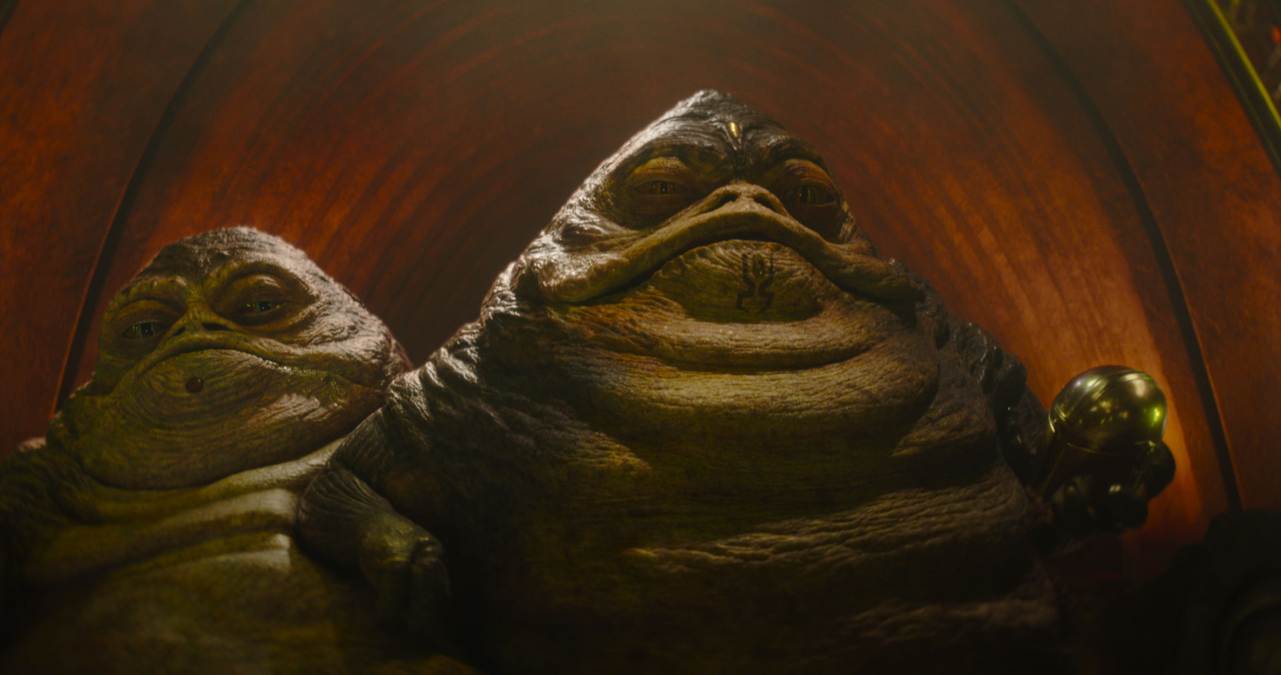
This article contains minor spoilers for The Mandalorian and Grogu.
At the climax of The Mandalorian and Grogu‘s first act, the odds stack up against Din Djarin. A horde of monsters floods into the gladiatorial arena to which he’s been sent, forcing Mando and Rotta the Hutt, the shockingly ripped son of Jabba the Hutt, to fight against a giant lizard in a leather vest, some unsettling worm thing, a gloopy dude with giant eyes, and other beasties.
At first, the fight scene just sucks, one of many indifferently-shot action sequences in The Mandalorian and Grogu. The monsters have neat shapes and move around in a way that could be compelling, but they’re all the color of old dishwater, various shades of green and brown and grey. But then you notice that the floor of the arena has a checkered pattern. And then you see the giant lizard guy smash its opponent on the ground, and you realize that these are the monsters from Dejarik, the holochess game that R2-D2 and Chewbecca play in the first Star Wars.
And you wonder, how did a franchise that once had incredible creature effects sink to this level?
If it’s been a while, or if you just watched Mando & Grogu and you have forgotten what good monsters look like, go back and watch the Dejarik part of Star Wars. The beasties are only on screen for a couple of seconds, but they’re immediately distinctive. The Kintan strider (the club-wielding neckless dude) is bright yellow. The Mantellian Savrip (leather-vest lizard) has rich green skin, which didn’t blend into the brown of his clothes. The molator (think Squidward, but melting from toxic waste, like that hoodlum in Robocop) seems to glow neon blue.
In Star Wars, we only see the Dejarik pieces clearly for one insert shot. The rest of the time, they’re just small pieces sitting in front of R2 and Chewie, part of the scenery. And yet, despite their small size and their lack of opacity (they are holographic, after all), the monsters stand out and stick in your memory. Animator Phil Tippett and his team made the creatures so amazing that despite being on screen for less than a minute, and only being the focus of the screen for mere seconds, the Dejarik pieces have become favorites, leading to their inclusion in Mando & Grogu.
Even more impressive is the fact that the Dejarik scene isn’t even the best creature feature moment in Star Wars. The Cantina scene is the stuff of legend, and with good reason. It begins with some Y-headed thing popping into the frame, his glowing yellow bug eyes offsetting the shadow. The camera cuts around to show us the other inhabitants: a yeti with the head of a spider, a couple of astronauts, a bat guy demanding his drink, the freaking Devil is there, just hanging out.
Like so many of the best parts of Star Wars, the denizens of the Cantina were assembled by accident and necessity. Reshoots and budget constraints forced make-up artist Rick Baker to just grab what he had lying around his shop to met George Lucas‘ demands for more odd aliens. Thus we get a ton of interesting-looking guys who show up without names or backstory. They are just there to look cool, build atmosphere, and flesh out the world.
The scene plays like a grab bag of random weirdos, and it plays perfectly. There’s a reason that everything from the Halloween town in The Nightmare Before Christmas to the spa from Spirited Away to the Troll Market in Hellboy II to even Star Trek (remember the bar that Bones visits in The Search for Spock?) all follow the Cantina model.
Yet, despite being chock-full of aliens, The Mandalorian and Grogu never comes close to the Cantina scene. To be sure, a couple of the creatures look cool. The puppeteering of Grogu and the Babus Frik remains incredible, and the climax prominently features a giant white snake that is genuinely impressive. But almost all of the creatures are like the Dejarik pieces seen in the gladiator arena: dull and forgettable.
Part of the problem stems from the movie’s color-grading. Mando & Grogu may have graduated from Disney+ to the big screen, but it still looks made for streaming, with the colors all flattened the same shade of grade, better to account for TVs and phones. As a result, the Dejarik monsters, the monkey played by Martin Scorsese, the Hutts, the ‘droids, and everyone else has a pallete of grey, green, and brown.
The other part is that Star Wars is rarely about anything but Star Wars anymore, which is why the Dejarik monsters are there in the first place. Lucas’ demands and Baker’s desparation to fill out the world left plenty of space for surprise and imagination, heightened by the fact that Kenner produced toys of guys like Hammerhead, the slug-like guy in the Cantina. But now, Hammerhead has a proper name (Momaw Nadon) and a backstory and a Wookieepedia entry, so that his next appearance won’t be a surprise, but rather a callback to make everyone who knows about Momaw feel very smart.
Star Wars used to be filled with wonder and surprise. The Mandalorian and Grogu proves that the franchise is now about trotting out creatures you already know and understand, made as bland and ugly as possible.
The Mandalorian and Grogu is now playing in theaters.
The post Mandalorian and Grogu: Star Wars Forgot Why the Cantina Scene Matters appeared first on Den of Geek.