By
By 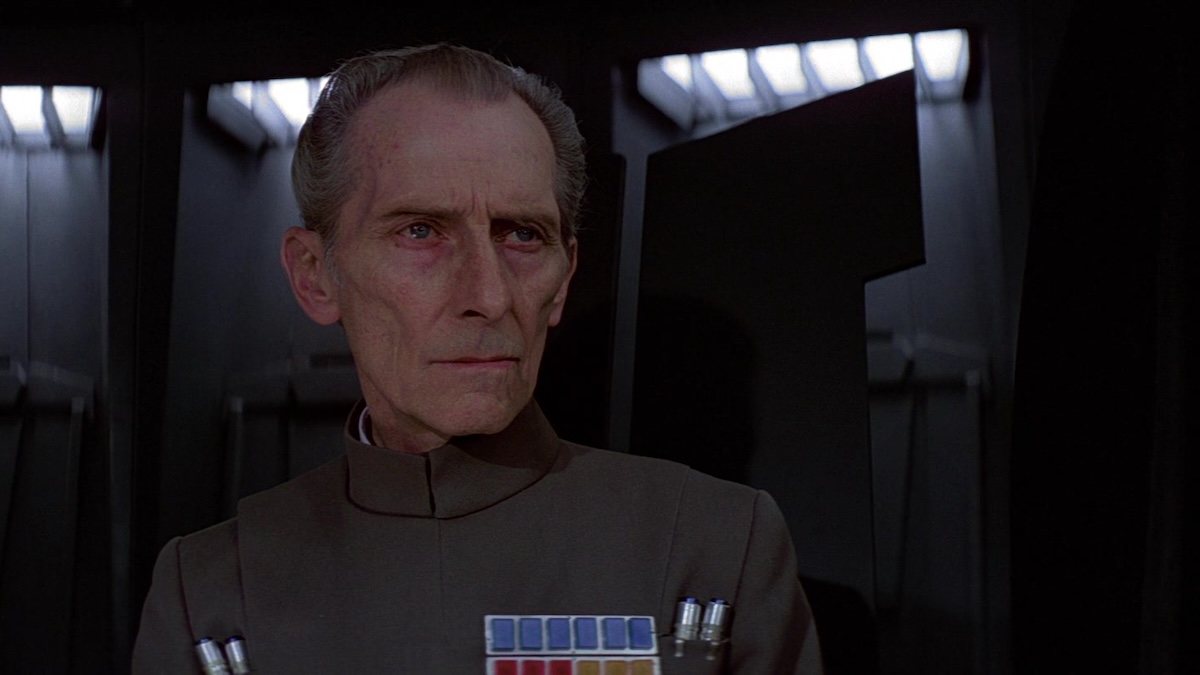
At the end of Rogue One: A Star Wars Story, after all of the heroes have perished on their mission, Darth Vader arrives to absolutely wreck a bunch of rebels. The 60-second sequence shows Vader slashing dudes with his lightsaber, crushing enemies with the Force, and deflecting every laser blast. Yet, even within that bravura moment, Darth Vader will never be as frightening as Admiral Motti, the little snot played by Richard LeParmentier in the first Star Wars.
Even if you don’t know Motti’s name, you certainly know one of his lines: “This station is now the ultimate power in the universe! I suggest we use it.” Motti gets Force choked by Vader and blown up in the Death Star, and that’s part of what makes him scary. He’s a regular guy, not a corrupted space wizard. Moreover, he’s a regular guy who gleefully calls for global genocide.
Motti is just one of many mundane villains of the Star Wars universe, bland guys with British accents, receding hairlines, and indifference to human suffering. These company men are the greatest villains in the world of Star Wars, and the franchise lost something when it started ignoring them.
Beaucrats lost their importance almost immediately. In the original Star Wars, Darth Vader was a smaller concern. He served as an enforcer for Grand Moff Tarkin and his history with Obi-Wan Kenobi made him an issue for Luke Skywalker, even before their familial relationship was revealed. But when Princess Leia makes a crack about Tarkin holding Vader’s leash, she was not cutting him down as much as she was pointing out what everybody knows: he’s a yes man, a weird religious nut who Tarkin kept around to serve a purpose.
The functionaries stick around through the rest of the original trilogy, most notably Firmus Piett (Kenneth Colley), who debuts as a first officer during the battle of Hoth in Empire Strikes Back and returns as an admiral in Return of the Jedi. But the introduction of Emperor Palpatine immediately diminishes their importance. With the reveal that the Empire is run by a monstrous space wizard who can shoot lightning from his fingertips, Vader changes from anomaly to centerpiece. From then on, the company men are no more important than Storm Troopers, incidental figures on the sidelines of a battle between magic users and their allies.
The franchise has never recovered from the change. The prequel trilogy works beaucracy into its main plot, including trade negotiations, cross-planet supply chains, and legislative rules. But all of these scenes involve bizarre-looking aliens or Palpatine, played only with only slightly less malevolence by Ian McDiarmid. Gone were the banal humans doing evil deeds. The sequel trilogy did no better, pairing Kylo Ren with the functionary General Hux. But not only was Hux increasingly diminished across the trilogy, but Domhnall Gleeson played the character as a passionate lunatic. None of these characters felt like regular guys just doing their jobs.
It’s easy to see why Motti, Piett, and even Tarkin faded to the background. Unremarkable humans could never steal the screen from Darth Vader, Kylo Ren, or Emperor Palpatine. Moreover, Star Wars operates according to moral binaries. There’s the Light side and the Dark side, and you’re either one or the other.
Yet, the series has never been without its shades of grey. One of the reasons that Han Solo remains a favorite, beyond the fact that he’s played by Harrison Ford, is that he’s a scoundrel, a guy who hides his heart of gold under layers of cynicism. The Mandalorian became a hit in part because it dealt with the paper pushers after the fall of the Empire. Werner Herzog’s the Client, Carl Weathers’s Greef Karga, and even Giancarlo Esposito’s Moff Gideon had more in common with Motti and Piett than they did Vader or Ren—at least until Gideon’s quest for the Darksaber turned him into a supervillain.
Of course, nothing demonstrates the importance of the Star Wars company man better than Andor, easily the most creatively successful spinoff series. The series takes place entirely within the margins of beaucracy, whether that be Senate chambers where Mon Mothma (Genevieve O’Reilly) did her part, the offices of the Preox-Morlana Authority that spawned Syril Karn (Kyle Soller), or the industrialized prison of Narkina 5. Cassian Andor (Diego Luna) dies on the beach of Scarif, immolated by a Death Star blast. But that’s not nearly as terrifying as the indifference of the judge on Niamos, who efficiently sentences Cassian to prison because that’s what the paperwork prescribes.
As wonderful as it is, Andor is an outlier in the franchise, and shouldn’t be looked at as a guide for other movies and shows. Star Wars without Jedi and Sith, without aliens and droids, isn’t Star Wars at all. But when the company men are present, the franchise gains a little more grit to make the frothy fun more enjoyable, a little more realism to make the fantasy that much brighter. The fantastic baddies like Vader and Ren work best when there’s a bland little Englishman behind them, treating a million voices crying out in terror like one more item on the daily checklist.
The post Star Wars Has Forgotten Its True Villains: The Company Men appeared first on Den of Geek.