By
By 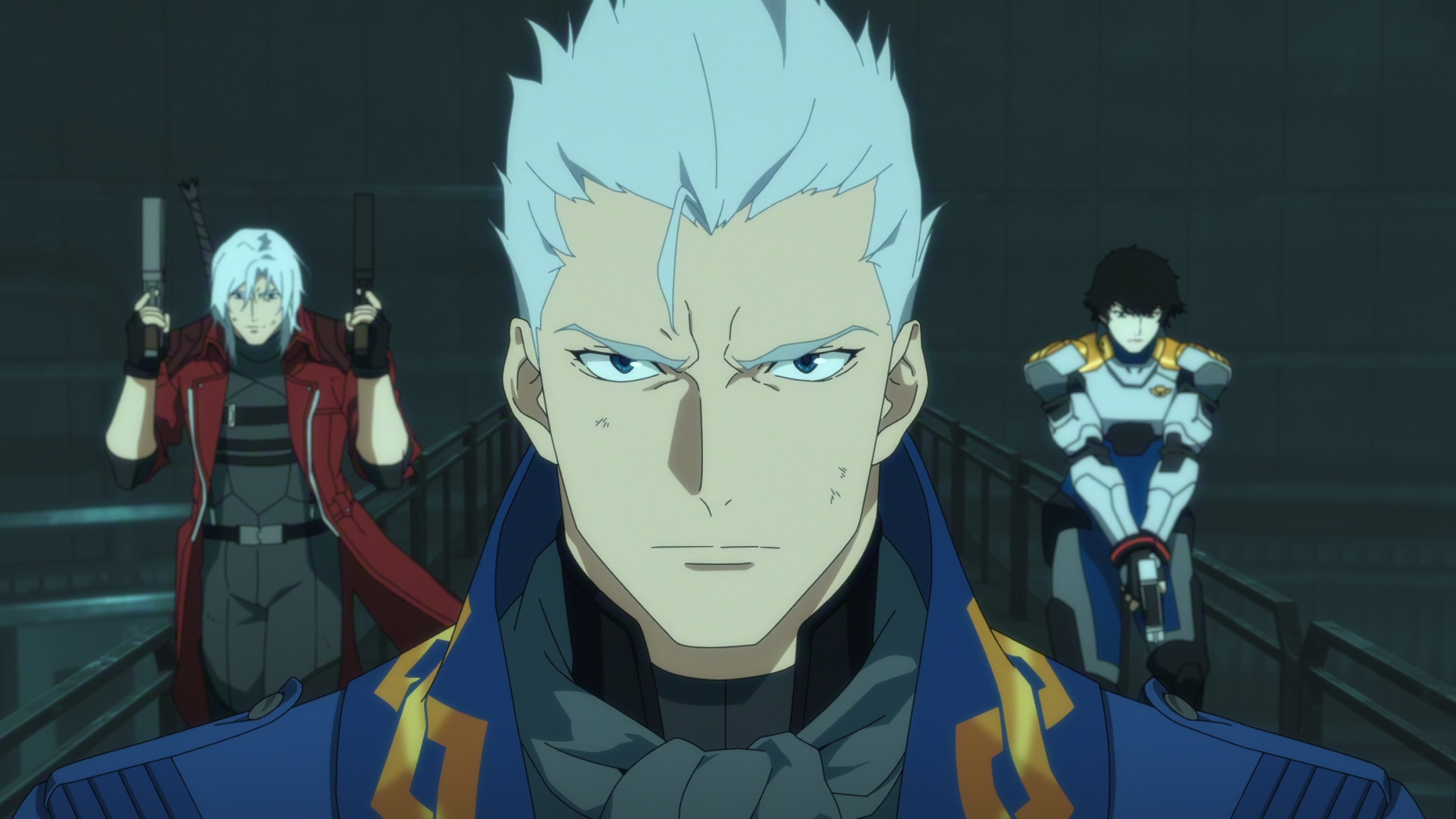
Fan-favorite gunslinging “Jackpot-”saying half-demon mercenary Dante Sparda is back for season 2 of Netflix’s Devil May Cry, joined by his equally powerful, more stoic and demonically-leaning twin brother. Dante (Johnny Yong) returns to TV with a renewed purpose: to defeat the king of the demons, Mundus (Ray Chase), and get his brother, Vergil Sparda (Robbie Daymond), back on the right side. However, Vergil is not the same little boy that Dante believed had died in the attack that killed their mother. Instead, he is now one of Mundus’ top soldiers.
In the ending of season 1, Dante was betrayed by Mary “Lady” Arkham (Scout Taylor-Compton), who chose the demon-slaying organization, Uroboros, over the chaotic half-demon gun slinger, resulting in him being cryogenically frozen in the organization’s lab.
Season 2 picks up where season 1 left off, showing the impact that Dante’s captivity has on Lady and the current state of the war in Hell, a world actually named Makai. Lady is faced with the guilt of her hand in the deaths of hundreds of innocent Makai refugees. The head of Uroboros, Arius (Graham McTavish), makes a deal with the literal cowboy president, President Hopper (Jon Gries), to manufacture the war, resulting in the continuous deaths of thousands of Makaians, for both good optics for a presidential campaign and for test subjects for the organization.
Season 1 was a great introduction to this newest rendition of Devil May Cry, but this season makes it really start to feel like a world and is very reminiscent of the world-building in the first and second seasons of Castlevania. Dante is given a level of depth and complexity that, in some ways, hasn’t been seen since the franchise’s first installments. Taking a change from his more serious counterpart in the Devil May Cry anime from the early 2000s.
Vergil is given a chaotic rebrand: a multifaceted personality with a more monotone demeanor than his twin, yet somehow just as, if not more, chaotic. Showing that the recklessness of the Sparda bloodline didn’t just go to one twin. Though better trained than his younger brother, Vergil is just as naive about his own brainwashing and the impact that Mundus’ propaganda has on his ambitions to avenge his mother. Holding the same ambition as Dante, they find themselves on opposite corners of the boxing ring, only to be forced together to take down their mutual enemies, Arius, who is trying to revive Argosax the Chaos, an even bigger threat than Mundus, and Mundus, who lied to Vrigil about who killed his mother.
One of the main emotional themes this season is the impact that father figures and male relationships have on the main characters.
The twins’ father, Sparda, almost literally haunts the narrative. His absence from their lives, even his whereabouts, is never fully explained, even in the stories’ source materials. Dante and Vergil both reject and embrace their father’s legacy in various ways in the season. Vergil rejects his humanity, believing it inhibited his ability to protect his mother. In season 1, Dante rejected his demonic nature due to his seeing demons (Makaians) as nothing but evil due to their hand in his mother’s death. This season, Dante embraces humanity, as it is the only thing he has left of his mother.
Lady still deals with the trauma of her father’s experiments that ultimately turned him into the villainous demon, the Jester – a traumatic transition she witnessed – as her father brutally killed her mother, and set her on the path of hating the Makaians. Lady admits to herself that her father’s greed for knowledge was his undoing, having lost her father long before his transformation.
Even Mundus’ relationship with Sparda and Argosax is a reflection of generational trauma amongst mentor figures. Argosax, the original king of Makai, had his tyrannical reign ended by Mundus, who saw that his mentor had gone too far. Only for Sparda, his top general and loyalist subject, did the same when he saw that Mundus had strayed too far from their path.
Matilda “Mattie,” a young girl whom Lady and Dante meet, loses her grandfather, Prof. Lucan, a powerful, arcane scientist and sorcerer. Mattie is impressionable, dealing with the feelings of hatred and anger that the story’s main protagonists dealt with at her age, acting as a mirror for them in certain scenes.
Even the season’s main antagonistic figure, Arius, is impacted by the cruelty of his father. Learning that Arius had lived numerous lifetimes, his father subjected him to severe abuse that resulted in an event that twisted his childhood ambitions and fascinations into a homicidal and power-driven future.
The entire season shows the impact of childhood trauma, the conclusions made based on it, and impacts people for the rest of their lives, humans, and demons alike.
The season does a good job at really developing the fact that Dante and Vergil don’t know their father; everything they have learned about him comes from second-hand sources. The series has truly conveyed that, despite Sparda’s legacy being the main focal point of the series, no one truly knows him.
The season goes full force on the idea that every single character that we meet has a legacy that impacts their lives, leading some to their deaths.
The season does a great job of captivating the viewer, though there are a few critiques to be made about the CGI used to animate the bigger figures like Mundus, Argosax, and Dante and Vergil’s Devil Trigger forms, whose movements can sometimes feel clunky.
The storyline is well done. The DanLady shippers are in for a treat, as are Vergil stans with the newest take on the character. The season calls back to some of the most iconic scenes in the games, while making the characters feel alive again.
All eight episodes of Devil May Cry season 2 are available to stream on Netflix now.
The post Devil May Cry Season 2 Review: DMC Takes Daddy Issues to Extreme Power Levels appeared first on Den of Geek.