By
By 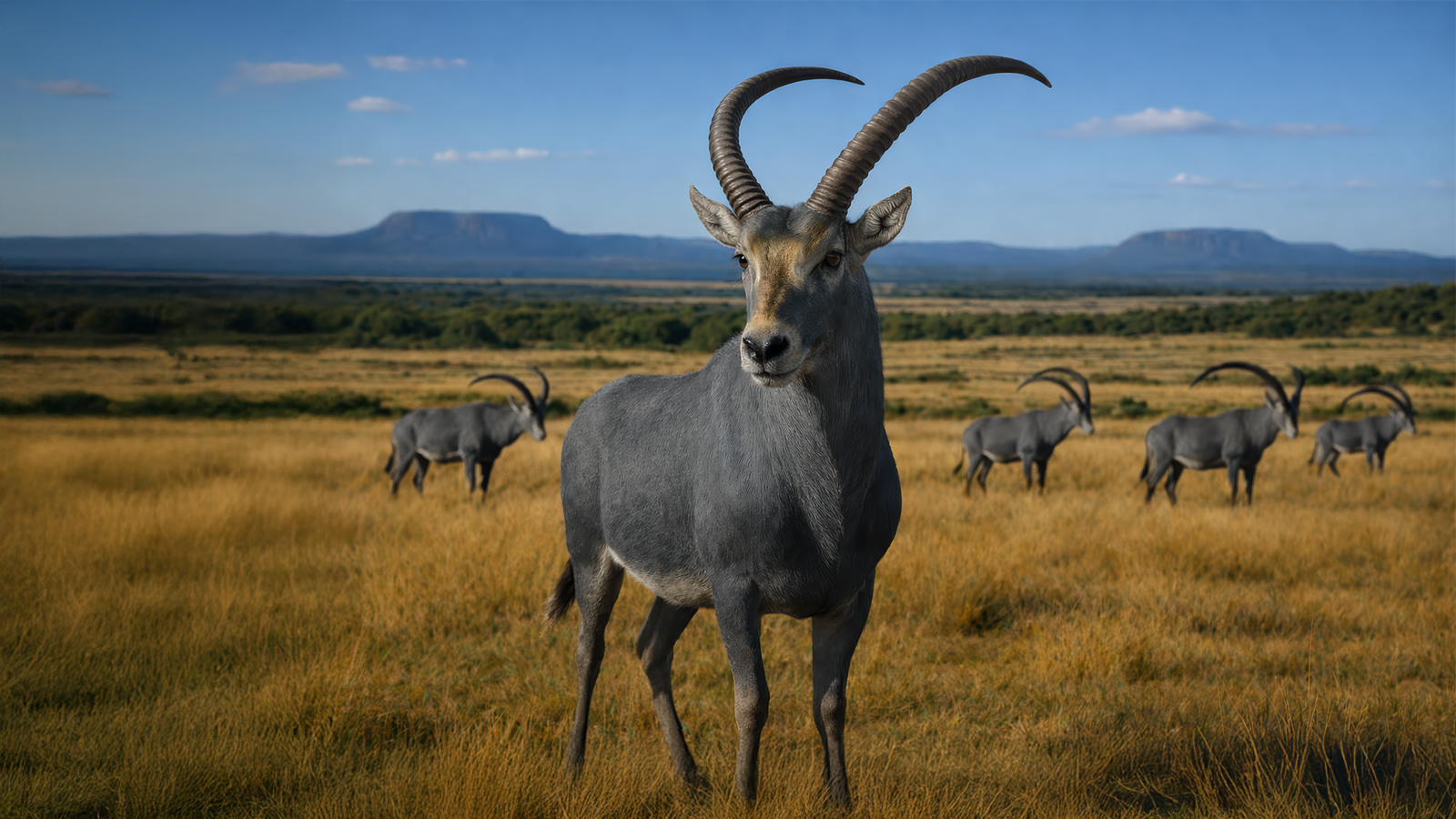
More than 200 years after mankind hunted the Hippotragus Leucophaeus, aka the bluebuck, to extinction on the plains of South Africa, the petite and well-horned antelope is set to make a comeback. This revelation also marks the sixth publicly announced de-extinction project at Colossal Biosciences, the biotech firm that gave the world woolly mice and the functionally revived dire wolf last year.
Following on the company’s stated goal to have a woolly mammoth calf birthed by 2028—as well as intentions to also resuscitate genetically edited versions of the thylacine, the great moa, and the dodo—the bluebuck would be a departure in some ways from the headline-grabbing Pleistocene throwbacks of recent news cycles. It could also mark a genetic coup for African ecosystems, which saw European settlers and Boers hunt the bluebuck to extinction by the year 1800.
The biodiversity upshots are suggested to supplement current antelope populations which are facing modern pressures of climate change, a loss of habitat, and poaching, among other travails. According to the International Union for Conservation of Nature, 29 of the world’s 90 antelope species are threatened with extinction, and a further 62 percent of antelope populations have declined. Five antelope species in Africa are currently classified as “critically endangered.”
“People see David Attenborough movies, and they just think of antelopes as ubiquitous running through Africa,” says Colossal CEO Ben Lamm. “They think they don’t need anything, that they’re like deer and there’s just too many of them. And that’s not true. About 30 percent of them are endangered with extinction.”
This is one of the key reasons that some researchers at Colossal have been proponents since the company’s founding in 2020 for reviving the bluebuck. Lamm gives special credit to Michael Hofreiter, a Professor for Evolutionary Adaptive Genomics at the University of Potsdam, Germany, as well as a scientific advisor at Colossal.
“Since day one, when we were just talking about the mammoth, he’s like ‘We have to do the bluebuck. It’s just so amazing, and antelopes need help,’” Lamm recalls. At first, Colossal invested in Hofreiter’s DNA research of the bluebuck, but the CEO really saw it as one of many research projects to analyze, such as investments into cave hyenas. “We’re not working on cave hyenas, but one of our researchers is really passionate about it. So it’s cool, and it’s cool for science, so we’ll fund those projects. And that’s where the bluebuck fell.”
Yet as more scientific data came in, the more evident it became that they could relatively easily make a bluebuck.
“We’ve solved assisted reproductive technologies and all the IVF stuff,” Lamm explains. “We’e solved the induced pluripotent stem cell stuff. We’ve already created the genomes and all the comparative genomics. We’re editing and we’re so bullish on the editing.”
Set to be the first Colossal de-extinction project to reach the finish line with more than a hundred edits on the source genome, the bluebuck is working from a roan antelope’s genome, as well as the ovum retrieval and IVF data of the scimitar-horned oryx. Lamm expects to use roan as the surrogate mother(s) for the first generation of Colossal bluebuck as well.
“We will have a bluebuck in years,” Lamm states. “We don’t know if it’s two or four, but it ain’t a decade. It’ll be before five for sure.”
Other than realizing they could make a bluebuck, it was some of the things Colossal’s chief animal officer Matt James told Lamm that made the company begin thinking they should.
“We started doing a lot of work in Africa on the conservation front, and antelope conservation is massively underfunded,” Lamm notes. “And Matt said, ‘Well, it would really help the antelope.’ And then there’s not any hate groups against the bluebuck. It’s not like a megalodon or anything insane like that. Everyone generally likes antelopes and deers.”
Finally, he admits, there is what could be compared to a video game’s branching skill tree. While a renewed bluebuck could reintroduce some biodiversity, it could also have implications in bovid production.
Says Lamm, “Maybe there’s applications to apply the technologies into bovids and then have applications to livestocks or food security or other things, which we just haven’t been focused on. Those could be interesting technologies from a license or monetization perspective.”
Ultimately, though, the prospect on paper might be palatable since it would be bringing back a species that went extinct due to the actions of humans in modern history—as opposed to a species of wolf or mammoth that died out millennia ago. The Colossal CEO, however, seems skeptical that the bluebuck announcement will change any minds overnight about the merits of de-extinction.
“We don’t take the perspective of trying to persuade,” Lamm says. “We [prefer] the opportunity to educate. I don’t think it’ll have a true effect on the people that just aren’t pro de-extinction, because the dodo is also a recent extinction and so is the thylacine, and I don’t think it has to be a Pleistocene era de-extinction. I think [some folks] just generally don’t like de-extinction.” With that said, he contends about 80 percent of the scientific community supports Colossal’s conservation efforts and thinks continued benefits in that field will be what changes minds. Furthermore, he suggests what is more promising is how the science is inspiring the next generation.
“My biggest testament that we’re doing something right is we surveyed our investor base, and 30 percent of our investors found out about us, not from you guys or CNN, or anyone else. Thirty percent came from their kids,” says Lamm. “That makes me think we’re doing a lot more right than wrong if nearly a third of our investor base came from the fact that their kids were having meaningful scientific dialogue with them at home.”
And in the context of the bluebuck, Lamm thinks there’s an opportunity to teach recent human history to kids—and their parents.
“I hope they want to learn about other lost species that may not get the biggest headlines like a woolly mammoth, and I hope that they research about South Africa and other species that went extinct in South Africa and the African continent,” Lamm says. “I don’t think it’s a bad thing to learn that this colonization period went on and weird decisions were made.”
He adds, “There’s been a lot of really bad decisions throughout history that people kind of wrapped as progress… I truly don’t think it was intentional. I don’t think they were fearful of the bluebuck. There was just a general view of abundance that wasn’t accounted for, and in that lack of accounting, people just eradicated species and destroyed landscapes.”
In a few years, that landscape might be a little more populated though.
The post Colossal Biosciences Aims to Bring Back the Bluebuck by 2030 appeared first on Den of Geek.