By
By 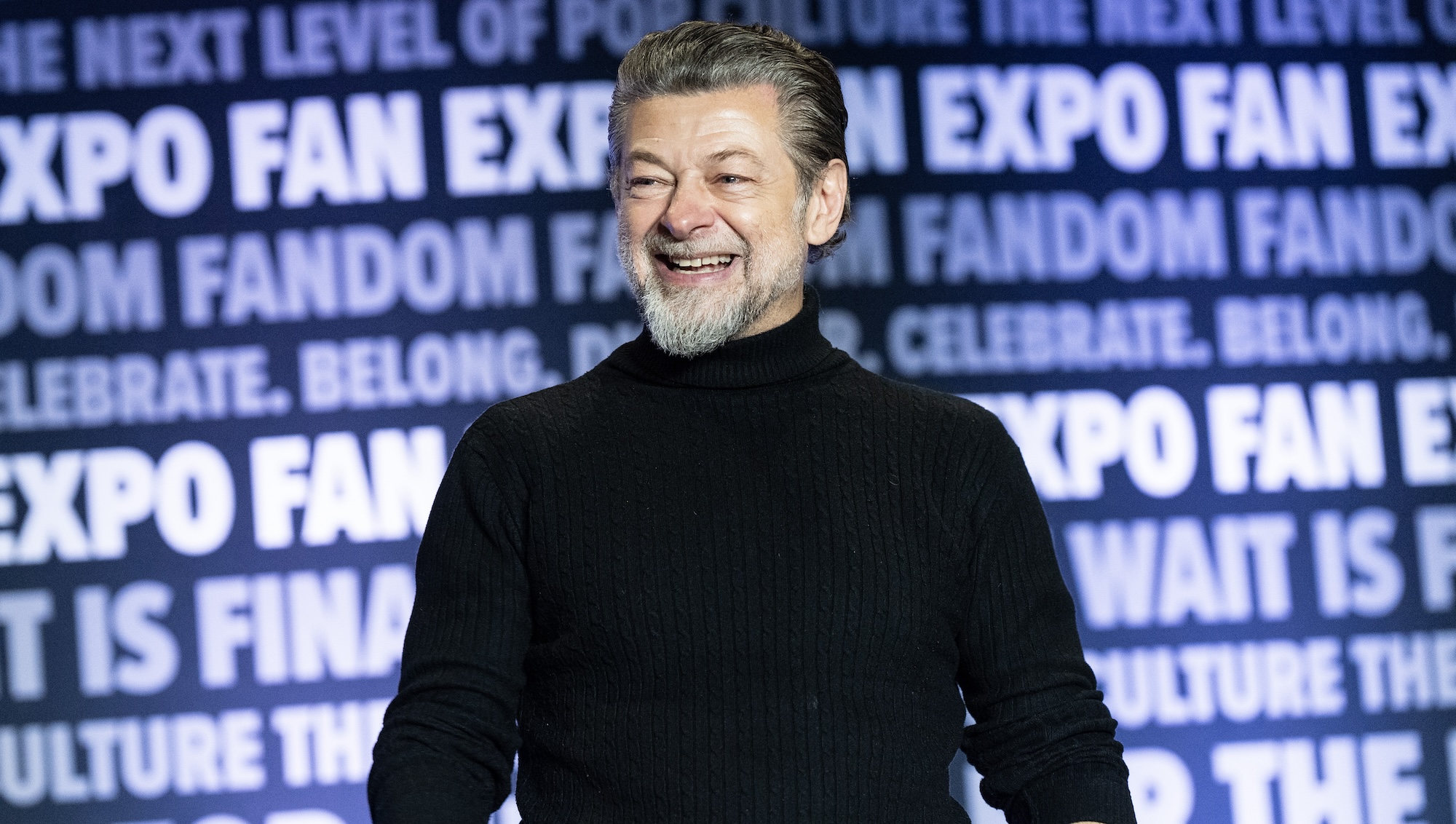
Andy Serkis was still a child when his father disappeared into a black bag.
Before that horrible, indescribable plunge into uncertainty, the future actor and filmmaker had something of a cosmopolitan upbringing. Raised in Ruislip Manor, an area in the outer reaches of West London, Serkis is the son of Lylie, a half-English and Iraqi mother, and Clement, an Iraqi-Armenian father. And it was in Iraq that Clement helped build and raise up a Baghdad hospital, a feat which brought Serkis as a youth often to Middle East. That changed after his father made an anti-Ba’athist speech shortly after the party of new dictator Saddam Hussein came to power.
“It landed him in a great deal of trouble,” Serkis reflects decades later on the other side of Hussein’s rise and fall, and Iraq’s continuous shift in fortunes. “He vanished for a while. He disappeared. We didn’t know what had happened to him for two months.”
Ultimately, Serkis’ father was released from prison and the country, and that hospital stood long enough to be commandeered by invading Americans, who in turn transformed it into a military facility. Still, neither Serkis nor his family has stepped foot in it since the 1980s.
“I suppose I was made aware of power and the abuse of power quite early on,” Andy says.
An Orwellian Life
The corrosive nature of power remains firmly perched in the storyteller’s mind. How could it leave after those dramatic childhood memories? Or, for that matter, his most famous roles, including the compromised and ruined Gollum, desperate to please his precious One Ring, or the more equanimous and regal Caesar in the recent Planet of the Apes trilogy. When we catch up with Serkis in a posh Italian eatery in New York’s Upper East Side, with the one-time King Kong actor fittingly dining on a meal of octopus, it is those formative experiences and stories he seems most eager to revisit. After all, he has just completed more than a decade of work that came with realizing his vision for an Animal Farm adaptation.
“I first read it on the bus going to school when I was about 11 or 12 years old,” Serkis recalls of George Orwell’s dystopian parable about an animal revolution against humans that, tragically, still ends in oppression and tyranny. “I remember being really taken in by this story that I knew was a fairy tale, because it had animals in it, so it felt innocent. And yet, there was something very sinister underneath it. It was the first time I really connected with a book in that way.”
Serkis confides his own childhood experiences with the Ba’athists might have made the story resonate with him more easily, saying when he read it, “I could see what was going on with the show trials of the animals and the persecution of the proletariat, as it were, by the elite.”
It was an image that stayed with him and came into greater focus when the prospect of turning the 1945 novel into a 21st century film became tangible. Serkis first began discussing the film with the Orwell estate around 2011, and even then the concept was to modernize the story. Initially, that would have featured a more complex approach, with the film being conceived as a motion-capture epic that utilized the same technology Serkis helped pioneer in movies like The Lord of the Rings. However, the tact eventually pivoted to treating it as a family-friendly animated endeavor.
The more all-ages attempt at modernizing Animal Farm for young viewers of today has earned the ire of a number of critics due to, among other things, the film essentially supplanting the novel’s allegory about the Russian Revolution with a more current vision of authoritarianism. But in addition to underscoring that the Orwell estate always gave this direction their support, Serkis is quick to point out that the film taps into the dark despair about the cycles of human history which appear in the book.
“We really wanted to make this for young people, and so it becomes what are the things they can relate to?” In this way, Orwell’s reigning ambitious pig Napoleon better resembles a modern-day populist prone to self-aggrandizement and mendacious lies than a 1:1 proxy for Joseph Stalin. And as Serkis sought to “explore the world of the pigs” more than their largely off-stage presence in the novel, one of the female pigs of the film becomes akin to an influencer than Orwell’s oblivious people-pleasers.
“It’s more pernicious because it’s aimed predominantly at the destruction of truth,” Serkis contends, “and that’s such a huge theme of the book, the annihilation of what is the value that we ascribe to truth.” And if his desire to “go inside the bunker” of the pigs’ world led to any curiously overt echoes of Donald Trump, then even that is coincidental, according to the director. “We asked Seth [Rogen] to play Napoleon in 2012,” Serkis says. “Trump wasn’t even on the scene, really. Not in terms of a credible force.” Still, he allows “it’s bizarre” how much the dismantlement of truth has accelerated around the world since that time.
In the end, Serkis would seem to argue that, for all its modernizations and tweaks, his Animal Farm still grapples with the same grim observations of human nature that Orwell first set to capture on the page. Pointing to the anecdote of how the premise of the book came to the author upon seeing a country work-horse being beaten half to death by its owner, Serkis suggests Orwell’s entire biography is what makes the story timeless.
“He was part of the British colonial forces out in Burma,” Serkis says. “And he had gone from this posh public school boy at Eton to being part of the Burmese police force on behalf of the British Empire, and inflicting and controlling. Then he realized the error of his ways.”
In some sense, alongside activism that saw Orwell fighting the fascists in Spain, Animal Farm was a kind of atonement for the author. As well as a tribute to all who are exploited—not least of all the animals.
Monkeying Around for a Career
Much of Serkis’ journey has likewise been shaped by an appreciation and study of animals, of the farm persuasion or otherwise. The vocal inflections that led to the breakthrough of Gollum’s sound and cadence came from the actor watching his cat stifle a hairball. And of course two of his other most famous roles, Caesar the lawgiver in Matt Reeves’ Planet of the Apes trilogy and King Kong, came from our distant simian cousins.
“You become aware that all animals are sentient, they all have codes,” Serkis says about our neighbors on this planet. “They all have ways of being. They all have behavior. We are so connected to them and the patterns of behavior are recognizable. Anthropomorphization is something I’ve spent a lot of time doing.”
He developed a kinship, especially, with gorillas during the production of King Kong some 20 years ago. It began with an eye-opening tour of gorillas in the mists of Rwanda, where he observed how their peaceful and almost beatnik behavior better resembled hippies vibing out around a Piccadilly drum circle than the monster of Merian C. Cooper’s original 1933 King Kong.
But it was after he returned to England to work with gorillas at the London Zoo at Regent’s Park that he got to know the friendly female ape named Zaire—and aa bloke named Bob.
“I spent a good couple of months everyday visiting Zaire, and having a 1:1 sort of relationship with them,” Serkis explains. “We used to play games, we used to pass sticks to each other…. and Bob had been brought in as part of the breeding program, and he was very jealous of me because he was supposed to be there, but the three female gorillas were not interested in Bob. But with Zaire, I had a bit of a friendship.”
With a grin growing across his face, Serkis adds, “So Bob really didn’t like me. He used to watch me with beady eyes and give me a really hard stare every time I used to walk past his enclosure. Then he started this habit of gathering a small pile of stones, and whenever I turned my back, he’d throw them.”
Finding Kong’s animosity for Adrien Brody would come naturally later.
One Role to Rule Them All
The study of physical behavior, human or animal, live-action or motion-capture, unsurprisingly is organic to Serkis, especially these days, albeit he’ll admit it’s a far cry from how he initially perceived his art form. Serkis in fact felt slighted when he was first told Peter Jackson was considering him for the role of a digital character named Gollum in the Lord of the Rings trilogy. “There must be a load of decent roles in that film where I could play proper characters!” he told his agent at the time. In retrospect, however, Serkis concedes he was training his whole life for Gollum.
“I’ve always found physicality, voice, and the psychology of a character to be inextricably linked,” says Serkis. “Voice comes out of where you carry tension or pain, or how you express yourself in an articulate or inarticulate way.” In the case of Gollum, that includes the epiphany that only a heaving feline could inspire. “He’s got this constriction in his throat and the raspiness in his voice, and that breath was really about where he carries his tension.”
When Jackson and longtime collaborator and partner Fran Walsh first approached Serkis, motion-capture was more a nascent technology associated with the medical industry’s ability to build functional prosthetics than it was seen as a moviemaking tool. Yet Serkis’ history with movement, both as a student at Lancaster University and as a young actor playing a character named Dog Boy in April De Angelis’ play, Hush, made Gollum’s vulnerability seem natural. This proved doubly true since Dog Boy required nudity every night in front of a London audience.
“Gollum is slightly naked and faces the elements,” Serkis muses, “and I shaved my head completely so that I could feel the wind on my skull.” Plus, he sheepishly laughs, “You have to be quite fearless to wander around in a gimp suit. No question! I’ll never forget the first day of shooting Lord of the Rings, and turning up in front of a crew of 250 rough, tough Kiwis on top of a mountain, and standing there in little more than a lycra speed-skating suit.”
Fathers, Sons, and Batman
Coming to film direction from the school of acting, Serkis equates the transition as generally going from being the son to a father. As the helmer, he must lead, or parent, a whole production. But while Animal Farm represents a kind of zenith in a 15-year journey for the filmmaker into cinematic parenthood, the next peak is coming fast, and it’s one where he will inhabit multiple generations at once: The Lord of the Rings: The Hunt for Gollum.
“We’ll find out if that son gets out of control,” Serkis chuckles about his most famous character. “Tell him, I might have to discipline him or them.”
It’s a production Serkis is particularly excited about since it is a chance to go back to some of the old ways the original film trilogy was produced between 1999 and 2003. “We’re using miniatures; we’re employing some of the older techniques and bringing some of the new techniques to bear as well. So we will be walking the tightrope of creating a world that people are familiar with, but also in terms of the story, it’s an entirely new story.”
With that said, Serkis is unsure of how many stories he has left to tell. He is always eager to continue his first love of acting, including when he reprises the role of Alfred Pennyworth in Matt Reeves’ The Batman: Part II.
“I read a script a long way back but I know it’s evolved and changed since, so I have no idea where it is at the moment,” Serkis teases. But even there, the thrill is largely collaborating again with his Planet of the Apes partner and patriarch.
“Matt and I worked on the Planet of the Apes movies together first of all, and we developed a very strong friendship, and actually one of the themes that sort of link us is his relationship to fatherhood. So his is always an emotional approach, and he took a very emotional approach to Batman. In the first film, the relationship between Alfred and Batman is quite an emotional one. And that notion of father is important going back to your original [Apes]. It’s very present for us both, so I’ll be interested to see if that develops in this one.”
But for his own onscreen children beyond Gollum and now Orwell?
“I’m working on all different types of projects. The only problem is there’s only so much time. And all you have to do is decide what to do with the time that is given to you,” Serkis says, with the trace of a Hobbit-like smirk. “It really is though. There comes a point with filmmaking, if they’re all going to take as long as Animal Farm, you think, ‘Wow, how many more have we got?”
At least enough to scale Mount Doom one more time.
Animal Farm is in theaters on Friday, May 1.
The post Andy Serkis on the Legacy of Orwell, Gollum, and His Passion for Animals appeared first on Den of Geek.