By
By 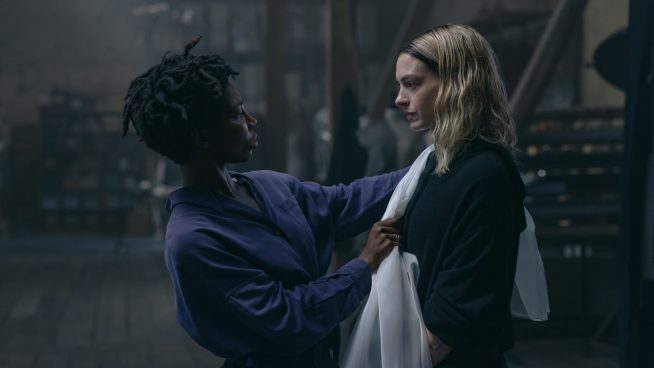
David Lowery is nothing if not a masterful curio. The multi-hyphenate storyteller (whose IMDb credits span directing, writing, cinematography, producing, editing, acting, sound design, and – somehow – many more roles) has delivered some true knockouts alongside some true stinkers, with a handful of mixed bags in between. His very best films defy traditional storytelling logic. Take, for instance, his spin on the Arthurian legend, The Green Knight, a kaleidoscopic spirit quest that actively eschews the hero’s journey, comfortably positioning itself outside what audiences typically expect of fantasy epics. Or A Ghost Story, which frames the existential enormity of loss through Casey Affleck wearing a white sheet with eye holes cut out. In Mother Mary, he’s trying something entirely new: a dialogue-driven breakup song of a ghost story about the haunted rift between a pop star and her dressmaker ex.
There’s a cyclical, dream-logic quality to Mother Mary that begins and ends with performance. The titular Mother Mary (Anne Hathaway, in rare form) takes the stage in front of an adoring audience of tens of thousands. Lights flash. The sound system blazes. Love emanates from the crowd. But something is amiss. There is something cracking within the woman on stage – something tearing her apart from the inside out. This drives Mary to acclaimed dressmaker Sam’s (Michaela Coel, staggering here) doorstep. She has a simple request: she needs a gown to wear during a special midnight performance that will make her feel like herself again. That will purify her. That will lead to clarity. But it’s more complicated than that. There’s history between these two that crackles with tension from the first moment they share a room together. The detritus of their severed personal bond, rich with its broken familiarity, lies open – an exposed wound. But is that wound a door or a key? This, good reader, is the spine of the experience that is Mother Mary.
Lowery’s film explores this tension with a woozy mix of theatricality and surrealism – what at first feels grounded in dialogue takes flight into something ethereal, existing only in the realm of emotional logic. If you asked me to explain what this film is about, its plot would remain hard to define. It’s a story of broken hearts and the wreckage of romance, one that dabbles in metaphorical and literal ghost stories as much as it does the dizzying revelries of the limelight. If that sounds like hokum, that’s because it probably is. And yet it is much easier to feel what this movie is about.
As may be expected, this esoteric and difficult-to-classify feature is a tall order. Mainstream audiences will likely reject it whole cloth. For large swathes of the movie, it’s framed as a very theatrical tête-à-tête in close quarters between its two performers. But even those who aren’t swept up by the totality of Lowery’s vision should find the performances nothing short of remarkable. Both leading ladies are functioning at the absolute peak of their powers. Michaela Coel is wholly magnetic; her twisted grins and evocative line delivery help create a character that’s as decadent with emotional complexity as the dresses she hems. Against her, Hathaway balances both the superstar prowess of the stage version of Mother Mary and an uncharacteristically vulnerable turn as the shell of a woman she becomes outside the spotlight. This story is fundamentally an exploration of these two women, who rose to fame together, as one edged the other out and adoration withered into distance.
[READ MORE: Our review of ‘Green Knight‘ directed by David Lowery and starring Dev Patel]
Backed by a darkly poppy, Gen Z-purring soundtrack – complete with original songs like “Holy Spirit” and “Burial” that were written and produced by Jack Antonoff and Charli xcx – that serves a dual function of leaning into the pure pop draw of a concert experience while reframing Mary’s fame as a kind of storied, romance-driven balladry, Mother Mary could functionally be classified as a musical. Though its musicality is found as much in its lyrical script and balletic performances as in the songs themselves. The script flows through Hathaway and Coel so musically that, at times, you feel like one might break into song – or start levitating.
Nearly every element of Mother Mary’s existentially wonky, experientially maximalist production feels like a polemic against the filmic norm. The costumes are exquisitely designed: lush and pointed, twisting fabric into expressions of identity that feel as volatile as the woman wearing them. The soundtrack is industrial, pounding, and riddled with suggestion. The whirling choreography is staggering – two instances stand out. One sees Hathaway perform her newest song without the song actually playing; she writhes and stomps across the floor, breathing life into silence in breathtaking fashion. Another finds her climbing and descending a series of stairs to and from the stage, a Sisyphean labor that underscores the endless cycle of performance.
As the film tilts increasingly toward the supernatural, so too does its intention sharpen into a knife. This is a story about the scars we allow those who’ve entered our souls to carve. Just as it asserts itself to join the pantheon of mind-bending movies that feature a red dress. Make no mistake: Mother Mary is doing its own thing, and it has no interest in holding the audience’s hand through any of it. Anyone walking in expecting the beats of a romance, the mechanics of a horror, or the arc of a pop-star biopic will likely find themselves frustrated, if not outright outraged. Instead of a masterclass in esoteric filmmaking, they may see The Emperor’s New Clothes. And it’s precisely at this intersection where Lowery will either lose his audience – or draw them to the absolute edge of their seats. I was firmly in the latter camp, finding the effect spellbinding, intoxicating: invitee to one of the most electrifying films of the year so far and one of its most unabashedly mystifying. Let Mother Mary cut you open and float inside. Or don’t.
CONCLUSION: David Lowery’s hypnotic ‘Mother Mary‘ is a breakup song filtered through the lens of a ghost story, mounted with spectacular production elements and stitched together with unreal performances from Michaela Cole and Anne Hathaway.
A
For more reviews, interviews, and featured articles, be sure to:
Follow Silver Screen Riot on Letterboxd
Follow Silver Screen Riot on Facebook
Follow Silver Screen Riot on Twitter
Follow Silver Screen Riot on BlueSky
Follow Silver Screen Riot on Substack
The post ‘MOTHER MARY’ Is the First Great Movie of 2026. You’ll Probably Hate It. appeared first on Silver Screen Riot.