By
By 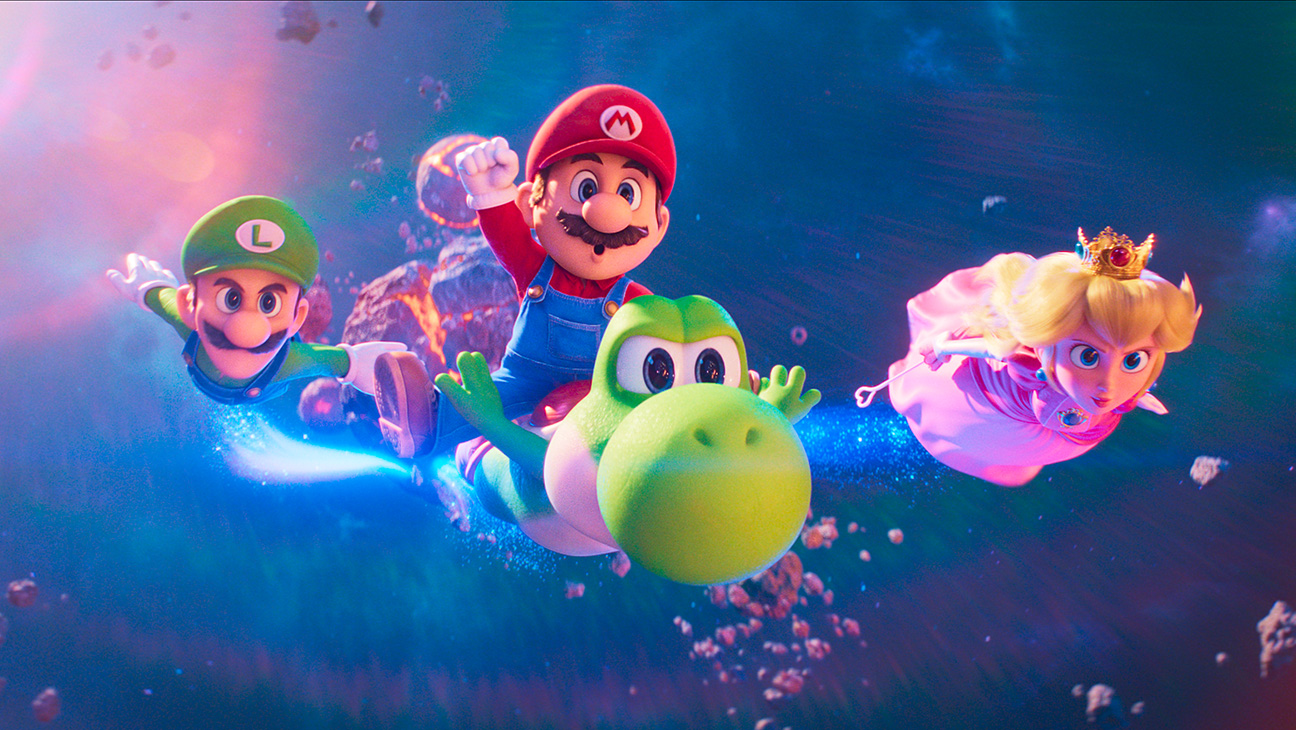
A common critique of modern trailers is that they often spoil too much story. Many give away key plot beats, the funniest jokes of a comedy, or the best scare scenes. The intent is obviously to lure in an audience with the best parts. Yet if the best parts are the only good parts, it can feel like watching the movie is a waste of time.
The Super Mario Galaxy Movie, on the other hand, has so little story that it feels more like watching an extended trailer than a feature film. It is the sequel to the successful The Super Mario Bros. Movie, a film that was a smash success even though it had a rough and uneven plot. At least it had a plot, as trope-laden and shallow as it was.
There is essentially no plot in this movie. It opens with a new villain, Bowser Jr., kidnapping new princess Rosalina, with the goal of powering a device that will let him take over the universe. This is the only plot beat to come for the remaining 99 minutes, with the rest of the film consisting of main characters wandering around reference-laden environments with the general aim of rescuing other characters but with little actual agency in doing so.
Reference-laden is the most generous description of what feels like a Where’s Waldo? of movies. Each scene is a new page where Nintendo loyalists can spot a different property or game element being referenced. Admittedly, this goes deep into the well and seems to be priming for a Super Smash Bros. movie due to the berth of pulls, if not because of any actual plot point. There is a childish fun to this approach, and Brian Tyler’s score is a delight with its musical references.
But the movie unfortunately has as much character development as a Where’s Waldo? book, which is to say none. Mario and Luigi have no arc or development of any kind, and the introduction of Yoshi adds nothing besides a cute pet creature. Bowser and Peach get the closest approximation of character arcs due to each having new familial relations, yet Peach never has an actual dialogue scene with her new relation, so it hardly matters. Bowser, meanwhile, has actual change, but Jack Black‘s performance is so shoved to the periphery that it never really has impact. There’s no attempt to replicate the success of the song “Peaches,” a bizarre choice for such a commercially-inclined movie, but another hallmark of what feels like a lazy and rushed work.
Admittedly, Illumination‘s animation approach suits these Nintendo characters well. There are some beautiful environments and recreations of various Mario video game landscapes, though sadly the actual Galaxy parts are minimal. For a movie named after one of the most highly-regarded 3D Mario games, this pulls very little from the named source material. Given the animation quality, it would have been neat to see some of Galaxy’s finer moments brought to life. But this is too busy serving as a reference book than actual movie.
One could say these Super Mario movies represent a sea-change for video game movies. More and more are being made, and many are more successful than the embarrassing attempts of the past. The last Mario made tons of money, and this one is doing the same. Yet it’s a shame that mediocrity defines The Super Mario Galaxy Movie. The filmmakers should have reached for the stars instead of merely drawing a reference to one.
Tell us your thoughts on The Super Mario Galaxy Movie and rank it on the new and improved Flickchart!