By
By 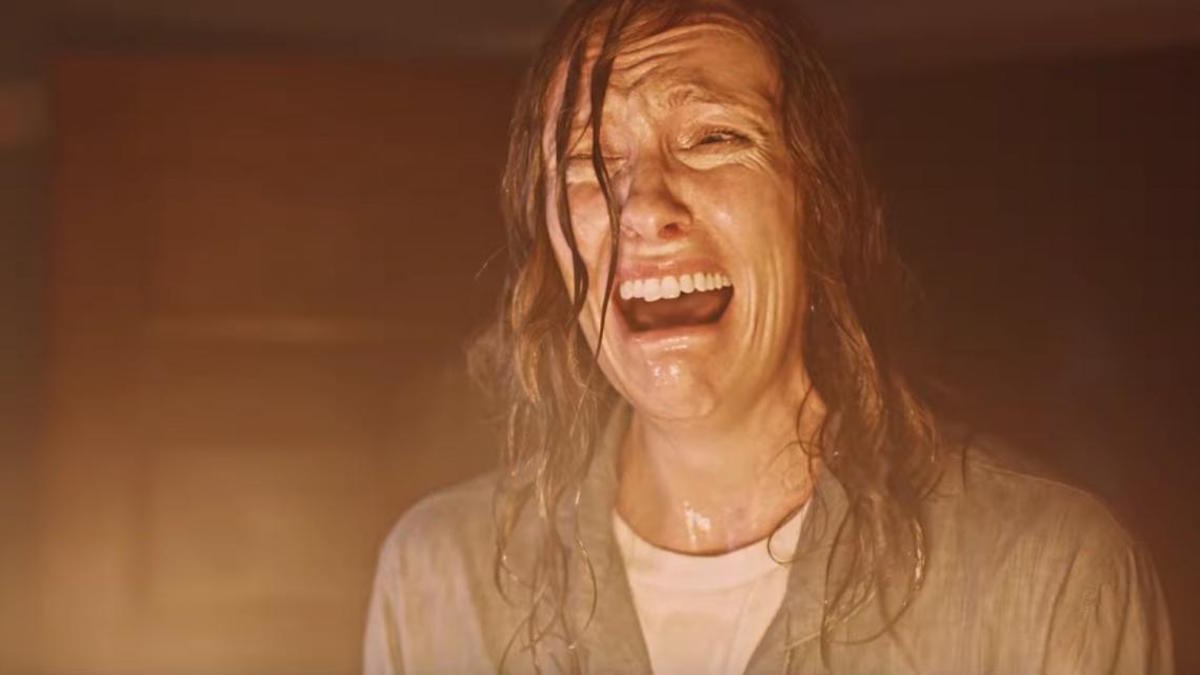
The trailers for The Woman in the Yard, released this past March, promised a scary movie with a delicious premise. One day a woman clothed in black arrives on the front lawn of a single mother’s home… and she refuses to leave. That’s the sort of premise that has made for many a tight, satisfying thriller, exactly the type of movie that director Jaume Collet-Serra (House of Wax, Orphan) likes to make and that Blumhouse likes to produce.
What does this woman in the yard want? Who could she be?
And yet, as soon as chaotic shots of blurry lights disrupt the opening scene, which largely features a couple sharing their dream and autumnal images of a peaceful farmhouse, we already know the answer. She’s trauma. The monster is trauma. Again. And it’s not nearly so scary as it used to be.
We live in an age of trauma horror, movies and television shows in which the scariest thing has already happened, and the story we are watching is just about the residual effects. And it’s getting tiresome. For every great Mike Flanagan project, there’s a The Woman in the Yard, a Halloween legacy sequel, or the Hellraiser remake, a movie that forgets to be scary while groping after some deeper significance.
A Horrible Horror Trend
It’s hard to find the point where trauma became a mainstay of horror. Certainly scary movies of the past have made monsters out of insurmountable mental and emotional wounds. David Cronenberg‘s The Brood (1979) features people whose psychic damage (or fear of their romantic partner) manifest in little murder-children. 1983’s Psycho II sees a reformed Norman Bates (Anthony Perkins) trying to resist the call of his mother while being hounded by Lila Crane (Vera Miles), who cannot get over what happened to her sister Marion (Janet Leigh) in the first film. Rob Zombie‘s Halloween II (2009) devotes a surprising amount of time to Laurie Strode (Scout Taylor-Compton) dealing with the emotional and physical scars left by her previous encounter with Michael Myers.
Much easier is pinpointing why trauma horror became so popular. One could argue that Millennials and Gen Z prioritize mental health over their predecessors, and show a greater willingness to admit that historical injustices affect the world today. But it probably has much more to do with the release of two great films about inescapable grief, Jordan Peele‘s Get Out from 2017 and Ari Aster‘s Hereditary in 2018.
To be sure, both films are about trauma. Throughout Get Out, Chris Washington (Daniel Kaluuya) tries to downplay both his mother’s death by auto accident and the way the white people surrounding him make claims on his body and Blackness. Those feelings stay hidden until he undergoes a hypnosis session with the mother of his white girlfriend (Catherine Keener), who brings to the fore his hidden feelings of helplessness, which the film visualizes via the incredible image of Chris falling into an empty expanse.
In Hereditary the Graham family tries to continue living life as normal after the death of a fairly estranged grandmother. Soon afterward, the woman’s adult daughter (Toni Collette) loses her own child, Charlie (Milly Shapiro), in a shocking demise. In the aftermath, the more Collette’s character and her surviving family members cling to what they think they know about each other, the more twisted their sense of identity becomes, as demonstrated in scenes of son Peter (Alex Wolff) smashing his head into a desk or his mother’s tirade against him at the dinner table.
The characters in Get Out and Hereditary are not your usual horror movie victims. They have far more depth than the average soon-to-be dead person in a slasher, who largely exists just to have sex and do drugs and die. They even stand out from characters in ghost stories, who must suffer because of evils from the past. These characters are scared of what’s in their minds, of their own psychology. But, crucially, they are scared. And that’s what makes them superior to their many imitators.
Feeling Unafraid
The biggest problem with the glut of trauma horror that’s followed Get Out and Hereditary is that much of it is simply not scary. The filmmakers spend so much effort trying to be clever or trying to give their characters depth that they forget the simple appeal of a monster chasing its victim.
Few movies demonstrate this problem better than the 2022 remake of Hellraiser, directed by David Bruckner. The work of writer-turned-filmmaker Clive Barker, the original Hellraiser has plenty of psycho-sexual depth to work with, which it supplemented with stomach-churning visuals. Moreover the Cenobites and their leader Pinhead (Doug Bradley) were not the villains of the movie; that title belongs to the fratricidal Frank Cotton (Andrew Robinson) and his lover Julia (Clare Higgins). Yet even a first-time director like Barker knew how to build scares around Frank and Claire’s doings and the threat posed by the Cenobites’ existence.
Bruckner’s remake, written by Ben Collins and Luke Piotrowski (who share a “story by” credit with David S. Goyer), returns the Cenobites to their amoral status after too many sequels made them little better than basic slasher monsters. But it does so by focusing on the tensions between recently-clean addict Riley McKendry (Odessa A’zion) and her brother Matt (Brandon Flynn). The hurt feelings between them become the source of tension, making Pinhead (Jamie Clayton) and the Cenobites into mere kinky stand-ins for the existential hangups in a larger, blander domestic drama.
Neither Get Out nor Hereditary suffer from that problem. When Collette unleashes an unholy wail after Annie discovers Charlie’s headless body in the back of the family car, Aster keeps the camera trained on Peter’s emotionless face. Even better, Aster knows to set aside the psychology in the final third of the film and lets Hereditary be a movie about a demon-worshipping cult, giving space for incredible scenes like those with Annie skulking in darkened corners.
Likewise Peele turns Get Out into a straightforward mad scientist movie for its final third. But even when he deals with a character’s psychology, Peele keeps it scary. The signature image from Get Out, that of Chris staring directly at the camera, is emotionally rich. Kaluuya’s tear-filled eyes communicate to the viewer that he’s suddenly confronted with memories and feelings he’s tried to avoid. He is letting the full weight of a world rigged against him come into view. But it’s also very scary, as he’s immobilized, and his body has become part of this evil white family’s larger machinations.
Inescapable Boredom
Get Out and Hereditary are masterpieces. It’s no wonder that so many have failed to live up to the standard of Peele and Aster, who have gone on to establish themselves as two of the greatest filmmakers of our era.
The problem isn’t that The Woman in the Yard, Hellraiser 2022, and Halloween 2018 aren’t as good as Aster and Peele’s movies. It’s that they spend so much time trying to be deep that they forget to be scary. To paraphrase Hank Hill’s famous observation about Christian rock, can’t they see they’re not making the characters any deeper, they’re just making the horror worse?
It’s time for horror movie makers to focus on just being scary. That’s why we come to the genre. We have plenty of dramas to watch if psychological depth is the main draw. There’s nothing inherently wrong with having complicated characters in a scary movie. But if they can’t be deep and scary—and so, so many filmmakers have proven that they can’t be deep and scary—then it’s better to be scary first.
Sadly, the prestige given Oscar winner Get Out and A24 sensation Hereditary is hard to ignore, so we’re not likely to see the age of trauma horror end soon. It’s going to stay on our screen like the Woman in the Yard, just sitting there: not scaring us, not making us think about inner turmoil, just wasting our time.
The post It’s Time to Escape the Age of Trauma Horror Movies appeared first on Den of Geek.