By
By 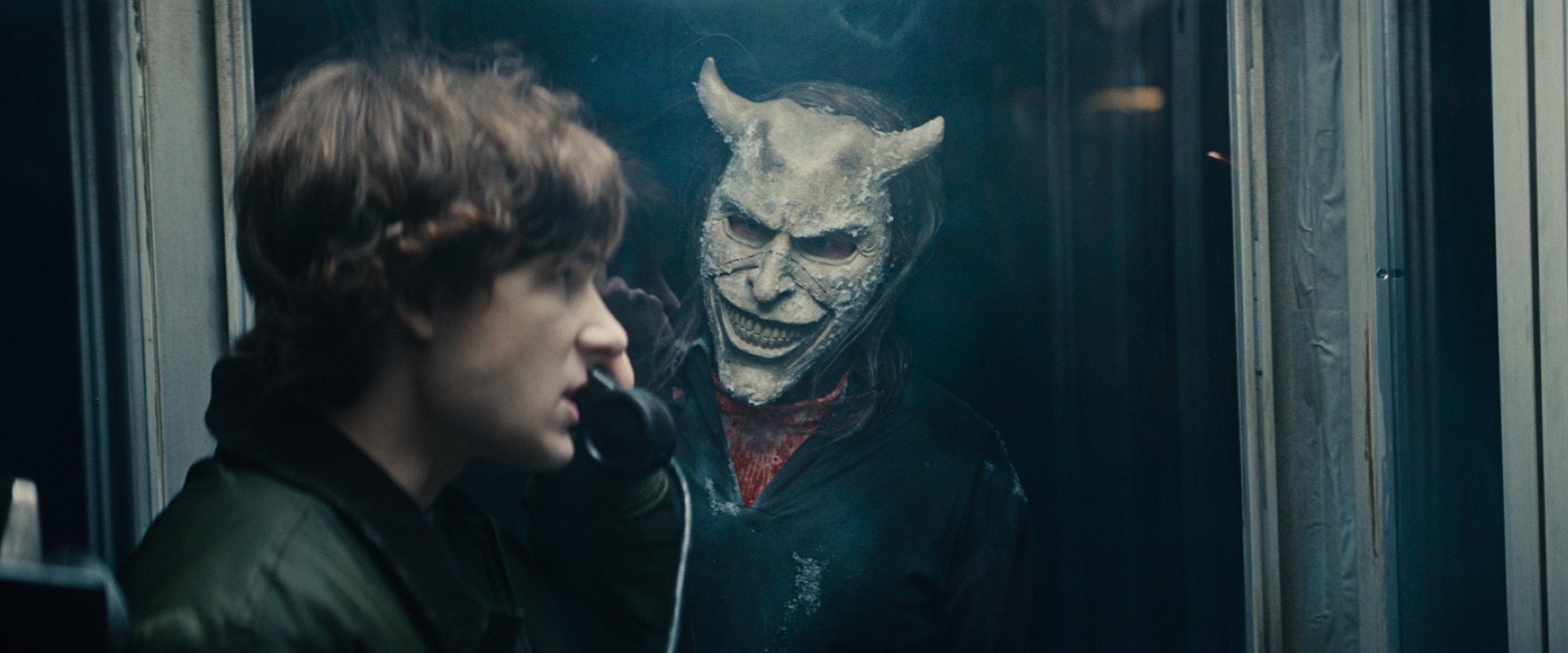
Black Phone 2 (2025)
Dead is just a word.
Four years after Finney Blake seemingly ended the reign of the Grabber, Black Phone 2 picks up in 1982 with a lingering question: can evil really die? Finney (Mason Thames) is now a brooding high-schooler wrestling with the trauma of his past, while his psychic younger sister Gwen (Madeleine McGraw) begins receiving haunted dream-calls from the black phone — visions of three boys who were stalked and killed in 1957 at Alpine Lake, a remote winter camp. Gwen persuades Finney to journey to that snowy site, where they become ensnared in a dark vortex of supernatural menace: the Grabber (Ethan Hawke), though dead, returns in spectral form — far more dangerous in death than he ever was in life. Together, they must confront not only the killer’s evolved threat but also the emotional legacies binding them, and ultimately wrestle with whether vengeance, memory, and faith can save or condemn them.
Scott Derrickson, returning as both co-writer and director, expands the small-scale dread of the first film into a chilling, winter-bound nightmare that feels both indebted and independent. Where The Black Phone (2021) worked primarily as a claustrophobic, basement-based horror with ghostly voices over a disconnected receiver, here Derrickson opens up the world to dream logic, snowbound isolation, and surreal atmospherics. He clearly relishes the freedom of moving the story from suburban captivity to Alpine Lake’s chilly expanses, but even within that shift he retains a moral core and a hallucinatory visual poetry.
One of the most striking elements of Black Phone 2 is Derrickson’s command of the dream and nightmare sequences, which look and feel completely separate from the film’s waking world. Shot with a Super 8 aesthetic — grainy, flickering, and bleached at the edges — they evoke the home-movie unease Derrickson first explored in Sinister (2012) and the original Black Phone. The effect is tactile and hypnotic, as if these visions were recorded on haunted film stock pulled from memory itself. There’s a clear Nightmare on Elm Street influence in how the Grabber invades Gwen’s sleep and warps the logic of her reality. In these sequences, the imagery turns dreamlike and grotesque — echoing phones, phantom children, landscapes that seem to shift beneath her. Derrickson blurs memory, time, and haunting into a single fevered continuum, giving the sequel a distinct, hallucinatory rhythm. The Grabber becomes almost Freddy Krueger-esque: no longer a mere abductor confined to a basement, but a revenant force capable of invading dreams, distorting time, and terrifying across the barrier of sleep.
Just another friendly reminder to let it go to voicemail.
At its core, though, Black Phone 2 remains a story about family, trauma, and spiritual reckoning. Gwen’s psychic connection to the phone transcends the idea of a simple gift or curse; it becomes a legacy tied to her mother — who once worked as a counselor at the Alpine Lake camp — and to a past that refuses to stay buried. Finney’s volatility and detachment hint at survivor’s guilt and repressed fear, and Mason Thames wears that weight with conviction. His Finney is no longer the resourceful teenager of the first film, but a haunted soul pushed to the edge. Madeleine McGraw, meanwhile, steps forward as the emotional anchor: Gwen is no longer the secondary sibling, but the one whose gift — and burden — might hold the key to the terror itself. The dynamic between them tightens: love, resentment, guilt, and protection intertwine in a shared nightmare that feels deeply human beneath the horror.
The supporting cast adds texture without stealing focus. Demián Bichir brings gravitas as Mando, the supervisor at Alpine Lake Camp, grounding the adult world with quiet authority. Jeremy Davies returns as Terrence, the father of Finney and Gwen — a stabilizing, if fraught, presence in their fractured lives. Miguel Cazarez Mora, transitioning from his role in the first film, plays Ernesto, Gwen’s high school friend and tentative love interest, providing both emotional support and moments of comic relief as her visions intensify. Arianna Rivas joins as Mustang, Armando’s niece, adding another thread of connection to the camp’s human element.
Derrickson hasn’t merely re-shot The Black Phone with snow; he’s taken the germ of its mythology and stretched it into something richer. Thematically, Black Phone 2 is less about the horror of abduction and isolation than about the persistence of evil, the power of memory, and the horror of faith under siege. There’s a quiet religious undercurrent — unsurprising given Derrickson’s long interest in spiritual horror — that treats faith and salvation as real, serious forces within the story rather than symbolic gestures, even as the film remains genuinely frightening. The Grabber increasingly becomes a bottomless pit of sin and vengeance, likening himself to infernal forces, while Gwen and Finney’s struggle plays out as much a spiritual trial as a fight for survival.
Visually, the film is gorgeous in its cold, crystalline dread. Cinematographer Pär M. Ekberg sculpts snow and shadow into crisp, moody compositions, letting the white void feel as menacing as the darkness. The palette shifts restlessly — warm interiors, glowing red heating rods, bleeding edges in dreams, and drifting snowfall that seems to whisper. Amid this stark beauty, Derrickson doesn’t shy away from brutality: the violence is sharp, shocking, and very bloody, splashing against the film’s pale winter canvas like fresh wounds. Across its frozen cabins, flickering lanterns, and spectral silhouettes, Derrickson channels a distinctly 1980s aesthetic — woodgrain, retro tones, and analog distortions that give Black Phone 2 a tactile, throwback texture. Combined with the coarse grain and pulse of its horror imagery, the film often feels like an unearthed 1983 midnight movie — haunted, breathing, and alive.
Where the film occasionally falters is in its pacing and structure — the connective tissue between acts sometimes feels loose, and a few emotional climaxes resolve a little too neatly to fully land. Additionally, some of the supernatural rules surrounding the Grabber feel inconsistent. The film introduces an intriguing dream-logic framework, with the Grabber returning as a vengeful spirit who attacks through visions and nightmares. However, the boundaries between dream and reality often blur to the point where the internal logic becomes muddled — at times, he appears to cause physical harm outside the dream world without clear explanation. Still, these are forgivable blemishes in what is otherwise a solid expansion of the original’s mythology. The film’s ambition, atmospheric texture, and willingness to push deeper into its supernatural elements more than compensate, propelling the story forward with energy and purpose.
As a horror sequel, Black Phone 2 does what so many follow-ups fail to do: it extends rather than repeats. Derrickson deepens the mythology, pushes his characters into unfamiliar terrain, and embraces nightmare logic with confidence and emotional clarity. His use of dream sequences feels artful rather than gimmicky, and the film’s subtle homage to A Nightmare on Elm Street — particularly in the Grabber’s dream-invader motif — adds texture without imitation. Derrickson reaffirms himself as one of modern horror’s boldest voices, fusing visceral tension with spiritual unease. Black Phone 2 stands as both a chilling evolution of the original and a winter nightmare — a sequel that answers the call of the original and turns it into something even darker and more assured.
3.5 / 5 – Great
Reviewed by Dan Cachia (Mr. Movie)
Black Phone 2 is currently streaming on Universal Pictures Australia