By
By 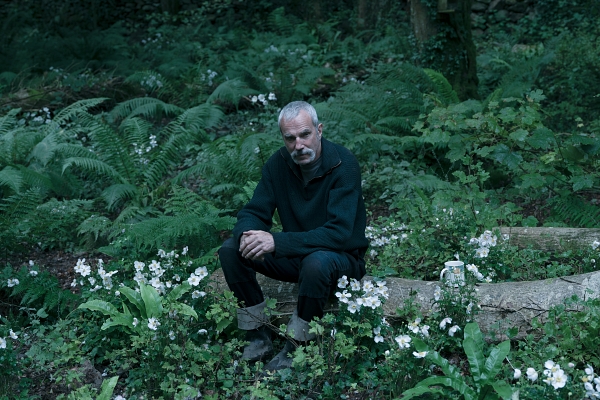
At first glance, Anemone, the debut feature from Roman Day-Lewis, seems like it’s lured one of our greatest living actors out of retirement for a dull nepo baby art project: all slow-moving plot and impressionist stylings. The early scenes consist almost entirely of people sitting silently in rooms, saying nothing; their silence doing the heavy lifting. As the plot drags on – pacing is not exactly Day-Lewis Jr.’s strong suit – the story gradually blooms into something hauntingly resonant: a ghost story about a man who abandoned his life, leaving behind a pregnant wife and unborn son. This dereliction of familial duty lingers more heavily the deeper we get to know Ray (Daniel Day-Lewis)and what drove him to leave behind a full life and take to the woods. The hostile Irish landscape, with its undulating trees, whipping winds, stormy clouds, crashing waves, and borderline apocalyptic weather, becomes a character unto itself: a tempest threatening the authority of the almighty. It is here that Ray has lived in isolation for over twenty years.
The film opens with a child’s illustration: raining skies, Irish and English flags, and bloodied bodies. It sets the somatic center of Anemone, a film about fathers and sons, about what we inherit through blood, and the cost of violence and revolution. That revolutionary spirit, once prized for its promise, curdles into something grotesque, pitiful, and shameful. This is where we meet Brian (Samuel Bottomley). He’s returned home with bloody knuckles, having nearly beaten another man to death, and rotting in bed. He’s abandoned his post, and his surrogate father, Jem (Sean Bean), decides it’s time to track down Brian’s biological father, his brother Ray, in the hopes that finally meeting him might dislodge some deep-seated anxiety about his place in the world. When Jem first arrives at Ray’s off-the-radar cabin in the woods, he’s met not just with silence, but a silence dripping with hostility. It’s clear there’s bad blood between these brothers, but more than mere resentment, there’s a heavy, unspoken something or perhaps several somethings. Jem is quietly religious; he prays before meals and carries his faith with quiet consistency. Ray, on the other hand, views such gestures with a kind of condescending detachment, as if religion were a relic of someone else’s weakness. Religion runs quietly throughout Anemone, often channeled through the natural world, where the landscape itself becomes both sanctuary and reckoning.
The film takes its time unpacking these tensions. The patience required is, frankly, a bit much. I found the first hour or more to be an exhausting exercise in atmospheric brooding. But as Ray’s layers begin to peel back, thanks in large part to Daniel Day-Lewis’s phenomenal performance, the film gradually gathers emotional heft. He elevates every scene, every moment, every glance, with a kind of effortlessness that will be sorely missed if he vanishes into retirement again. And when we finally understand who Ray is and what drove him toward isolation and abandonment, the movie locks into an undeniable thematic power that almost makes the unwatchable stretches feel worth it.
[READ MORE: Our review of ‘Possessor‘ directed by Brandon Cronenberg and starring Sean Bean]
While the bulk of the film rests on the tension between Ray and Jim, we also get occasional asides to Brian and his mother, Nessa (Samantha Morton). At first, these scenes feel like narrative parentheticals, emotionally adjacent but not quite essential. But they gradually bloom into something more substantial and we see the connection through father and son. Both performances are quietly affecting, with Morton especially grounding the film in something raw and maternal.
There’s also something low-key special about the fact that Anemone was written and directed by Roman Day-Lewis and stars his famously elusive father. This is, after all, a film about fathers and sons, but more crucially, about absent fathers. I admittedly haven’t read much into the behind-the-scenes of why Roman wrote this film (I try to write from my experience of the film itself rather than the intention and background of the film), but it’s hard not to wonder if there’s some therapeutic shadow-work going on here, the kind of cinematic exorcism only a world-famous father and his artistically inclined son could attempt. Though I’m not suggesting Daniel Day-Lewis was an absentee dad or anything, there’s something undeniably provocative about a son directing a film about fatherly absence, starring his own father, about a son who can’t move on because of that very absence. That duality hits.
In the end, I found more to admire in Anemone than to dismiss, even if getting there tested my patience. On one hand, the end result felt impactful, but it’s also admittedly a slog getting there. Scenes drag to the point where I found myself checking my watch repeatedly, yet by the end, I felt like I’d earned something by sticking with it. The statement of it all wasn’t lost on me. Something did sink in. Now will most casual moviegoers have that same experience? Probably not. This isn’t something I’d recommend to the casual AMC attendee as Day-Lewis’ debut has very little mass appeal. But for those with a taste for impressionistic, art-house slow burns, it’s worth a shot. Even if it’s only to see DDL in theaters one last time.
CONCLUSION: It takes its sweet, brooding time, but ‘Anemone‘ eventually lands somewhere potent. Daniel Day-Lewis, of course, makes the journey worthwhile, proving again why he’s widely considered the GOAT.
B-
For other reviews, interviews, and featured articles, be sure to:
Follow Silver Screen Riot on Letterboxd
Follow Silver Screen Riot on Facebook
Follow Silver Screen Riot on Twitter
Follow Silver Screen Riot on BlueSky
Follow Silver Screen Riot on Substack
The post ‘ANEMONE’ Flows Into Something Poignant, Eventually appeared first on Silver Screen Riot.