By
By 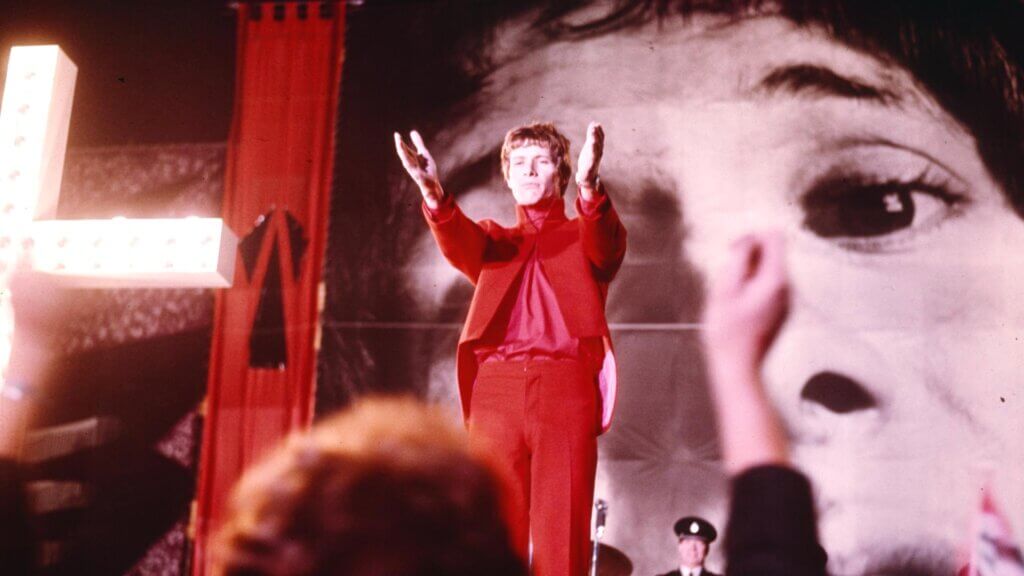
This article contains major spoilers.
Dystopian films are often treated as a collection of recognizable images: surveillance cameras, brutalist architecture, militarized police, overcrowded cities, and citizens dressed in identical clothes. Those images can establish a mood, but they do not define the genre. A ruined society is not necessarily dystopian, and a film does not become philosophically interesting merely because its future looks unpleasant.
The more important question is how an unequal social order sustains itself. Dystopia begins when violence becomes organized, justified, and absorbed into ordinary life. A government may punish dissent directly, but it can also regulate behavior through employment, entertainment, education, religion, consumer pleasure, or the distribution of social status. The most effective systems do not need to terrorize every person at every moment. They teach people to anticipate what power wants and adjust themselves accordingly.
Gregory Claeys associates political dystopia with fear, isolation, and social arrangements that weaken solidarity (Claeys, 2017). Michel Foucault’s account of disciplinary power helps explain why schools, prisons, clinics, and workplaces recur so often in dystopian fiction: these institutions train people to become observable, useful, and compliant (Foucault, 1995). Gilles Deleuze extends the problem beyond enclosed institutions by describing forms of control that operate continuously through markets, information, access, and debt (Deleuze, 1992).
These ideas provide the criteria for this list. Each film depicts a society in which power is systematic rather than merely personal, control shapes everyday behavior, and the dominant order presents its own violence as necessary, rational, or beneficial. This excludes many excellent post-apocalyptic films in which institutions have simply disappeared. It also excludes the familiar titles that dominate most lists of dystopian films. 1984, Brazil, Blade Runner, Gattaca, Children of Men, Snowpiercer, and The Hunger Games have already received extensive attention elsewhere.
The twelve selections below are less predictable, but each film earns its place by identifying a distinct mechanism of social control. Several also complement my lists of Marxist films for philosophy students and films about human nature and technology. The entries appear in chronological order and are not ranked by quality.
1. Privilege (Peter Watkins, 1967)
Mechanism of control: celebrity, propaganda, and managed rebellion
Steven Shorter is the most popular singer in Britain, but his apparent influence belongs to the institutions managing him. His concerts manufacture youthful rebellion as a controlled spectacle. Fans are invited to scream, resist, and identify with his persecution, yet every emotional response has already been anticipated by the corporations and government officials shaping his public image.
The system eventually converts Steven from an imprisoned rebel into the face of a religious-nationalist campaign. Commercial media, organized religion, advertising, and the state do not compete for authority; they coordinate their messages. Celebrity culture becomes politically useful because it gives institutional power an intimate human face. People who might distrust a government can still love a performer.
Privilege is especially valuable because it does not imagine propaganda as a crude lie imposed on a passive population. Steven’s fans experience real desire and excitement. The manipulation occurs through the organization of those feelings. Even dissent is permitted as long as it can be packaged, sold, and redirected toward conformity. Peter Watkins therefore anticipates a form of control in which authenticity itself becomes a managed resource (Scovell, 2017).
The film’s central insight is that mass culture does not have to eliminate rebellion. It only has to decide what rebellion looks like, provide an approved object for it, and make every alternative difficult to imagine.
2. The Year of the Sex Olympics (Michael Elliott, 1968)
Mechanism of control: entertainment, audience measurement, and political apathy
Originally broadcast as a BBC television play, The Year of the Sex Olympics imagines a society divided between the “high-drives,” who control government and media, and the “low-drives,” who constitute the audience. The ruling class keeps the majority passive through an endless stream of sex, humiliation, food, and spectacle. Repression has been redesigned as programming.
The television executives do not simply broadcast what they want people to watch. They monitor audience reactions and refine their output accordingly. When an accidental death produces unusually strong engagement, suffering becomes the model for a new reality program. A family is placed on a remote island for the “Live Life Show,” and danger is introduced whenever ordinary survival no longer generates enough excitement.
The film is regularly described as a prediction of reality television, but that description understates its political argument (Bass, 2020). Its real subject is a feedback loop between power and appetite. The audience’s reactions appear to guide production, creating the impression that viewers are getting what they want. Yet the available desires have already been narrowed to consumption, voyeurism, and momentary stimulation.
There are no telescreens ordering the population to obey. People remain politically harmless because the screen supplies a continuous substitute for participation. The result is a dystopia in which freedom of choice survives only as the freedom to select among distractions.
3. Punishment Park (Peter Watkins, 1971)
Mechanism of control: emergency law, criminalized dissent, and media spectacle
In Punishment Park, the United States has responded to political unrest by invoking emergency powers. Antiwar activists, organizers, and other supposed threats are brought before civilian tribunals. They may accept lengthy prison sentences or choose “Punishment Park,” a desert course where they are promised freedom if they can reach an American flag before armed officers capture them.
Calling this arrangement a choice gives arbitrary state violence a procedural appearance. The defendants may speak, but the tribunal has already classified their politics as dangerous. They may select the desert, but the police control the terrain, water, rules, and interpretation of events. Due process survives as a performance whose conclusion is effectively decided in advance.
Watkins films the action as a documentary, placing a camera crew beside prisoners and police. This complicates the status of witnessing. The presence of reporters does not restrain the authorities; it can help transform punishment into evidence that the system is functioning. Images of state violence become part of the official record without necessarily producing accountability. The film’s mobile camerawork gives its fictional detention system the immediacy of sanctioned violence observed in real time (Mitchell, 2016).
Unlike dystopias built around secret police, Punishment Park shows a state that wants its legal vocabulary to remain visible. Power is most secure when persecution can be described as public safety and unequal coercion can be described as a fair choice.
4. Dead End Drive-In (Brian Trenchard-Smith, 1986)
Mechanism of control: carceral comfort and the management of surplus populations
After Crabs and Carmen drive into the Star Drive-In, the wheels are stolen from their car, and they discover that the cinema has become a detention center for unemployed young people and social outsiders. Police guard the exits, but daily life inside does not resemble the familiar austerity of a prison. The detainees receive food vouchers, drugs, music, films, and a community organized around consumption.
This relative comfort is the institution’s most effective barrier. The government has isolated a population it considers economically unnecessary, then supplied enough pleasure to weaken the desire to leave. Some detainees even treat Crabs’s escape attempts as irrational. Confinement has become familiar, while freedom promises uncertainty and deprivation.
The drive-in is therefore more than an inventive location. It joins two spaces that are usually treated as opposites: the prison and the leisure complex. Junk food, exploitation films, and subcultural style do not liberate the inmates from the state. They form the culture through which captivity becomes tolerable. The government also encourages conflict between existing detainees and newly arrived immigrants, redirecting anger away from the institution that confines both groups (Nette, 2015).
Dead End Drive-In asks how much force a state actually needs when it can combine exclusion with entertainment. Its answer is uncomfortable: a locked gate becomes harder to challenge when the people behind it are given reasons to stop imagining an outside.
5. Sleep Dealer (Alex Rivera, 2008)
Mechanism of control: borders, remote labor, and corporate ownership of infrastructure
Alex Rivera’s Sleep Dealer imagines a future in which the United States has sealed its border while continuing to depend on Mexican labor. Workers in Tijuana receive implanted nodes that allow them to control robots operating north of the border. Their labor crosses freely; their bodies do not.
Memo Cruz becomes one of these “node workers” after a corporate military system destroys his family home. He can weld steel on an American construction site without gaining wages, rights, mobility, or membership in the society benefiting from his work. The technology appears to overcome geography, but it actually perfects the unequal border. Employers receive productive labor without accepting responsibility for the laborer’s health, family, or political claims (Silverman, 2008).
The same infrastructure connects outsourced work, privatized water, drone warfare, and commercialized memory. The film does not locate power in a single dictator or machine. Control emerges from several systems that reinforce one another: corporations own essential resources, borders sort bodies by value, and networks extract work at a distance.
Sleep Dealer reverses the optimistic language of global connection. A network can link two places while preserving—and even intensifying—the hierarchy between them. The question is not whether technology brings people closer, but who is allowed to move, who remains fixed in place, and who profits from the connection.
6. Advantageous (Jennifer Phang, 2015)
Mechanism of control: economic pressure, gendered employment, and bodily commodification
Gwen Koh works as the public face of a biotechnology company, but her employers decide that she is no longer young or “universal” enough to represent the brand. To preserve her income and secure her daughter’s future, Gwen agrees to transfer her consciousness into a younger body using the company’s experimental procedure.
No official forces her to accept. This apparent freedom is precisely what makes Advantageous such an effective account of social control. Gwen chooses within conditions structured by unemployment, expensive education, gender inequality, racial branding, and maternal responsibility. The company can describe her sacrifice as personal ambition because the economic system has hidden the coercion inside her available options.
Jennifer Phang’s future is quiet and visually beautiful. Women have not been formally prohibited from public life; they have simply become easier to discard. New technology does not dissolve older hierarchies. It gives employers a new way to make workers responsible for modifying themselves to satisfy the market. Phang has described the film as a female-centered dystopia concerned with how women of different classes respond to pressures produced by a value system designed around male priorities (Heeney, 2015).
The film asks where consent ends when survival requires self-erasure. If refusing a procedure means losing one’s livelihood and a child’s opportunities, the language of individual choice conceals more than it explains.
7. Level 16 (Danishka Esterhazy, 2018)
Mechanism of control: disciplinary education and internalized femininity
The girls confined inside the Vestalis Academy are taught that obedience, cleanliness, patience, and modesty will prepare them for adoption. Their days are divided into lessons, medication, skin care, and surveillance. They are punished for curiosity and encouraged to report one another’s failures.
The institution’s lessons have almost no educational content. The girls are not even taught to read. What appears to be a school is a disciplinary system designed to produce compliant bodies for wealthy clients. Its language of feminine virtue trains the students to interpret resistance as impurity and submission as moral achievement. Esterhazy has connected this structure to the ways girls are taught to accept a subordinate social position rather than imagine themselves as people who might shape society (Kermode, 2019).
Foucault’s concept of the “docile body” is particularly useful in this context. Power operates through timetables, examinations, observation, correction, and repetition rather than constant spectacular violence (Foucault, 1995). The academy’s success depends on making every student participate in her own regulation.
Level 16’s eventual revelation—that the girls are being prepared as sources of youthful skin—makes its metaphor literal. A culture that values women primarily for beauty and obedience does not merely limit what they can do. It teaches them to preserve the very qualities through which other people intend to consume them.
8. Lapsis (Noah Hutton, 2020)
Mechanism of control: gamified labor and algorithmic management
Ray Tincelli enters the “cabling” industry to pay for his brother’s medical treatment. Like other independent contractors, he hikes through forests laying cable for a quantum computing network. The job promises flexibility and entrepreneurial independence, but workers are assigned routes, scored through handheld devices, denied ordinary protections, and pressured by automated competitors that can take their work.
The company rarely needs a supervisor to issue direct commands. Its interface distributes tasks, creates urgency, measures output, and turns competition into an apparently neutral feature of the system. Workers experience exploitation as a series of individualized decisions: accept another route, move faster, maintain a rating, and blame oneself for falling behind.
Deleuze’s account of control is useful because Lapsis is not primarily about confinement. The workers move through open landscapes, yet the network follows them everywhere. Access to income can be adjusted continuously according to data, reputation, and performance (Deleuze, 1992). Freedom of movement coexists with intense economic control.
Hutton has said that the film targets the gamification of labor and the way technology companies use the promise of self-sufficiency to strip protections from independent contractors (Hutton, 2021). Lapsis turns that critique into a deceptively modest dystopia. Its workers are not ordered into a factory, but they must carry the factory’s logic with them.
9. Strawberry Mansion (Kentucker Audley and Albert Birney, 2021)
Mechanism of control: surveillance, taxation, and advertising inside the unconscious
In 2035, James Preble works as a government dream auditor. Citizens record their dreams, and the state inspects those private images for taxable objects. What begins as an absurd extension of bureaucracy becomes more disturbing when James discovers that corporations can insert advertisements directly into dreams.
The film’s handmade effects and romantic fantasy distinguish it from the cold visual language associated with dystopian science fiction. Yet its playful appearance supports a serious theory of power. The unconscious has traditionally represented one of the few spaces beyond direct social supervision. In Strawberry Mansion, even that interior territory has been converted into data, taxable property, and commercial inventory.
Government and corporate power do not remain separate. State surveillance creates the archive that makes commercial intrusion possible, while advertising makes constant monitoring economically valuable. As Erik Luers notes, the film combines dream auditing with a broader critique of government influence over private life (Luers, 2022). The result resembles surveillance capitalism taken to its logical psychological conclusion.
Most dystopias regulate public speech or visible conduct. Strawberry Mansion goes further by asking whether a private self can survive once unchosen commercial messages occupy the imagination. Control no longer stops at determining what people buy. It shapes the desires from which buying decisions emerge.
10. Medusa (Anita Rocha da Silveira, 2021)
Mechanism of control: religious patriarchy, beauty standards, and peer enforcement
Mariana belongs to a conservative Christian community in Brazil. By day, she and her friends cultivate an image of cheerful feminine purity. At night, they wear masks, hunt women they consider sinful, and force their victims to apologize on camera. The young women are both subordinated by patriarchal authority and active participants in enforcing it.
This dual position makes Medusa more complex than a simple story about authoritarian men controlling women. The system distributes its violence. Female friendship, social media, church music, beauty work, and fear of exclusion all become instruments of discipline. The women monitor one another’s appearance and behavior because status within the group depends on performing the correct form of femininity.
The Institute of Contemporary Arts describes Mariana’s sect as repressive and patriarchal, but the film’s most disturbing scenes show how thoroughly that repression has become a social identity (Institute of Contemporary Arts, n.d.). Belonging offers community, aesthetic coherence, and moral certainty. Rejecting the group therefore means losing more than a set of beliefs.
Medusa shows how authoritarian power can reproduce itself without a centralized surveillance apparatus. When people gain recognition by policing others, control becomes intimate and participatory. The system survives because its subjects are offered the minor privilege of deciding who should be punished next.
11. Plan 75 (Chie Hayakawa, 2022)
Mechanism of control: bureaucratic abandonment and coerced “choice”
In Chie Hayakawa’s near-future Japan, citizens aged seventy-five and older may enroll in a government program that provides money, assistance, and an organized death. Plan 75 presents itself as compassionate and voluntary. Its offices are efficient, its employees are polite, and its promotional language emphasizes dignity.
The film gradually reveals that this choice is manufactured by the withdrawal of other choices. Michi is healthy and independent, but she loses her job, struggles to obtain support, and becomes increasingly isolated. The state that makes continued life difficult makes death administratively simple. Financial incentives then allow structural abandonment to appear as an individual preference.
Jennifer Coates argues that the film challenges the tendency to equate aging with decline and asks what society owes people regardless of their perceived usefulness (Coates, 2024). This is the foundation of its dystopia. Plan 75 treats productivity as a measure of personhood, then translates that judgment into a friendly public service.
The film does not need secret executions or visibly cruel officials. Workers can participate while thinking of themselves as helpful, and applicants can comply while believing they remain autonomous. Plan 75 demonstrates how euphemism, convenience, and underfunded alternatives can make coercion almost impossible to locate in any single decision.
12. The Ordinaries (Sophie Linnenbaum, 2022)
Mechanism of control: class hierarchy, censorship, and narrative visibility
The Ordinaries takes place in a world organized by cinematic importance. Main Characters receive color, music, dramatic storylines, and social privilege. Supporting Characters live repetitive lives at the edge of the action. Outtakes are excluded from the official narrative altogether, their voices and images treated as formal defects.
Paula is a Supporting Character training to become a Main Character. Advancement appears possible, but only for people who can perform the emotional conventions expected by the ruling class. Her education does not challenge the hierarchy; it teaches her to seek recognition from it. The closer she moves toward narrative centrality, the more she discovers that the world’s history has been edited to justify existing privilege.
Sophie Linnenbaum uses changes in color, aspect ratio, sound, editing, and genre to make class power visible. As Yun-hua Chen observes, the film’s authoritarian order assigns different cinematic resources to Main Characters, Supporting Characters, and Outtakes (Chen, 2023). Inequality determines who receives the formal qualities through which an audience recognizes someone as fully real.
This makes The Ordinaries an unusually self-aware dystopian film. Political power often depends on controlling representation: who can speak, whose suffering forms a plot, and whose disappearance counts as an event. Linnenbaum literalizes that process by turning narrative attention into a social resource distributed by class.
What These Dystopian Films Reveal About Social Control
The societies in these films do not all resemble totalitarian states. Some retain employment, consumer choice, popular entertainment, religious community, or voluntary government programs. Their citizens are not always forced to obey at gunpoint. They are classified, evaluated, entertained, indebted, isolated, or encouraged to make the “responsible” choice.
This is why power and social control provide a more useful way to approach dystopian films than visual style alone. A society can look clean, colorful, efficient, and even compassionate while systematically narrowing who may speak, work, move, age, dream, or appear as a full person. The violence is often most effective when it disappears into routine.
These hidden gems also complicate the familiar opposition between freedom and oppression. Control rarely eliminates agency altogether. Instead, it organizes the conditions under which agency is exercised. Gwen chooses the procedure in Advantageous. Michi applies to Plan 75. The cablers in Lapsis accept their routes. The women in Medusa enforce their own hierarchy. Each choice is real, but none begins from an equal distribution of power.
The defining question of dystopia is therefore not simply whether people are free. It is who designed the available choices, which institutions benefit from them, and what happens to anyone who refuses to choose correctly.
References
Bass, G. (2020, April 14). 5 ways The Year of the Sex Olympics predicted the way we live now. British Film Institute.
Chen, Y.-H. (2023, April 10). An interview with Sophie Linnenbaum on The Ordinaries. Film International.
Claeys, G. (2017). Dystopia: A natural history. Oxford University Press.
Coates, J. (2024). Ageing, personhood and care in Chie Hayakawa’s Plan 75 (2022). Screen, 65(3), 352–372.
Deleuze, G. (1992). Postscript on the societies of control. October, 59, 3–7.
Foucault, M. (1995). Discipline and punish: The birth of the prison (A. Sheridan, Trans.). Vintage Books. (Original work published 1975)
Heeney, A. (2015, May 2). Advantageous director Jennifer Phang talks bringing feminist sci-fi to the screen. Seventh Row.
Hutton, N. (2021, February 12). What a feminist, anti-colonial science lab taught me about ethical filmmaking. Talkhouse.
Institute of Contemporary Arts. (n.d.). Medusa + Q&A.
Kermode, J. (2019, February 21). On the level: Danishka Esterhazy on telling women’s stories in genre films and Level 16. Eye for Film.
Luers, E. (2022, February 23). Welcome to the dollhouse: Kentucker Audley and Albert Birney on Strawberry Mansion. Filmmaker Magazine.
Mitchell, N. (2016, March 24). Where to begin with Peter Watkins. British Film Institute.
Nette, A. (2015, May 14). 10 great dystopian Australian road movies. British Film Institute.
Scovell, A. (2017, February 28). The 50-year-old British film with a chilling warning for today: Peter Watkins’ Privilege. British Film Institute.
Silverman, J. (2008, January 23). Sleep Dealer injects sci-fi into immigration debate. Wired.
The post 12 Dystopian Films About Power and Social Control appeared first on Philosophy in Film.