By
By 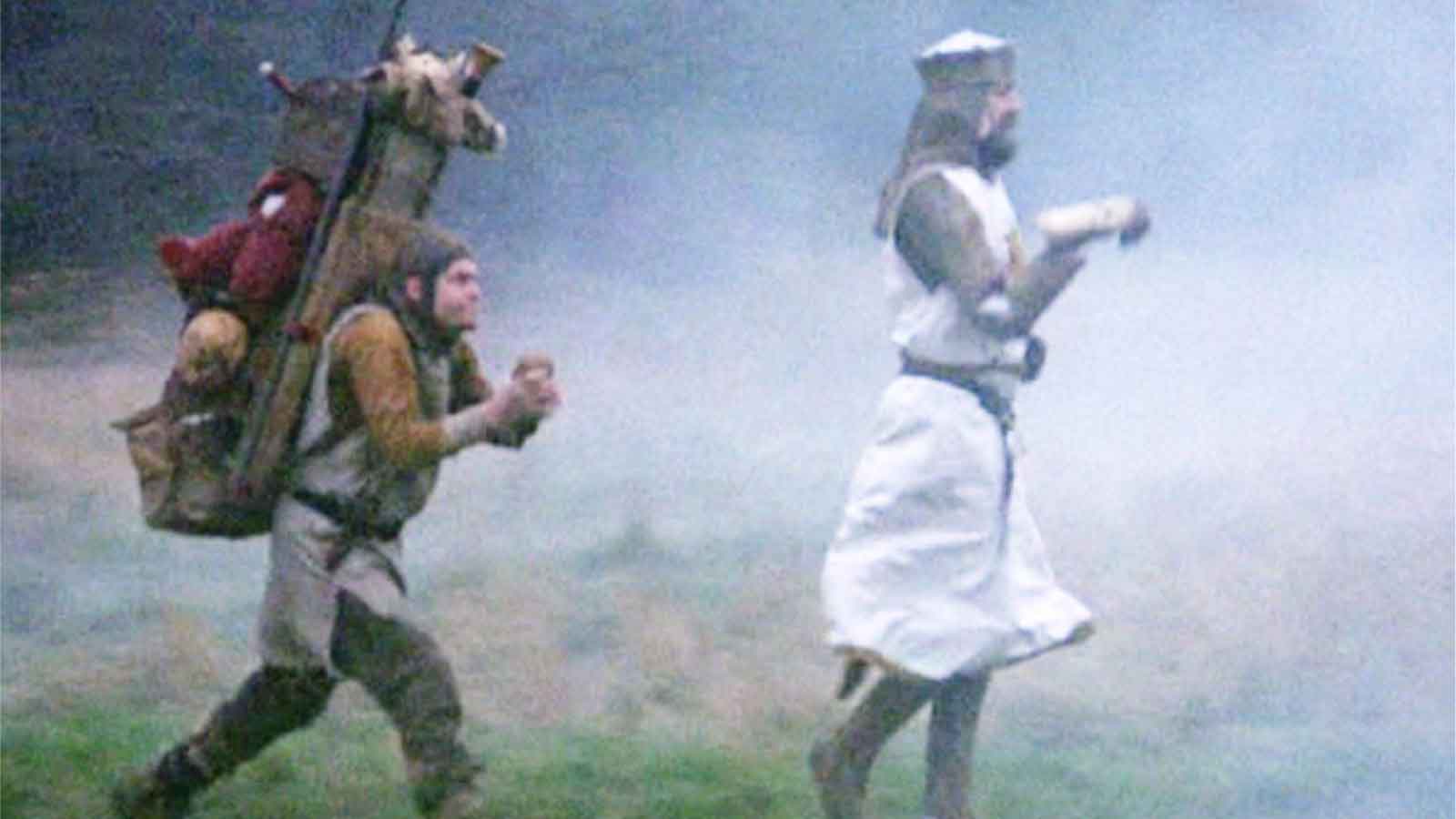
A massive budget can buy elaborate sets, huge crowds, expensive visual effects, and just about any prop a filmmaker could want. Having almost no money, however, can force people to get considerably more creative. Some of the most memorable details in movie history weren’t originally clever artistic choices at all. They were solutions to problems the production simply couldn’t afford to fix properly. A missing crowd made a romantic scene more intimate, cheap household items became unforgettable props, and limitations that could have ruined a movie ended up defining its entire look. Sometimes having fewer resources really does produce better ideas. Here are 15 movie details that only exist because the budget was too small.
Monty Python and the Holy Grail (1975), The Coconut Horses
King Arthur’s knights famously gallop around without any actual horses while servants bang coconut shells together behind them. The Pythons originally intended to use real horses, but the production couldn’t afford them, turning a financial limitation into one of the movie’s most recognizable running jokes.
Halloween (1978), Michael Myers’ Mask
Michael Myers’ blank white face wasn’t created by an expensive Hollywood effects department. The low-budget production transformed an inexpensive Captain Kirk mask by altering its hair, eye holes, and color, accidentally creating one of horror’s most recognizable faces.
Rocky (1976), The Empty Ice Rink
Rocky and Adrian’s first date feels unusually intimate because they’re practically alone at the skating rink. The production couldn’t afford the hundreds of extras needed for a busy rink, so the scene was rewritten around the location being closed, and the limitation ultimately made the moment more personal.
Clerks (1994), The Black-and-White Photography
The monochrome look of Clerks feels like the perfect match for its stripped-down world, but it was largely a practical solution. Kevin Smith couldn’t afford the additional lighting required to properly shoot color film under the convenience store’s fluorescent lights, so black and white became the cheaper option.
Mad Max (1979), Its Rough, Stripped-Down Look
The original Mad Max was made for a fraction of what its sequels would eventually cost, forcing George Miller and his crew to work with limited equipment, vehicles, and resources. Those constraints helped give the movie the raw, dangerous quality that later became central to the franchise’s identity.
©IMDb
El Mariachi (1992), Almost Everything Gets Reused
Robert Rodriguez made his feature debut for roughly $7,000, which meant virtually nothing could be wasted. Props, locations, costumes, and even takes were carefully planned around whatever was already available, giving the movie a resourceful DIY style that became part of its appeal.
©IMDb
Reservoir Dogs (1992), We Never See the Big Heist
For a movie about criminals pulling off a diamond robbery, Reservoir Dogs is remarkably uninterested in showing the robbery itself. Keeping most of the action centered on conversations and confrontations in a warehouse allowed Quentin Tarantino’s low-budget debut to avoid staging the kind of elaborate heist sequence it couldn’t afford.
©IMDb
The Evil Dead (1981), The Homemade Horror Effects
Sam Raimi didn’t have a major studio effects department available for his first Evil Dead movie. The crew relied on handmade makeup, improvised rigs, inventive camera techniques, and inexpensive materials, helping create the messy, unpredictable visual style that fans came to love.
©IMDb
Night of the Living Dead (1968), The Homemade Gore
George Romero’s tiny budget meant expensive special effects weren’t an option. Chocolate syrup and other readily available materials could stand in for blood and gore because the movie was being shot in black and white, allowing cheap tricks to look surprisingly convincing on screen.
The Terminator (1984), The Dark, Industrial Los Angeles
The first Terminator couldn’t offer anything close to the enormous action sequences its sequels eventually would. James Cameron instead concentrated much of the story in nighttime streets, alleys, clubs, and industrial spaces, helping turn a budget-conscious production into a grim, almost horror-like chase movie.
Primer (2004), The Extremely Ordinary Time Machine
There is no glowing portal or enormous futuristic laboratory when time travel is invented in Primer. Shane Carruth made the movie for only a few thousand dollars, so its machine looks like something a couple of engineers could plausibly assemble themselves, which only makes the movie’s science feel more believable.
Saw (2004), The Bathroom
Much of Saw revolves around two men chained inside the same filthy bathroom, a setup perfectly suited to a production working with limited resources. What could have looked restrictive instead created the claustrophobic atmosphere that became one of the defining images of the entire franchise.
©IMDb
Paranormal Activity (2007), The Home-Video Look
Oren Peli didn’t need to construct an elaborate haunted house because he filmed the movie in his own home. Its extremely small budget encouraged stationary cameras, natural-looking interiors, and long stretches of apparently ordinary home footage, all of which made the supernatural events feel disturbingly plausible.
©IMDb
American Graffiti (1973), Cruising the Same Streets
George Lucas couldn’t afford to build an enormous recreation of early-1960s America, so American Graffiti keeps its young characters cruising through a relatively contained world over the course of a single night. Cars, diners, parking lots, and radio music do much of the work, creating a nostalgic atmosphere without expensive spectacle.
Escape from New York (1981), The Fake Computer Graphics
Snake Plissken’s navigation display appears to show computer-generated wireframe images of New York, but creating real digital graphics was beyond the production’s means. The filmmakers instead built a physical model, painted it black, and highlighted its edges so that filmed footage of the miniature looked convincingly computerized.
The post 15 Movie Details That Only Exist Because the Budget Was Too Small appeared first on Den of Geek.