By
By 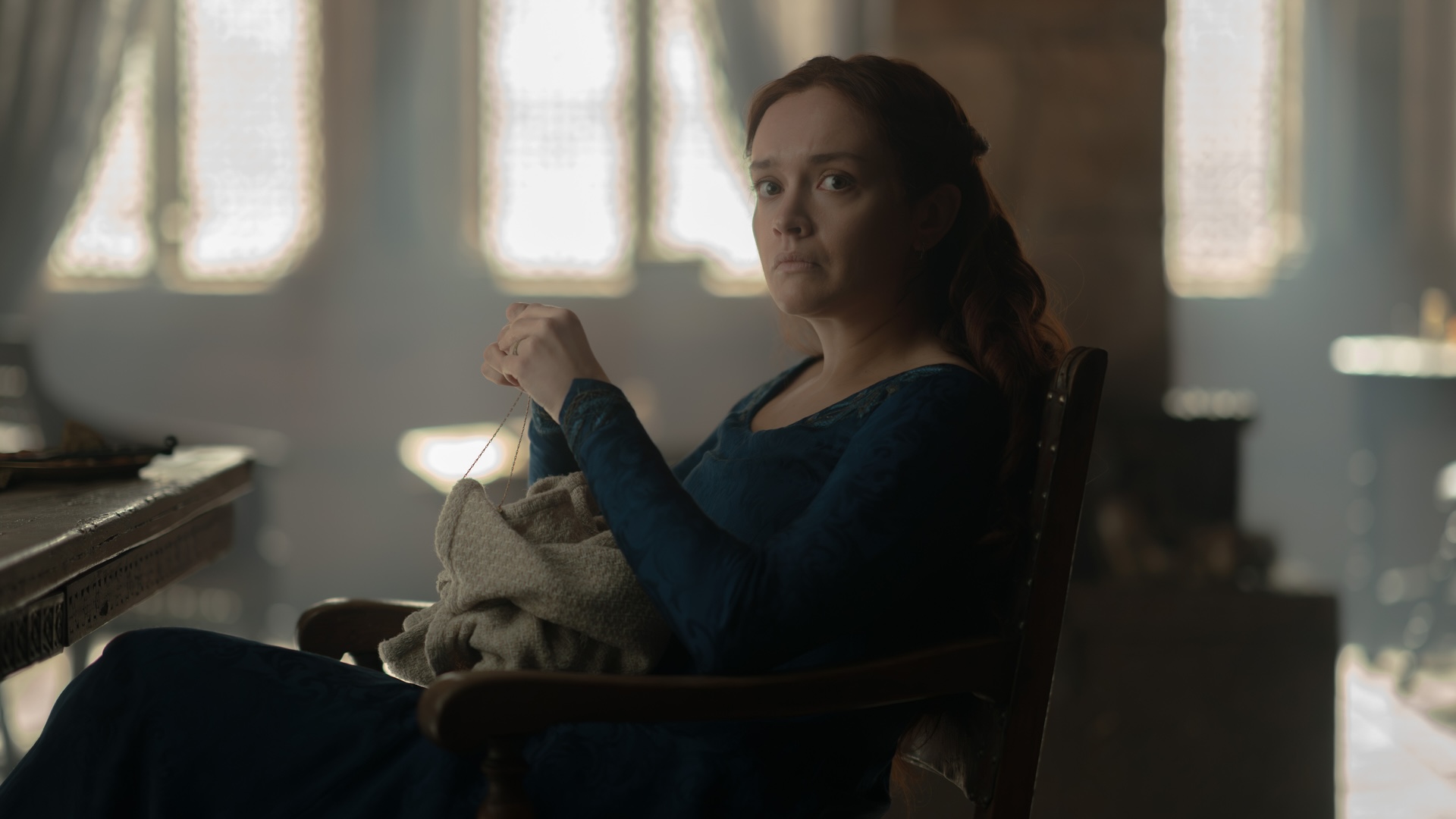
This article contains House of the Dragon season 3 spoilers.
In the last month, I found myself rewatching the first season of House of the Dragon. This was done partially to remember details that four years and a dozen-plus episodes can make hazy. But it was also out of nostalgia for a series that I absolutely adored in its freshman year and that, while I still enjoy, has increasingly come with caveats.
It’s been difficult to put a finger on why, but it crystallized vividly during the seventh episode of season one, “Driftmark.” This was the blockbuster hour where, after being aged into full adults, a lifetime of grievances and slights came boiling to the surface between Rhaenyra Targaryen (Emma D’Arcy), the Crown Princess, and Alicent Hightower (Olivia Cooke), the stepmother queen. In fact, by this time in the series the latter positively seethed with purpose, eager to supplant her former friend with Prince Aegon, Alicent’s eldest boy by Rhaenyra’s father. It is also the episode where, due to the actions of Rhaenyra’s own second son, Prince Aemond, Alicent’s other boy, lost an eye.
It’s that terrible familial calamity which causes everything to come pouring out and the battle lines within the royal household to finally be made clear before our poor, deluded King Viserys (Paddy Considine). There was no more hiding from the decades of resentment on both sides of the divide between the ascending Black Queen and her emerald-hued counterpoint.
“What have I done but what is expected of me?!” Alicent cries as she attempts to extract a literal eye for an eye for her son with a dagger in her hand. “Forever upholding the kingdom, the family, the law while you flout all and do as you please—whereas duty, whereas sacrifice is trampled under your pretty foot again?! Now you take my son’s eye, and to even that you feel entitled!”
Ever since I read Fire & Blood some years ago, I’ve happily been a “Team Black” apologist, if one indeed must have a preference between Rhaenyra and the lad whom Alicent eventually helps crown as Aegon II. But that doesn’t mean the rightful queen’s rivals and opponents must agree that Rhaenyra was usurped and betrayed, or that they are not justified to their own sense of indignation.
In the first season, Cooke got to play a far more nuanced vision of Alicent than what is in the pages of Fire & Blood, which by design is never a full picture of any single character. Author George R.R. Martin wrote the fictional history book from the perspective of a scholar centuries later who must wade through contradictory, biased accounts, while still giving us his own biases as a patriarchal and misogynistic medieval mind. But even with all that context, Cooke’s Alicent is by default a different creation than what Martin could ever suggest between the lines. Some years older than Rhaenyra, the literary Alicent was never the Princess of Dragonstone’s friend or confidant. Nor, as far as we know, did she harbor secret doubts about what King Viserys wanted in his succession. Cooke’s Alicent has more texture, more complexity, than the scheming stepmother. But that also makes her moments of cruelty and ferocious defense of her family’s interests all the more compelling.
The show’s Alicent loved Rhaenyra at some point, sure, but in order to protect the lives of her own children, she had no qualms in the first season about discrediting Rhaenyra’s sons by humiliating the princess and demanding the newborn Prince Joffrey be hand-delivered to the queen’s chambers minutes after the boy’s birth—causing Rhaenyra to walk bleeding and barefoot across the Red Keep. And when Alicent is righteously outraged that her son was maimed by one of Rhaenyra’s boys, the Queen Mother’s back is far too against the wall to see the truth that viewers know (Aemond sought to use a weapon against Rhaenyra’s younger sons first). She’s also far too vindicated by the double standard between Rhaenyra’s agency as a royal heir and her own secondary status as “merely a wife,” to be reasoned with.
In a medieval world where to play the game of thrones means “you win or you die,” taking an impartial macro view of things is a luxury Alicent can ill afford, even when she doesn’t have a slippery father whispering treason in her ear. In House of the Dragon, we are told that Alicent never participated in the palace coup until she misunderstood Viserys’ final words, but even before that moment, she rightly is warning her son that as long as Aegon and his siblings live, they will be seen as a threat to Rhaenyra’s claim.
The show’s rather saintly and good-hearted Queen Rhaenyra (at least in the first two and a half seasons) might seem unlikely to plot the murder of her half-siblings, but her avuncular husband Daemon has no problem going behind her back and using violence to supposedly strengthen her claim. Hence the Blood and Cheese fiasco.
Alicent does horrible things in the first season of House of the Dragon to her former friend and to the realm. One of the painful agonies for her in season 3 is even when daughter Helaena asks why did her mother not entertain other suitors for her hand? Alicent and the viewer know that Rhaenyra offered Jacaerys’ hand in the first season, which would have prevented a civil war, but out of pride and hypocritical condensation, the equally adulteress Alicent could not bear the thought of her daughter marrying one of those bastards.
… It was a tragic folly, but given how the character was presented in that first season, the perspective of a Hightower girl draped in the religious dogma of the Starry Sept of Oldtown would absolutely not want to marry a daughter to a bastard. She’d also be protecting her family by proving Joffrey is another strong, brunet son of Rhaenyra’s. Seven Hells, wanting to maim a child in revenge for her own son being half-blinded is downright reasonable in a world where her king is ready to execute a man who calls the strong princelings bastards.
All of which might be a long way to say that when I came to the moment in the penultimate episode of House of the Dragon season 3 where Alicent was wandering aimlessly around Harrenhal, quivering with fear because she just poisoned and attempted to murder the same exact son on Rhaenyra’s behalf, I couldn’t help but sigh at how precipitously the show had from its first year. The same ferocious-when-provoked mama bear who was ready to blind a child on behalf of her second son is now poisoning him to aid a best friend she feels guilty toward like we’re in a particularly soapy episode of Dynasty.
I understand there are thinly-hplotted rationalizations for how we got to this moment: an increasingly unhinged Rhaenyra ordered Alicent to escort one of the Black Queen’s assassins to Harrenhal in order to kill Aemond, all while the monarch keeps Alicent’s beloved daughter Helaena as hostage. Also at this point, the show has tried its damndest to not only make Prince Aemond repellent to viewers—which isn’t too hard to do after he murders a child over the cliffs of Storm’s End—but also grotesque to his own mother. Hence the out of left field moment this season when he tries to seduce mommy into an Oedipal couch of luxury and damned incest.
Nonetheless, it is nigh impossible to watch the first season of House of the Dragon and the third in the same month, and not conclude Olivia Cooke is playing two different characters. In the first season, she is a conflicted, even tormented, usurper who ultimately takes to heart the patriarchal dogma of her world; so, yes, she puts the needs of her family above all others. In the third season, by comparison, she is a voice of reason and conscience in Rhaenyra’s quickly descending court of decadence, a reasonable and empathetic soul who will do anything to save her daughter from the patriarchy, and her friend from self-aggrandizing lunacy. She’d even rather kill a son than scheme with him to use the biggest dragon in the realm to liberate Helaena and reclaim the security of other family members like Prince Daeron and the oft-forgotten granddaughter Jaehaera.
There are the breadcrumbs of a character arc connecting the two Alicents, but it’s both rapidly contrived and ludicrously modernized. While this is by rights a fantasy series, the best seasons of Game of Thrones and House of the Dragon are rooted in an ancient, medieval worldview that is allowed to have its iconoclasts and rebels—Arya Stark, Brienne of Tarth, Tyrion Lannister—but in the main is rooted by people like Alicent: a person of their times who acts on what is best for them, their house, and especially their children.
Alicent in seasons 3 and 2 doesn’t really seem to do that despite an exquisite performance by Olivia Cooke. She is a woman so tormented by her sense of sisterhood for the woman who once let her son’s blinding go unpunished that she would rather put Rhaenyra’s needs above those of her family. It is the antithesis of not only what we know about Alicent in Fire & Blood, but how she was characterized in the first season. A hackneyed insert scene of Aemond kissing her doesn’t really paper over a character defined by “family,” “duty,” and “sacrifice,” the very words she spits at Rhaenyra in “Driftmark.” Now she is eagerly throwing away those self-identifying touchstones for a childhood bestie whom she turned on 20 years ago and actively undermined nearly every day thereafter.
I feel bad for picking on this one characterization, because Cooke makes incredibly intelligent and subtly arresting choices in her performance. But the writing utilized to get her to the point where she is poisoning Aemond rings as false as Daenerys deciding on an apparent whim to burn all of King’s Landing. The plot strains to justify the intended shock, and the actor is left to pick up the pieces.
It is the most extreme example in a series that has worked very hard until the season 3 finale to keep Rhaenyra’s hands clean, Daemon’s submerged in the filth, and Alicent’s bent and curved in a penitent position as penance for her culpability as a Green woman who put the wants of sons before the needs of daughters.
I like Rhaenyra, I enjoy Daemon from a distance as he guides fans down the primrose path, and I find Alicent to be a hypocrite and tragic woman enamored with her chauvinistic cage. But when all of them spend most of season 3 aware of these dynamics, the series loses the shifting moral ambiguity and nuance of Martin’s world. Whether you’re Team Green or Black, it all begins to resemble a general beige.
With luck the final season will bring back the wide spectrum of morality, culpability, and character nuance that made this Dance so bitterly exciting in the first place. Rhaenyra going the full Henry II on the High Septon is a great start.
The post House of the Dragon Season 4 Needs to Let Alicent Be Alicent appeared first on Den of Geek.