By
By 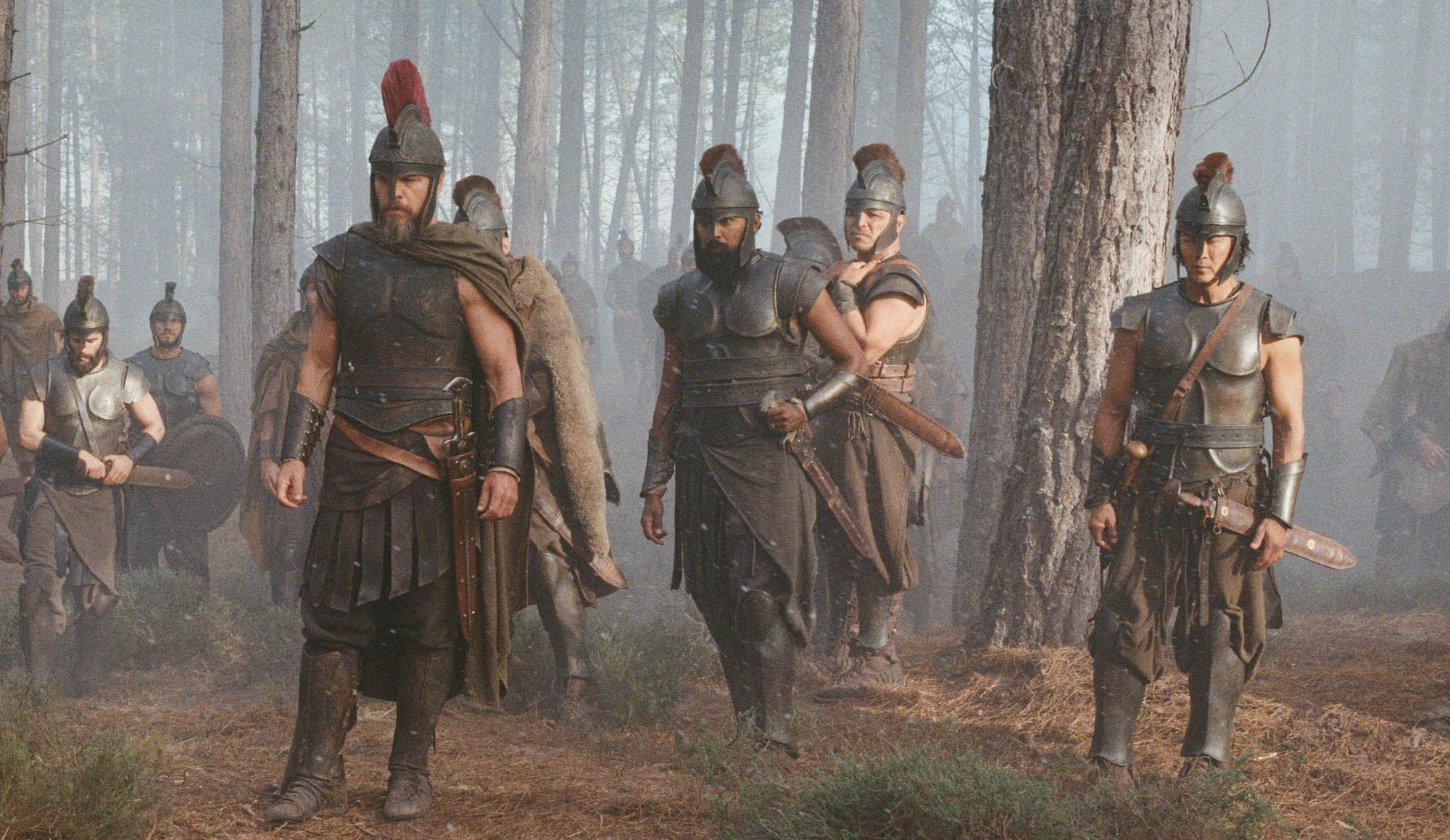
The Odyssey is now officially the highest grossing movie in Christopher Nolan’s career. The filmmaker of Inception, Oppenheimer, and three different Batman pictures capped that milestone Sunday when Odyssey crossed $1.1 billion at the global marketplace, topping a benchmark last set by The Dark Knight Rises 14 years ago.
In one sense, the scale of popularity for this film should not be too surprising. It was long ago when Nolan reached the rare heights of a director who is a brand unto himself. (Think Hitchcock, Spielberg, Cameron.) What is striking, though, is how strongly the movie immediately entered the zeitgeist, triggering headline-grabbing debates among classicists about the film’s interpretation of xenia—the Ancient Greek custom of hospitality called “Zeus’ law” in the movie—and gaining instant frontrunner status in the Oscar blogosphere. More remarkable still is how swiftly the film mooted months of engineered anger, resentment, and outright racism and transphobia that stalked the movie online for months.
To be clear, this is not to say the film is above criticism. Dr. Emily Wilson, whose 2018 translation of Homer’s Odyssey was a major cited resource for Nolan, has been scathing in her multiple critiques of the movie. Yet the highly specific, and loud, echo chamber of hysteria shadowing the film’s prerelease has been largely defanged. Those anticipating a backlash against the film on X, YouTube, TikTok, and other social media apps have ended up looking like dejected politicos, moping at a concession speech party.
This contingent is likely best represented by sometime-trillionaire Elon Musk, who summed up on his X app in March why so many were convinced the movie would fail: “Chris Nolan is an anti-White racist,” he wrote. He then doubled down again last month right before the movie’s release by adding, “Chris Nolan desecrated Homer and groveled on his knees just to meet the woke rules required to win an Oscar.” Musk is definitely the loudest and most powerful of this noxious narrative, but he was champinioning an already thriving chorus of YouTubers and X sycophants outraged at the casting of Kenyan actor Lupita Nyong’o as Helen of Troy and that trans actor Elliot Page appears at all in the movie. In their minds, the vague “wokeness” of the flm could only result in failure.
They were obviously wrong.
And yet, as amusing as that is, we’d argue the limpness of such hateful and narrow-minded interpretations of artists—or really just our fellow men and women in general—has always been a subject on Nolan’s mind. That applies to The Odyssey with its portrait of a man in Matt Damon’s Odysseus who undermined Zeus’ law and thereby helped hasten the decline of civility and civilization itself. But the same lesson can be traced as far back as the film that made Nolan a household name with casual moviegoers, The Dark Knight.
During that Batman movie’s climax, Nolan and his co-writer brother, Jonathan Nolan, orchestrate an elaborate social experiment sequence which pits the bottomless nihilism of the film’s Joker (Heath Ledger) against the Nolans’ interpretation of our shared humanist values. The film’s supervillain, very much coded as both a terrorist in a post-9/11 context as well as the lone shooter (which today might be called an incel), has created a scenario where he expects “innocent civilians” to murder a boat full of convicts to save their own necks. Instead neither ferry explodes, leading to Christian Bale’s Batman to taunt the Joker: “What were you trying to prove? That deep down everyone is as ugly as you? You’re alone!”
The sequence in The Dark Knight feels almost akin to utopian-thinking, particularly in a film that earlier showed more than a handful of Gothamites ready to assassinate a stranger if it might save a loved one in the hospital. But the scene’s core tenets speak both to a recurring optimism about humanity that runs throughout Nolan’s oeuvre, as well as a categorical rejection of the type of vitriolic nastiness that can lead people to seethe in rage at seeing Black, Latino, trans, or otherwise non-white, hetero faces in the media.
None of which is to say Nolan is explicitly political in most of his films. There is in fact a deliberate aloofness to his work that caused some to view the aforementioned Batman trilogy as conservative wish fulfillment—including when The Dark Knight Rises was accused in 2012 of being a smear against the then-prevalent Occupy Wall Street movement, despite the movie having been written and already filming before the first Occupy Wall Street protest occurred. Those Batman movies, much like the concept of superheroes themselves, are certainly supportive of law and order, and the use of authority.
But I’d contend Nolan doesn’t seem as interested in making a capital “P” political statement with his films—be it “woke,” “conservative,” or otherwise—as he tends to engage with what he perceives to be shared and cross-cultural humanist values. The climax of The Dark Knight is not a full philosophical expression about what we need or deserve; it’s a comforting entertainment where the renewal of social order is established by broken systems and institutions working again.
If there is indeed a common political thread throughout Nolan’s work, it’s in the belief that likeminded, well-intentioned people (often with high levels of expertise and credentials) can come together to achieve great things for society. Yes, Batman saves Gotham City, but he does it with a lot of help from public servants and civic leaders, repelling together the forces of chaos and misanthropy; the storyteller similarly mirrors NASA’s mid-20th century national project ambition during the space race when the same agency again pools its resources and the wisdom of experts to save humanity in Interstellar. Meanwhile Dunkirk recounts a pivotal historical moment when thousands of British citizens risked their property, and in many cases their lives, to rescue UK forces stranded in France during the Second World War.
More recently Nolan has turned to WWII again to offer a bleaker flip side to this equation. His J. Robert Oppenheimer saw the great achievement of his work with so many brilliant minds on the Manhattan Project become the possible end of the world. It’s a grim epiphany that carries over to Nolan’s vision of Odysseus as a man with the literal weight of the Bronze Age collapse on his shoulders.
Nonetheless, the twin pole of this recurring theme is a protection of social norms and civilization from destabilizing forces. The Dark Knight Rises wasn’t anti-Occupy Wall Street; it’s an expression of Nolan’s fear of another variation of social collapse. If Joker was the lone gunman, and Batman Begins’ shadowy “League of Shadows” a thin comic book variation on al-Qaeda in the mid-2000s, then Rises’ Bane (played by Tom Hardy) is Robespierre in comic book drag. He’s the populist radical who uses genuine grievances about economic inequality and corruption to his own ends: the literal obliteration of social norms, including by overthrowing political institutions and ushering in authoritarian rule.
The menace of social decline, be it from supervillain terrorists and strongmen, climate change (Interstellar and Tenet), or a very large wooden horse, is the common theme. But this threat is met time and again by the humanist values Batman taunts the Joker with: people generally want to believe in good. As long as they remember their shared values, they can be better than the rage-filled nihilists who would seek to manipulate them, be it in a mob in front of a government building or on X. That carries through in The Odyssey where neither Odysseus or his wife Penelope (Anne Hathaway) forget their values and customs, even as the society around them loses a shared sense of empathy for strangers. Odysseus also breaks Zeus’ law by killing Penelope’s shameless suitors, but order is still restored, at least in Ithaca, when their son Telemachus (Tom Holland) becomes king.
Odysseus and Penelope, meanwhile, find peace by preserving their humanity and belief in “good,” complete with the small comfort that (rather miraculously) Odysseus can foresee how Greek civilization will rise again with a renewed faith in literacy and intellectualism, and in the shared customs that make us a decent society. It’s what keeps us from being so bitterly alone.
The Odyssey is playing in theaters now.
The post The Odyssey’s Wild Success Echoes Core Batman Lesson for Christopher Nolan appeared first on Den of Geek.