By
By 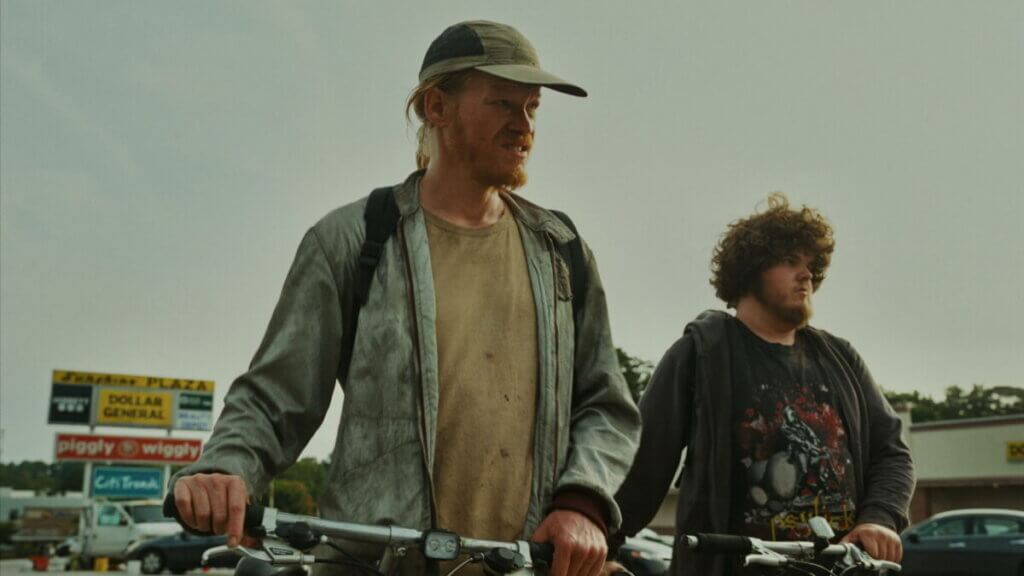
This review contains major spoilers. You’ve been warned!
If you’d like to see the film for yourself, you can stream it at this link.
Yorgos Lanthimos and conspiracy culture should have been a natural fit. Lanthimos built much of his career around closed systems, irrational rules, and characters who accept absurd premises as reasonable. Bugonia (2025), a remake of the South Korean cult film Save the Green Planet! (2003), gives him another world governed by its own warped logic. This time, however, that world feels far more ordinary than the ones he created in the past.
Teddy Gatz (Jesse Plemons) is a beekeeper and warehouse worker who believes that Michelle Fuller (Emma Stone), the CEO of the pharmaceutical company Auxolith, is an alien from the Andromeda galaxy. With the help of his cognitively impaired cousin Don (Aidan Delbis), Teddy kidnaps Michelle, shaves her head, and imprisons her in his basement. He believes her hair allows her to communicate with the other Andromedans, who are supposedly manipulating humanity and contributing to the destruction of the planet.
At first, Teddy’s theory appears to be nothing more than the product of an isolated and deeply unwell mind. The film’s early tension comes less from the question of whether Michelle is an alien and more from wondering why Teddy needs to believe she is one. His mother was left comatose after participating in a clinical trial connected to Michelle’s company, giving his paranoia an identifiable source. He has experienced real suffering, but he has organized that suffering into an elaborate mythology in which every injustice can be traced back to one enemy.
This is where Bugonia is at its strongest. Plemons makes Teddy frightening without reducing him to a generic madman. He speaks with the confidence of someone who has spent years building an internally consistent explanation for everything wrong with his life. Any evidence against his theory becomes evidence that the conspiracy is more sophisticated than he initially believed. As in The Number 23, another film about obsession and conspiratorial pattern-seeking, the protagonist can incorporate virtually any coincidence or contradiction into his belief system.
Stone is equally effective as Michelle, particularly when she begins treating the kidnapping as an extreme corporate negotiation. She studies Teddy, identifies his emotional weaknesses, and changes her approach whenever intimidation or reason fails. Even while chained in a basement, she sounds like a CEO attempting to manage a hostile employee. Her polished language and carefully controlled expressions make her difficult to trust, even though nothing could justify what Teddy and Don are doing to her.
Bugonia (2025)
The interrogation sequences create a slow-burn reversal. We begin by assuming that Teddy is completely delusional, but the film gradually introduces just enough uncertainty to make us wonder whether he has stumbled onto something real. This ambiguity suits Lanthimos, whose The Killing of a Sacred Deer similarly generates horror by refusing to explain the impossible. The difference is that Sacred Deer preserves its mystery. Bugonia eventually decides that ambiguity is not enough.
The film also makes Michelle the perfect target for the current “Eat the Rich” mentality. She is the CEO of a pharmaceutical company, lives in a sterile mansion, delivers rehearsed speeches about corporate responsibility, and has profited from a system that has inflicted tangible harm on Teddy’s family. The film carefully packages her as the human face of institutional greed.
There is nothing inherently wrong with this. Anger toward the extraordinarily wealthy does not exist in a vacuum, and a pharmaceutical corporation harming vulnerable people is all too real. The problem is that Bugonia turns this justified distrust into something suspiciously close to wish fulfillment. Michelle is not simply corrupt, indifferent, or insulated from the consequences of her decisions. She might be something quite literally not human.
This is essentially the conspiracy at the heart of John Carpenter’s They Live: the wealthy elites controlling society are secretly aliens. Yet Carpenter’s film uses that premise as an intentionally blunt metaphor for capitalism and consumer obedience. Bugonia treats the same basic idea as a revelation. What initially appears to be Teddy’s way of transforming complicated social problems into one convenient enemy eventually becomes the objective truth of the story.
This creates an interesting philosophical problem, though not necessarily one the film handles well. Teddy believes something true, but he does not arrive at that truth through a reliable process. His evidence consists of internet research, physical “clues” that prove nothing, personal trauma, and a theory designed to resist falsification. His conclusion happens to be correct, but that does not retroactively make his reasoning rational.
In epistemology, this distinction resembles the Gettier problem, which challenges the idea that a justified true belief automatically qualifies as knowledge. Teddy has a true belief, but its truth feels more like an extraordinary accident than the product of sound justification. He could have accused almost any powerful person of being an alien and used the same circular reasoning to “prove” it.
The film is aware that Teddy is dangerous. His suffering does not absolve him of kidnapping, torture, or murder, and the discovery of his previous victims makes it clear that Michelle is not the first person to be consumed by his theory. Don’s death further demonstrates how conspiratorial certainty can exploit people who are lonely, frightened, and desperate for a world beyond their own.
Bugonia (2025)
Research has connected conspiracy belief with feelings of powerlessness, resentment, social exclusion, and the desire to identify a clear culprit. Teddy embodies nearly all of these conditions. The conspiracy gives him significance. It transforms a powerless warehouse worker into the only man capable of understanding and preventing an interplanetary catastrophe.
But then Bugonia rewards that fantasy. Michelle really is an Andromedan. She returns to her people and orders the extermination of humanity, confirming not only that aliens exist, but that a seemingly human corporate elite has been secretly controlling the fate of the planet. Teddy may be violent, delusional, and wrong about various details, but the film grants him the validation that real-world conspiracy theorists perpetually anticipate: everyone laughed at him, and he was right all along.
This is what makes the ending so unsatisfying. It can be interpreted as an additional layer of irony. Humanity is not destroyed because Teddy was wrong, but because his cruelty convinces Michelle that the species is beyond saving. The powerless man and the powerful CEO ultimately share the same willingness to treat other people as disposable. Teddy reduces Michelle to an alien enemy, while Michelle reduces humanity to a failed experiment.
Unfortunately, the film seems more interested in the spectacle of its revelation than in this moral symmetry. By making the conspiracy real, it inadvertently validates the assumption that social inequality must be the product of a secret, coordinated force. The truth is generally less cinematic. Wealthy people do not need to be aliens to exploit workers, avoid consequences, or make decisions that harm millions. The systems that enable them are already visible.
Lanthimos explored institutional control more effectively in The Lobster, which I previously discussed in relation to human nature and technology in science fiction. That film creates an absurd society to expose the irrational demands placed on human relationships. Its world is bizarre, but its metaphor becomes more revealing the longer we remain inside it. Bugonia moves in the opposite direction. It begins with a recognizable world of corporate exploitation and online radicalization, only to explain it through a familiar science-fiction twist.
There are still elements that work. Plemons and Stone sustain tension through long stretches of dialogue, and Lanthimos finds moments of gruesome comedy in the collision between Teddy’s homemade procedures and Michelle’s corporate composure. The film also understands that conspiracy theories are rarely built from nothing. They often attach themselves to institutional failures and justified distrust.
Yet Bugonia never develops these ideas with the precision of Lanthimos’ best work. It panders to anti-wealth sentiment while also flirting too eagerly with the conspiratorial desire to discover that the world’s most powerful people are secretly inhuman. The premise might have worked as metaphor, but the final revelation makes it unnecessarily literal.
The result is intermittently tense, well-acted, and provocative, but considerably less thoughtful than it believes itself to be. Compared to The Lobster and The Killing of a Sacred Deer, it feels blunt, topical, and strangely eager to reassure the very worldview it appears to criticize.
Bugonia (2025) Movie Rating: ★★ out of 5
If you’d like to watch Bugonia (2025), the film is currently available to stream, rent, or purchase via Amazon.
The post Review: Bugonia (2025), A Disappointing Misadventure From Lanthimos appeared first on Philosophy in Film.