By
By 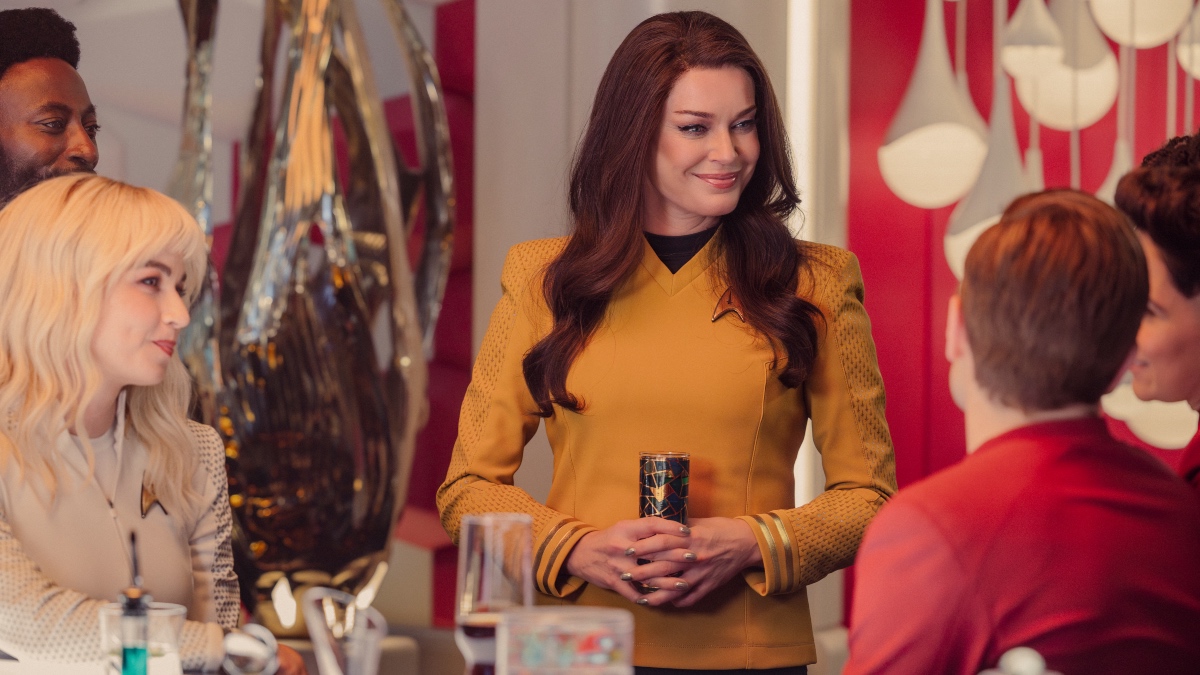
In “Human Best Friend,” the latest episode of Star Trek: Strange New Worlds, Ortegas and Scotty go on a wacky adventure to figure out what happened during an inebriated evening on a pleasure planet. The stakes are low, the gags are broad, and it all wraps up with XO Una Chin-Riley singing “Total Eclipse of the Heart” in Klingon. This after the Event Horizon-inspired horror of last week’s episode “The Griffin Incident,” which, in turn, followed the heady sci-fi of the season 4 premiere “Valles Marineris.”
For Una’s actor Rebecca Romijn, weaving through tones is a sign of the show at its peak. “We were a little caught off guard with season 3 with the strikes some of the staff changes,” she admits at a press roundtable. “I think we all agree that 4 and 5 are the strongest seasons of the series. We continue with some of the genre bending.” That playfulness in style doesn’t just reveal a show at its best, but a rejoinder to the current norms of streaming television.
What are those norms? To find an answer, we need look no further than the series that gave birth to Strange New Worlds, Star Trek: Discovery. Launched in 2017 as the anchor for the service then-called CBS All Access (now Paramount+), Discovery took a familiar franchise and gave it a glossy, modern upgrade, telling a single story about trauma and personal growth over the course of an entire season. Discovery hardly originated those tropes, and although the show grew much better at handling them in its third and fourth seasons, it certainly struggled as much as any other streaming entry.
Streaming and binge-watching has made episodic television all but obsolete. Where Star Trek could once air 24 more-or-less standalone episodes each season, Discovery and other shows told one single story, a bloated movie stretched out into eight-hours and chopped up into unsatisfying segments. The structure forced writers to come up with something like a character arc for each episode, but everything needed to be in service of the big reveal or payoff later on. Thus, seemingly every episode of Discovery asked Michael Burnham to both single-handedly save the galaxy and shed a tear about some memory or trauma, all in the hopes of keeping fans invested until the finale could deal with some multiversal threat.
Strange New Worlds has sometimes been guilty of the same problems (see the ultimate evil the Enterprise faced in season three). And it has carried over storylines across several episodes, especially Spock’s tangled love life and Pike’s knowledge of his fiery fate.
But these long-running stories have been less pronounced than the episodes that standalone. Season 2’s “Ad Astra per Aspera,” still the best Strange New Worlds entry, is a classic philosophical debate in the vein of “Measure of a Man” from The Next Generation, a chance for well-meaning people to consider the merits and problems of Starfleet. Season 2 also gave us the infamous “Subspace Rhapsody,” in which the Enterprise crew finds themselves singing their feelings, and even the weaker third season offered the high sci-fi bottle episode “Terrarium,” in which Ortegas befriends a Gorn.
“I would say that we’ve hit a stride,” declares Christopher Pike actor Anson Mount. “We’re so comfortable in our own machine that we built, and we have confidence in the structure under us now, so that when we play, we really play. Some of the most fun episodes that we’ve ever done are in these next 16 episodes, and they also have some of the highest stakes we’ve ever dealt with.”
For the cast, that means getting to learn skills they never had before. “I was a dancer, but I’ve never done Latin or ballroom dancing before getting on the show,” says Christina Chong, who plays La’an Noonien-Singh, before revealing the type of episode she wished the show could have tackled. “I wanted to visit some kind of underwater world. I pitched that so I could learn how to scuba dive and film underwater, but it never happened.”
“I want to go to a Robocop world, because Robocop is one of my all-time favorite movies,” laughs Spock actor Ethan Peck. “This is a very stupid joke, and it’s not a possibility and it doesn’t happen, so there’s no spoiler there. But that’s my dream. Robocop world.”
It’s hard to think of a modern show so willing to play with multiple genres, where even outlandish ideas such as an underwater planet or a Robocop world would be possible. Only Widow’s Bay, with riffs on Halloween and The Fog, comes close to playing with genres without being an anthology. But as Kirk actor Paul Wesley recognizes, the genre-hopping fits within Strange New Worlds because they hold to the central ethos of Star Trek.
“Every episode has a sense of mission and a sense of purpose,” Wesley observes. “Every time the show explores a world, we’re always wondering how it fits into Trek. And, at the end of the day, the show’s committed to a sense of exploration, imagination, and curiosity. To me, that’s the thing that connects our show and all the episodes, even if they seem off-track.”
Thus, even though it’s limited to seasons of no more than 10 episodes, Strange New Worlds gives viewers a taste of what used to be the norm of Star Trek series before the streaming era. With 24-to-29 episodes to play with each season, The Next Generation could send the crew to play Robin Hood, Deep Space Nine could stop for a ball game in the middle of a war, and Voyager could explore an idyllic Irish romance, all without sacrificing episodes about seeking out new life and new civilizations.
Every week, Strange New Worlds offers a surprise. We never know what genre we’ll get, but we do know it’s always pure Star Trek.
Star Trek: Strange New Worlds streams new episodes every Thursday on Paramount+.
The post Star Trek: Strange New Worlds’ Movie-of-the-Week Approach Is a Streaming Era Bright Spot appeared first on Den of Geek.