By
By 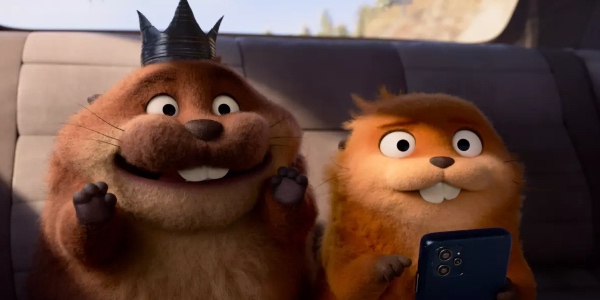
Pixar, for thirty-one years now, has been a leading name in the world of mainstream animated cinema. From their groundbreaking first feature with Toy Story (1995), to most recently Hoppers (2026), they’ve continuously delivered imaginative and family-friendly entertainment with relatable messages. No small part of the company’s history has been Pete Docter, who started as a storyboard artist and received story credit on Toy Story, went on to direct films like Monsters, Inc. (2001), Up (2009), Inside Out (2015), and Soul (2020)– the latter two of which won him Oscars for Best Animated Feature- and currently holds the position of Chief Creative Officer (CCO). But with the controversy sparked by some recent statements he made upon the release of Hoppers, it’s worth it to examine the line between art, politics, and personal morals.
Hoppers and the Perils of Sticking Your Foot In Your Mouth
source: Walt Disney Pictures
So right as Hoppers, directed by Daniel Chong, released in theaters, Pete Docter made the rounds in an interview with The Wall Street Journal, stating that he had LGBTQ+ themes removed from the movie Elio (2025) because, in his words, “We’re making a movie, not hundreds of millions of dollars of therapy”. Pretty hypocritical coming from the director behind those titles I just listed above. Moreover, he went on to claim that “As time’s gone on, I realized my job is to make sure the films appeal to everyone”. Just not LGBTQ+ individuals, it seems.
Why It’s Hypocritical
Regardless of whether or not Docter is homophobic, I don’t even know where to start with these comments. How is Inside Out, the story of the personified emotions in an eleven-year-old’s brain, NOT cinematic therapy? Especially when that kid, Riley, is coping with moving from one state to another? Or what about Soul, a film where an aspiring jazz pianist (Jamie Foxx) ends up in limbo, and realizes his true purpose is as a music teacher? Up was about an elderly widow who struggled to find meaning in life after his wife’s passing. Monsters, Inc. explored the perils of becoming a parent. So why would Docter feel the need to make such comments?
source: Walt Disney Pictures
Similar headlines were made in 2024, right around the theatrical release of Inside Out 2, where the character of Riley found a friend and mentor in an older girl named Val. According to a Forbes article, “One source described the edits as Doing a lot of extra work to make sure that no one would potentially see them as not straight“. This, despite the script not making the characters’ storyline anything more than platonic.
To Taboo and Beyond
source: Walt Disney Pictures
Two years prior to such a ridiculous- really, non-issue which was made into an issue anyway- Disney and Pixar sparked some controversy with a VERY brief same-sex kiss between two female astronauts at the end of Lightyear. When I say ‘brief’, mind you, I mean you could literally blink and miss. All the same, conservative viewers ran with it as a point of ammunition in the broader ‘culture war’. Superstar right-wing podcaster Ben Shapiro slammed the film by critiquing that “Children are not adults. What may be appropriate for adults is not appropriate for children”. Now, Disney, interestingly, allowed this (minor) bit of queer inclusion at the time. Why such a severe course correction from a company that already wasn’t exactly blazing new trails in this department?
Pushback Against LGBTQ+ Rights in the Current US Political Landscape
At a time when the current presidential administration has it out for LGBTQ+ rights at large, this isn’t the moment for cowardice. This isn’t the moment for, say, axing a transgender character from one of your shows, as was done with Win Or Lose . This isn’t the moment to disingenuously claim queer stories are ‘therapy’, especially when your resume includes Monsters, Inc., Inside Out, Up (2009), and Soul (2020). If TV shows such as Love, Victor (2020-2022) and Heartstopper (2022-2026)- which has a feature film finale being released on July 17- can find success and popular/critical acclaim, what’s to stop a series or motion picture from Pixar centered around a queer character from finding such universal praise?
Parting Words
I want to pose a question to Pete Docter for a minute: How would you feel if you were seen as against the norm? Too ‘different’ to be included in mainstream media? How much would it sting if you saw or read about a powerful executive calling stories about someone like you ‘hundreds of millions of dollars of therapy’? Going forward, I challenge you to actually run towards LGBTQ-centered stories instead of away from them. Queer people, and queer youth, deserve to be represented in media like anyone else. I sure know I could’ve saved myself years of agony if I had that in my adolescence.
source: Walt Disney Pictures
We live in a world that has always sought to control whose voices count in media, or if certain minorities are included, then how they were represented. Perhaps the most infamous example of this is the Hays Code, which was put into use in the movie and television industry from 1934 to 1968. The essential purpose of the system was “proscribing graphic violence, criminality, substance use, promiscuity, miscegenation, and homosexuality”, according to a Brittanica article. In other words, the mission of this code was to police what could or couldn’t be depicted in cinema based on the worldview Will Hays, the creator, had.
While that code may not exist anymore, the consistent decision to remove or prevent any inclusion whatsoever of a minority group- in this case, the LGBTQ+ community- and going so public about it, creates a ripple effect. One, it gives the homophobes and transphobes watching Pixar films validation in their vastly bigoted and illegitimate viewpoint. Two, it sends the message to queer people in the audience (especially children) that they are the ‘other’. It perpetuates a cycle of dehumanization and shame around things that are not inherently shameful. Being transgender is normal. So is being gay. So is being bisexual. And so on, and so on. My question for you, Mr. Docter, is simple: Will you have the courage to help change this cycle?
Does content like this matter to you?
Become a Member and support film journalism. Unlock access to all of Film Inquiry`s great articles. Join a community of like-minded readers who are passionate about cinema – get access to our private members Network, give back to independent filmmakers, and more.