By
By 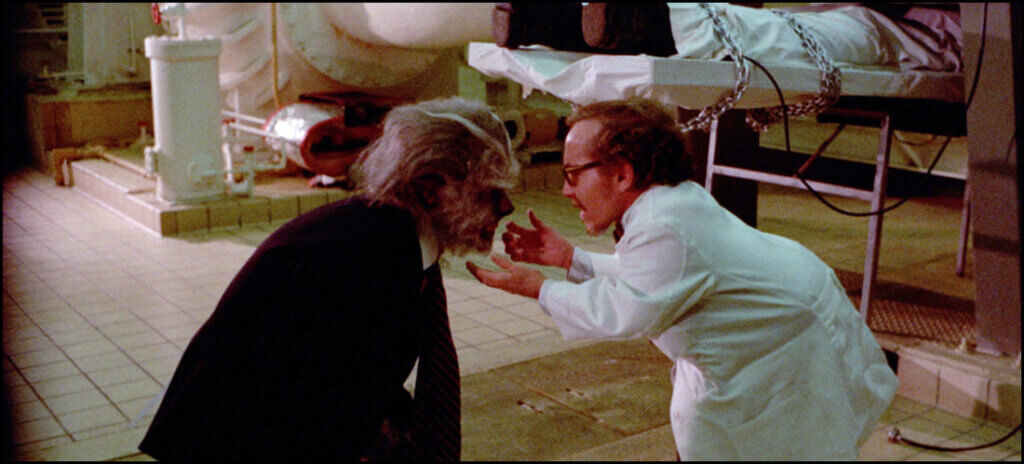
Political satire does not have to be subtle. Dr. Strangelove (1964) doesn’t pull any punches about its stance on militarism and the men entrusted with destroying the world. The Werewolf of Washington (1973) also wants to ridicule powerful men, but it never decides what it wants to say about them. The result is a political horror-comedy with almost no coherent political point.
Written and directed by Milton Moses Ginsberg, the film stars Dean Stockwell as Jack Whittier, a journalist sent to Hungary after having an affair with Marion (Jane House), the President’s daughter. While traveling through the countryside, Jack is bitten by a werewolf. He kills it with a silver-tipped cane, then watches it transform back into a man.
A local woman warns Jack that he will now suffer from the same curse and gives him a protective charm, which he promptly throws away. Jack returns to Washington and becomes a press assistant to the President (Biff McGuire). Before long, the full moon rises, Jack grows some unfortunate facial hair, and bodies start piling up.
There is potential here. Jack works inside a White House preoccupied with appearances, secrecy, and loyalty. A monster hiding beneath the face of an ordinary presidential aide is not a bad metaphor for political corruption. The film was released during Watergate, and the President is an obvious parody of Richard Nixon. Unfortunately, recognizing the target of a satire is not the same as understanding the satire.
The politics make almost no sense. The President behaves less like the leader of a major world power and more like the mayor of a small town. He and his staff become personally involved in local murders and minor issues that would never reach the Oval Office in real life. Despite references to Communism and a meeting with the Chinese prime minister, the entire federal government seems to have one pressing concern: somebody in Washington might be a werewolf.
The Werewolf of Washington (1973)
The political world has no life beyond Jack’s curse. The murders don’t expose a larger system of corruption, nor does the werewolf represent any specific policy, ideology, or abuse of power. It’s just a werewolf wandering around Washington while politicians freak out.
Political films can be broad, angry, and absurd. As I discussed in my list of Marxist films for philosophy students, filmmakers have used everything from montage to science fiction to make complex political arguments. The Werewolf of Washington seems to believe that putting a monster near the White House automatically qualifies as political criticism. It does not.
The film occasionally brushes against a good idea. Jack tries to confess what he has become, but the people around him either refuse to listen or place the President’s needs above public safety. When Jack convinces Commander Salmon (Beeson Carroll) to restrain him during the full moon, the President needs him for an interview, and the precautions fall apart. The government denies the truth because acknowledging it would be inconvenient.
That could have become a sharp comment on institutions protecting themselves. Instead, it gets lost among undeveloped subplots and characters who appear to have wandered in from different movies. I had a similar complaint about The Church (1989), whose political and religious ideas disappeared beneath too many mixed messages. The Werewolf of Washington is even more directionless.
The poor technical quality makes the story harder to follow. Many available versions come from degraded public-domain prints. The picture is faded and murky, but the sound causes the most damage. Dialogue is muffled, and some lines are nearly incomprehensible. I found myself reconstructing conversations from the actors’ expressions, which is not an ideal way to follow an already confusing film.
The Werewolf of Washington (1973)
A 2K restoration of the theatrical version was eventually released alongside Ginsberg’s director’s cut, so a better presentation exists. Without a restored version, however, the film can be exhausting. There’s a difference between the charming roughness of a low-budget production and a movie that sounds as though half its dialogue was recorded from the other side of a wall.
Dean Stockwell does what he can with Jack. His anxious screen presence fits a man who knows he is becoming a monster and cannot convince anyone to take him seriously. The makeup is far less convincing. It resembles an inexpensive recreation of The Wolf Man (1941), complete with furry hands, prominent eyebrows, and ridiculous teeth.
The violence introduces another problem. Jack kills both men and women, but the film does not present their deaths in the same way. Male victims are dispatched quickly or treated as information that moves the plot forward. When women are attacked, the camera lingers. We watch them scream, struggle, fall, and wait for the werewolf to reach them.
Carol J. Clover later described a similar pattern in “Her Body, Himself: Gender in the Slasher Film”: male deaths in horror are often comparatively brief, while female suffering becomes a visual event. The Werewolf of Washington predates the major slasher cycle, but it participates in the same tradition. The werewolf may attack anyone, but the film is more interested in watching women experience terror.
Laura Mulvey’s “Visual Pleasure and Narrative Cinema” offers another useful framework. Mulvey argues that mainstream cinema often positions men as active figures who control the look, while women become passive images placed on display. Jack is simultaneously the protagonist, monster, and figure whose perspective organizes the story. The women are lovers, victims, and bodies placed in his path.
As with the misogynistic characterization I criticized in The Flood (2024), the issue is not merely that bad things happen to women. Horror films need victims. The issue is how the film asks us to look at them. Male death receives little emotional or visual weight, while female attacks are stretched out for fear, excitement, and spectacle. The women’s suffering is meant to be watched.
Marion complicates this reading when she shoots Jack with a silver bullet. She acts, survives, and ends the immediate threat. But one decisive moment cannot undo the film’s pattern. Marion spends most of the story defined by her relationships to two powerful men: her father and her lover. Even when she kills the monster, the political system surrounding him remains unchanged.
The ending contains the closest thing to a successful political statement. After Jack attacks the President and is killed, the White House creates a heroic cover story. During the credits, the President addresses the public, only for his voice to become a growl. Jack may be dead, but the curse has moved into the highest office in the country. Corruption got a promotion, in this case. It’s a good final joke. The problem is that the preceding movie does almost nothing to earn it.
As a side note, The Werewolf of Washington has a respectable place in television horror history. It was one of the earliest movies subjected to the interruptions and jokes on Elvira’s Movie Macabre. Frankly, the film probably benefits from having somebody appear every few minutes to make fun of it.
The Werewolf of Washington is not without curiosity value. Dean Stockwell fans may enjoy seeing him wrestle with cheap makeup and an even cheaper production. But as horror, comedy, and political satire, it fails in roughly equal measure.
In short, The Werewolf of Washington has little staying power. It wants to bare its teeth at the American government, but it never figures out where to bite.
The Werewolf of Washington (1973) Movie Rating: ★½ out of 5
If you’d like to watch The Werewolf of Washington (1973), restored editions are available to purchase on Amazon. For more film reviews like this one, be sure to check out the Philosophy in Film homepage!
The post Review: The Werewolf of Washington (1973), A Political Satire Without a Point appeared first on Philosophy in Film.