By
By 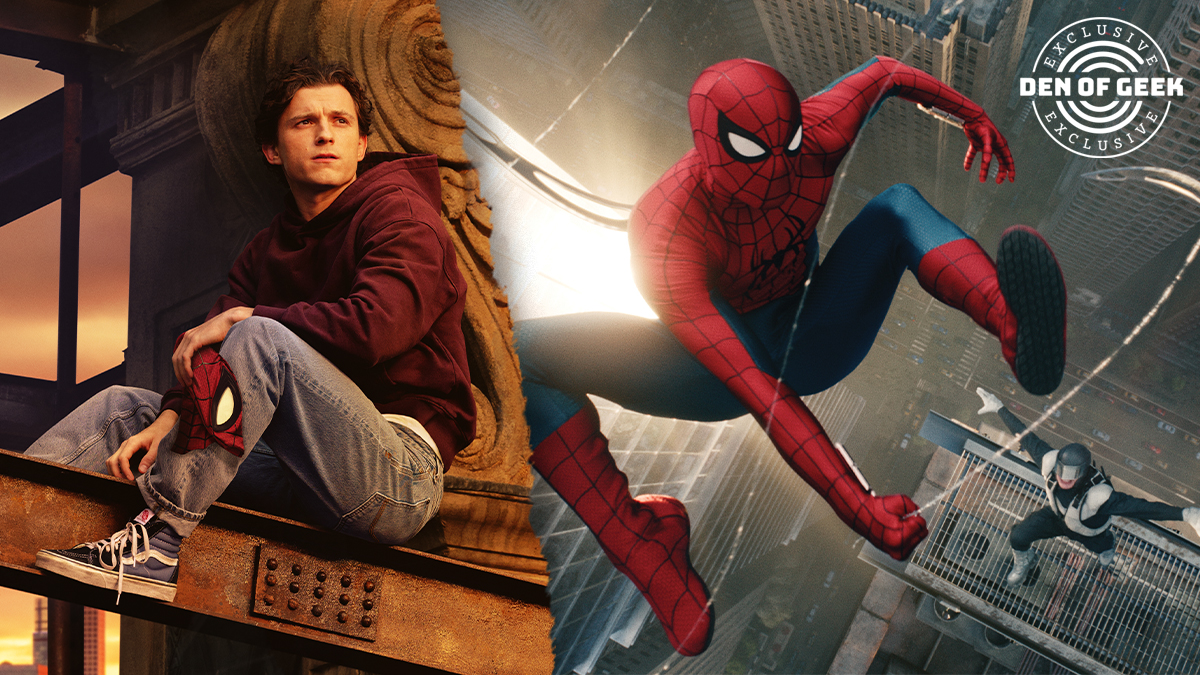
This article appears in the new issue of DEN OF GEEK magazine. You can read all of our magazine stories here.
Almost five full years ago, Spider-Man: No Way Home ended on a triumphant note when Peter Parker swung over Rockefeller Center in a homemade suit. Certainly No Way Home gave Spidey lots to savor in that moment. He’d just defeated the Sinister Six in all but name, cured his arch-nemesis the Green Goblin and got to rub shoulders with Tobey Maguire and Andrew Garfield on their own meta victory laps. Oh, plus, it was also the highest-grossing Spidey flick ever.
Yet for all its success, No Way Home also saw Peter lose both his beloved Aunt May (Marisa Tomei) and his identity as magic wiped the memory of Peter from everyone on Earth, including his best friends MJ (Zendaya) and Ned (Jacob Batalon). To star Tom Holland, those darker points left No Way Home feeling unresolved and the story unfinished. In his core, Holland felt the character still needed a Brand New Day.
“I always felt like Peter got over Aunt May’s death too easily,” Holland tells us. “The loss of Aunt May should be devastating. It should take up the entire third act of the movie. But we were trying to make something fun and exciting, so he meets these two other Spider-Men, the most iconic Spider-Men. We couldn’t have Tobey and Andrew having the time of their lives while my character’s crying all the time. It wouldn’t have worked.”
For that reason, Spider-Man: Brand New Day, directed by Destin Daniel Cretton, is not just a new beginning; it’s an expansion on the lingering traumas of a Peter we’ve watched grow across six movies. In between dealing with baddies like Scorpion (Michael Mando) and Tombstone (Marvin Jones III), teaming the Punisher (Jon Bernthal) and the Hulk (Mark Ruffalo), reuniting with MJ and Ned, and dealing with a mysterious newcomer played by Sadie Sink, Peter has to work on himself.
As Holland puts it, “Brand New Day deals with some of those things we had to gloss over in No Way Home.” In short, Peter Parker is finally finding the time to grow up.
Caught in a Dark Web
Peter Parker didn’t just lose his friends and his aunt in No Way Home. He also lost his childhood in a film that ended with MJ and Ned’s graduation. Peter got a GED. Now five years later, Brand New Day finds the trio at the end of their college careers, ready to enter adulthood. And as far as Peter’s concerned, it’s not going well.
“The first half of this movie is a really good example of someone handling his problems poorly,” Holland says. Zendaya agrees, describing Peter to us as “more vulnerable and intense than we’ve seen before. We’ve never seen him have to face all these challenges alone.”
So desperate is the situation that the kid from Queens turns to an unlikely ally: Frank Castle, a.k.a. the Punisher. For actor Bernthal, his gritty Punisher fits in the world of Spider-Man not because Castle has become lighter, but because Peter has gotten heavier.
“We’re dealing with a dark version of Spider-Man, where he’s closing himself off and trying to figure out who he is,” Bernthal observes. That situation means the Punisher treats Spider-Man differently from most superheroes. “Frank doesn’t buy into all this stuff. He’s a level guy and he gets frustrated with all this superhero stuff. But there’s a sense of mutual respect with Spider-Man. Frank knows that Spider-Man can do things that he can’t. Spider-Man’s embracing darkness in his life, and, as someone who’s been down that road, Frank doesn’t love that for anybody. It cracks open Frank’s heart. He’s begging Spider-Man not to go to the places he goes.”
The bond between Punisher and Spider-Man isn’t the only surprising personal shift in Brand New Day, as the pessimistic MJ has done her own maturing in the intervening years.
“In this moment, she’s juxtaposed against Peter’s situation,” Zendaya explains. “It’s a transformative point in a young person’s life where you finish college or start a new job and realize, ‘I am an adult now.’ You have to start making adult decisions and being responsible for them in a way that feels different. MJ’s trying to figure out who she is while retaining her relentless pursuit of the truth. She has these core values, and that’s where she and Peter connect. In his optimistic way, Peter’s always trying to stay true to who he is, and MJ’s trying to do the same.”
Such an emphasis on growth might be why director Cretton doesn’t completely accept Berenthal’s assessment. “Brand New Day has a more mature Spider-Man, but I don’t like the word ‘darker,’” he counters. “Spider-Man isn’t Batman.”
In the filmmaker’s mind, Peter is experiencing the same daunting big choices most young adults face. “When I graduated from college, I had a communications degree and no job prospects. I struggled through my 20s, sharing an apartment with three to eight guys, all of us looking for work. The reality of the world hit me in the face. In that stage, I learned what it really feels like to lose someone, to go through sadness and darker times, and I learned what was important in life for the first time. That’s the stage that Peter Parker happens to be going through. Does that make the movie darker? Maybe in moments, but it’s more a reflection of where Peter’s at.”
Jay Maidment / Sony Pictures
The World Outside Your Window
It’s not just Peter and MJ’s lives that are changing. Holland and Zendaya have come a long way in their careers and experiences since Spider-Man: Homecoming released almost a decade ago, to say nothing of the five-year gap between No Way Home and Brand New Day.
Holland explains, “One of the reasons we took a big break between No Way Home and Brand New Day was to allow the characters to grow up off-screen. Audiences who love the original franchise will see a different version of these characters from the outset. These movies have nods to my own personal life. After what I’ve been through as a young man, it felt right for the character to leave high school.”
Zendaya puts a finer point on it, suggesting her previous MCU movies with Holland represent “the college experience that we never got to have.”
Even Bernthal, a more established actor several decades senior to his co-stars, sees parallels between his life and that of the Punisher.
“I would never have been able to play Frank if I weren’t a father and a husband,” he acknowledges. “You can’t play him until you love people so much more than you love yourself, and you’d happily give your life for them. Then you can try to understand what it would be like if they were taken from you.”
As Bernthal’s description makes clear, Punisher comes from a drearier place than Spidey. That’s especially true of the MCU version of Frank Castle, last seen in the first season of Daredevil: Born Again and in the recent special The Punisher: One Last Kill, both decidedly R-level projects. Yet Bernthal believes that his friendship with Holland helped find a place for Frank in a PG-13 Spider-Man movie. “Frank and Spider-Man have a big brother/little brother relationship, reminiscent of my friendship with Tom,” Bernthal reveals. “It’s really a testament to Tom and Destin for making that work.”
Cretton knew to look for those real-world relationships while making a big superhero movie because he was doing the same thing, examining Peter’s loneliness through the connections in his own life.
“I think the human brain has a tendency to spin bigger problems from the issues in front of you,” he muses. “So exploring that tendency in the context of Peter Parker is therapeutic. I watch him go through this journey that reminds me of my personal experiences.”
More accurately, Cretton understands the devastating effects of Peter’s isolation because the director has lived his entire life in a community. “I grew up in a family with six kids, living in a small house in Haiku, Maui,” he says. “A two-bedroom house with a loft and one shared bathroom. My whole existence was communal. I shared a room with someone until I was 26. Even through college, because I was an indie filmmaker who had to save money, I shared a bunk bed with another person.”
The emphasis on community drives everything from his independent films Short Term 12 and Just Mercy to his Marvel projects Shang-Chi and the Legend of the Ten Rings and Wonder Man. Communal thinking also helps Cretton accept the scrutiny he’s under as a person telling the story of the most popular superhero in the world.
“There’s nothing like working with Marvel,” he says with a smile. “There’s nothing like the response you get from the fans, the good and the bad. They look at every frame and look for every little decision we made. It’s fun to have that type of participation in the movie we’re making. It really does feel like you’re participating in a big conversation. To me, that’s what cinema is all about.”
Yet for that conversation to continue in a satisfying way, Spider-Man movies need to have something to say, and that was the challenge coming out of the definitive ending posed by Spider-Man: No Way Home.
Jay Maidment / Sony Pictures
A New Way Home
Beyond its nostalgia plays, No Way Home worked because it finished the arc running through the previous MCU Spider-Man trilogy, all of which were directed by Jon Watts. From his first appearance in 2016’s Captain America: Civil War, Holland established his Web-Head as something different from what we’ve seen before, with a hip young aunt and a billionaire benefactor.
No Way Home stripped all of that away from Peter, essentially turning him into a new character with endless storytelling options—so many, in fact, that Holland and company weren’t sure where they wanted to go next.
Holland divulges, “We asked ourselves why we should make another one. The third was so fantastic in its nostalgia and its success that it felt like the perfect sign-off for Spider-Man as we knew him. It wasn’t enough to say that these movies do great business. We needed a reason to tell a story beyond the business of making another Spider-Man movie. So there were lots of conversations between [Sony Pictures Motion Picture Group CEO] Tom Rothman, [Marvel Studios President] Kevin Feige, and [producer] Amy Pascal. Once we figured out the movie’s message, everything started falling into place. Suddenly, it felt like we had a movie that was worthy of fans’ time, something fulfilling and satisfying.”
Holland’s description of the process brings to mind Spider-Man himself, swinging with ease past every obstacle. But the reality is that wallcrawler movies are exceptionally hard to make, if only because they involve both Sony Pictures, which has held film adaptation rights to the character since 1999, and Marvel Studios. Add to the mix actors such as Holland and Bernthal, who feel a sense of ownership over their characters, to say nothing of the legions of fans who have been following these heroes for decades, and the potential for conflict only grows.
Yet everyone making Brand New Day felt that the additional voices only made for stronger conversations and, in the end, a better movie.
“I found this group of people to be entirely egoless,” observes Bernthal. Even though he demurs when the issue of ownership comes up—“Frank belongs to the comic book fans, members of the military, and first responders,” he insists—Bernthal allows he’s invested in the Punisher, and that mattered to those making Brand New Day. “They were open to my ideas. Destin appreciated that I’ve been with Frank for a long time and knows how much I care about the character and the fanbase.”
Zendaya remained similarly cognizant of the fans, even though her character differs from the Mary Jane Watson of the comics.
“I want to pay homage to the character that people know,” she admits before disclosing, “I even tried to find a way to make her hair a little reddish” to match Mary Jane’s flaming locks. But she, too, prioritized good storytelling. “Ultimately, it was important that I didn’t neglect the character we’ve built over the years. She has this quirkiness and pessimism that complements Peter’s quirkiness and optimism. They brought these things out of each other, and it seems that their personalities have swapped because of the absence of the other person.”
“It was a lot of fun!” Cretton adds. “I worried that making the movie would be a disaster, with all these giant opinions battling each other and me right in the middle of it. Thank goodness that wasn’t how it went. It’s not as complicated as you’d think. I want each actor to own their character. Because then they can teach me about that character.”
Foregrounding collaboration allowed the team to navigate the expectations of a huge superhero movie, filled with beloved characters. Moreover, it enacted the communal spirit at the heart of Spider-Man: Brand New Day.
Jay Maidment / Sony Pictures
Spider-Man and His Amazing Friends
“Spider-Man: Brand New Day is about the power of human connection,” states Holland. “It’s about love and the power of friendship, the power of community. And it’s about the importance of asking for help when you need it.”
The movie couldn’t explore that theme without bringing back the two people Peter needs most, even if they don’t know who he is anymore and have spent the last five years living their own lives.
“It was a challenge, but both Destin and I were adamant that these movies don’t exist without Zendaya and Jacob,” Holland contends. “We wanted to make the audience miss MJ and Ned while still making their presence known. You still get all the fun of their presence, and there are some fun moments where Peter’s interacting with them, even though they don’t know who he is.”
“Honestly, we felt bad for Tom,” laughs Zendaya. “Jacob and I are just having a good time, minding our business. And Tom, bless him, is standing off in a corner alone, staring at us from afar! It was like an acting exercise, to play as if you’ve never met this person before. We had to imagine this life that Ned and MJ had without Peter’s presence.”
As befitting his character, Frank, Bernthal takes a more serious approach to the film’s central theme. He explains, “The movie shows what happens when you build a wall around your heart. Essentially being human means that light will shine through the chinks in your armor, and we’ll see that Peter and Frank, like all human beings, need companionship. They need friendship and love.”
Bernthal finds that theme not just in the movie, but also in the process of making it with Tom Holland. “I’ve known Tom since he was 17 years old. I’m so proud of him, and I love working with him.”
Zendaya goes further, stating that her reason for returning for a fourth movie as MJ can be summed up in two words: “Tom Holland.” Even after laughing off her confession and insisting that she returned because she found the character compelling, she cites his enthusiasm as a driving force. “It was really important to Tom that we didn’t just make another Spider-Man movie for the sake of making another movie.”
“Tom Holland has mastered the art of acting behind a mask,” Cretton says. “It’s a bit of Buster Keaton, a bit of Charlie Chaplin, a bit of Kabuki theater. I never worried about working with an actor who kept his face hidden, because Tom expressed it all with his body.”
Yet Holland himself shrugs off the praise to point out, “Spider-Man is one of the most beloved characters. It has nothing to do with me and everything to do with the fact that he’s just a young kid going through all the things we go through.”
So if Spider-Man’s loved by so many, and Spider-Man is the central draw, why does Brand New Day also have Hulk and Punisher and legions of villains, to say nothing of the various other characters who will pop up along the way? Will Brand New Day make Spider-Man a supporting character in a Spider-Man movie?
Cretton laughs off the question. “Oh, you’re going to get so much Spider-Man,” he insists. “Every one of these characters exists because they serve Peter Parker’s journey.”
Holland concurs, urging, “Watch the movie, and you’ll see. Spider-Man fans won’t be disappointed.”
Sony Pictures
Swinging Through the Suffering
In the pages of Marvel Comics, Spider-Man accidentally killed his girlfriend Gwen Stacy and saw countless allies die; he’s had his best friends turn into supervillains, was replaced by clones and arch-enemies, and was forced to choose between his aunt and his wife that one time. With all that in mind, the MCU Peter, with his friendship with Tony Stark and his acceptance by the Avengers, has lived a pretty charmed life.
But Holland would disagree. “There’s no shortage of trauma in Peter Parker’s life,” Holland observes. “He’s lost his mentor, his aunt. We don’t know what happened to his uncle in my universe, but we know he’s not in the picture. He’s lost the love of his life and his best friend.”
Such is the case for every incarnation of Spider-Man, not just the one in the MCU. Across the comics, cartoons, movies, and video games that make up the Spider-Verse, Spider-Man loses the people he loves again and again. Thus Brand New Day starts in a familiar place for poor Peter Parker. But for most fans, that’s where the hope of Spider-Man shines through.
“I connect with so much about Peter Parker,” Cretton says. “His eagerness to be a good person, his fumbling through it, but there’s so much joy in Spider-Man at the same time. It’s a lot of fun being a Spider-Man fan.”
Zendaya finds that joy and chaos in perhaps her character’s most iconic moment from the franchise when the otherwise unflappable MJ loses her cool while swinging across the city with Spidey. “Jon Watts came up with the idea MJ should be afraid of heights,” she remembers. “So we figured out how to realistically wrap yourself around someone swinging around a building. You’d just grab onto them with all your limbs. We’ve all wondered what it would be like to do that.”
The fantasy of spinning webs and swinging through the city is, of course, one of Spider-Man’s central appeals. But for Holland, it comes down to Peter’s perseverance.
“The suffering grounds Peter. It reminds you that he’s human,” Holland states. “I always thought that Peter Parker was special because of Spider-Man. Making this movie, I realized that Spider-Man is special because of Peter Parker. The grief that he experiences resonates with people.”
So even though Spider-Man: Brand New Day brings Peter lower than he’s ever been before, the depths only make the heroic moments more inspiring and the joyful moments more ecstatic. Swinging through the suffering is what Spider-Man, and growing up, is all about.
Spider-Man: Brand New Day opens on Friday, July 31.
The post Spider-Man: Brand New Day – Exclusive Inside Look at Tom Holland’s Passion Project appeared first on Den of Geek.