By
By 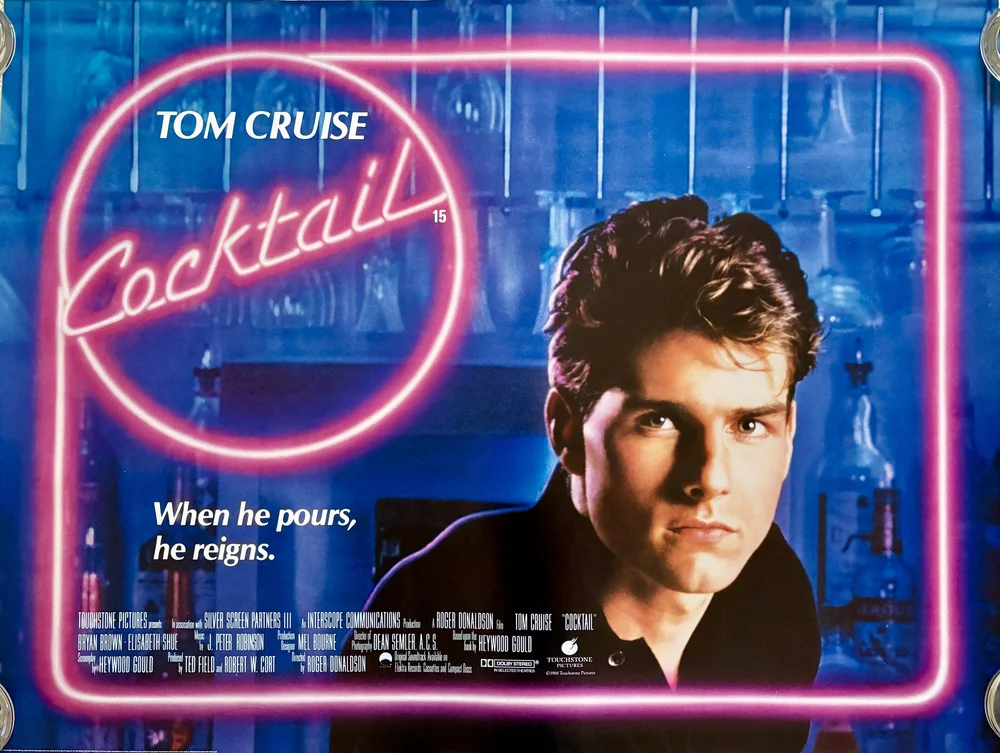
There are career choices, and then there are career swerves that leave you thinking, simply: what on earth possessed you? It is in such a swerve that we find Tom Cruise in 1988, post-Top Gun, and about to hit Cocktail face-first.
Imagine the pitch meeting:
“Tom, you just became the most bankable movie star on the planet playing a cocky Navy pilot. What if… and hear me out… you were still cocky, but instead of jet fighters, you do some bartending while dancing?”
Cruise, in what can only be described as an act of pure 80s confidence, or perhaps a dare gone wrong, said yes. And thus, cinema history was forever changed. Not improved. But definitely altered.
Cocktail
This whole thing could, of course, only have happened in the 1980s. There was something going on then that could only have happened at that time. Specifically, it is that business became “sexy”, somehow. Sitting in an office, making somebody else very rich, suddenly became some sort of life goal.
In the 1980s, the world of “business” was not a job. It was a shimmering, neon-lit fantasy realm where anyone with a suit and a vague understanding of leverage could become a millionaire by lunchtime. (See also: Wall Street, Working Girl, and The Secret Of My Success).
Into this arena steps our hero, Brian Flanagan. He is a young man with big dreams of big business and an even bigger ego. Unfortunately, his résumé consists mostly of “owns a smile.” so he is rejected from numerous jobs on Wall Street as he doesn’t have a business degree.
So he enrols in business school and takes a job as a bartender to pay his way through school because, in 80s movies, bartending wasn’t a job. It was a stepping stone to just about anything. Here he encounters Doug Coughlin, played by Bryan Brown. The most realistic thing in this movie is that the only Australian in it is working behind a bar. The natural order of things is restored.
He is less a mentor and more a human embodiment of a motivational poster you’d find in a dive bar run by Nietzsche. He introduces Brian to the world of flair bartending. This is where making drinks is secondary to spinning bottles like you’re auditioning for Cirque du Soleil: Alcoholic Edition.
As anyone who has ever had to wait at a bar will tell you, this presents a problem. Dude, I just want a fucking drink. Calm down. Stop dancing, and make me a goddamn mojito!
But no, here it is apparently acceptable for these guys to appear to make approximately two drinks an hour.
The concept of “Flair” bartending might have started in the 1800s with Jerry Thomas, but in the mid-1980s it was given a massive rebirth at a bar and restaurant at 1152 1st Avenue in New York. It was here that the very first TGI Friday’s opened, and it served as the inspiration for the whole movie while being the location of the first bar setting. Imagine that? TGI Fridays ever being this cool?
Here, whenever a customer orders a drink, and instead of just making it, they launch into a five-minute routine involving juggling, spinning, flipping, catching, and possibly summoning the spirit of Jim Morrison. By the time the drink arrives, the customer has aged visibly.
In Cocktail, this is not just accepted, it’s celebrated. Crowds gather. Women swoon. Men nod in approval. Drinks are irrelevant; it’s all about the performance. If anything, the alcohol is just a prop.
Coughlin’s Law
Threaded throughout this almost drink free, dance-infested extravaganza is philosophy for people who think fortune cookies are deep. Bryan Brown’s Doug Coughlin spends much of the film dispensing wisdom in the form of “Coughlin’s Law,” a series of aphorisms that sound profound until you think about them for more than three seconds. For example:
“Everything ends badly. Otherwise it wouldn’t end.”
This is presented as the kind of insight that should stop you in your tracks. In reality, it’s the sort of thing you’d hear from a guy at 2 a.m. who’s three whiskeys past coherence and has just been dumped via pager. Except in this movie nobody has enough time on their hands to wait for the juggling bartenders to deliver them three whole whiskeys.
Coughlin is essentially the devil on Brian’s shoulder, if the devil wore Hawaiian shirts and had a side hustle in existential dread. He’s charismatic, sure, but also the human equivalent of a midlife crisis that learned to mix cocktails.
He is balanced by Elizabeth Shue as Jordan Mooney, who arrives like a sunbeam cutting through all the barroom nonsense. Post-Karate Kid, Shue had already secured her place in the hearts of teenage boys everywhere, and the nation’s adolescent crush. Cocktail just doubles down on this. She’s smart, warm, and crucially appears to exist in a completely different, more grounded universe than everyone else.
While Cruise is out here treating bartending like an Olympic sport, Shue is quietly reminding the audience what actual human interaction looks like. It’s almost jarring. She’s the emotional anchor in a film that otherwise floats somewhere between a fever dream and a music video.
And what music!
If you could bottle the 80s and play it through some sub-standard speakers, it would sound like this soundtrack. Now that I think about it, I had the soundtrack to this movie on CD. And now I am ashamed…
There is The Beach Boys’ Kokomo, which somehow became a massive hit despite sounding like it was written during a particularly lazy afternoon. There is an entire parade of synth-heavy, sax-infused tracks that scream “we just discovered drum machines”, and then there are the old classics like The Hippy, Hippy Shake. The music is relentless. It doesn’t underscore the scenes, it becomes the scenes.
Every emotional beat is accompanied by a song that tells you exactly what to feel, just in case you were in danger of forming your own opinion. The net result is that by the time the movie gathers pace, you don’t just watch Cocktail, you survive it.
The fashion alone deserves its own documentary. Tank tops that defy structural integrity. Suits that look like they were designed by someone who just discovered shoulders. Hair that exists in a constant state of aerodynamic readiness. And because the 80s were in full flow, there is the attitude! This is a world where confidence is currency, subtlety is for cowards, and every problem can be solved with a combination of charm, alcohol, and questionable life advice.
This all seemingly supports the idea that bartending could be a stepping stone to corporate success, rather than something that was dreamt up during a particularly enthusiastic brainstorming session involving cocaine.
Never Phones It In
For all of the movie’s faults, though, let’s not pretend Tom Cruise isn’t giving this absolutely everything he’s got. He commits. This is an early example of Tom Cruise never, ever phoning it in and refusing to bring absolutely anything other than his A-game.
Every smile is characteristically Cruiseian, dialed right up to eleven. Every line is delivered with the intensity of a man who believes the fate of the free world depends on this particular cocktail being poured with maximum flair.
It’s fascinating to watch, because you can see his movie star machinery working at full capacity. Cruise isn’t just acting. He’s projecting. He’s selling you Brian Flanagan like he’s the hottest product on the market. The problem here is that Brian Flanagan is kind of a jerk.
He’s arrogant, self-absorbed, and makes decisions that range from questionable to downright asshole-ish. Suddenly, this all feels very familiar. Cruise’s sheer charisma almost papers over it. Almost. But just like in Risky Business, you do feel a little morally dirty at times for enjoying the character coming out on top.
The making of Cocktail is, fittingly, a bit of a cocktail itself. Equal parts ambition, compromise, and chaos. The script went through multiple rewrites, trying to balance romance, drama, and what can only be described as “bartending spectacle.” Directors came and went before Roger Donaldson took the helm, presumably after being assured that yes, this was a real movie and not an elaborate prank.
Yes, that Roger Donaldson. Thirteen Days, Dante’s Peak, No Way Out, World’s Fastest Indian. Before all of that, he made a dancing bartender movie. The 80s were fucking mad!
Cruise reportedly trained extensively for the bartending scenes, which explains why he looks like he’s genuinely trying to win a gold medal in Mixology Gymnastics.
The tone of the film seems to shift depending on which draft of the script you think you’re watching. One minute it’s a breezy romance, the next it’s a cautionary tale about ambition, and then suddenly it’s a philosophical treatise delivered via cocktail napkin.
Test audiences were apparently confused, which is hardly surprising. I am confused after watching it again to review it. Watching Cocktail is like trying to follow a conversation where everyone is speaking a different language, but somehow still understands each other.
The film eventually attempts to tie everything together with a message about love, responsibility, and the dangers of listening to men who quote themselves. It’s earnest. It’s sincere. It’s also wildly out of step with the rest of the film, which has spent the previous runtime encouraging you to believe that spinning bottles is a viable life strategy.
But that’s Cocktail. It zigzags between tones like a drunk trying to walk a straight line, and somehow, against all odds, it somehow reaches the finish.
Is Cocktail good? That depends on how you define “good.” If you mean coherent, well-structured, and tonally consistent, then no. Absolutely not.
Yet I found it incredibly watchable, highly entertaining, and strangely moving in places. It is a deeply bizarre artifact of its time that offers a front-row seat to peak 80s excess, so it is kinda hard to hate. It’s funny, it’s frustrating, it’s occasionally baffling, but it’s never, ever boring.
The post Retro Review: COCKTAIL (1988) appeared first on Last Movie Outpost.