By
By You grew up in the suburbs of Chicago and earned a degree in Education. What led you to pursue a career in film instead?
I’ve always been a big fan of storytelling. I quite enjoy watching movies, watching TV, reading comic books, reading science fiction, just about any form of storytelling I was always into. So it was natural that I wanted to go into a career that had to do with storytelling.
At first I wanted to be a comic book artist, so I went to college for graphic design and then ended up getting my master’s in education. But my father is also a martial arts teacher. He owns a martial arts school, so naturally martial arts was a big part of my life, and so was martial arts movies.
My father was a big movie fan, so he and my mom used to rent VHS tapes from Chinatown, like Drunken Master, Armor of God, just all types of kung fu movies.
And growing up watching those movies, and as a martial artist and as someone who really wanted to find his own identity, cultural identity, becoming a kung fu actor was something of a fantasy, but it was a dream that I’ve always had. And then after graduating from college and working for a year, I decided to move back to Hong Kong to give it a try, and I’ve been here for 20-plus years.
Do you remember the first role where you felt this might be your breakthrough?
It’s kind of hard to say which role that I felt was something that was going to be a breakthrough because, when you’re working you kind of, especially if you’ve been in the industry as long as I have, you learn not to have too many expectations.
You do your job, you do the best that you can and, you know, there’s so many factors involved as to, whether the project you’re working on is going to be successful, the role that you play is going to be successful. So all you can do is, try your best to help the director tell his or her story.
As I remember, the first role that I really kind of remember people stopping me in the streets to take pictures with, was for a role that I did in a movie called Marriage with a Fool. And the funny thing is it wasn’t even a martial arts movie, it was a comedy. It was a romantic comedy and I was a supporting character in it, it was written well and then I tried my best to impart my own personal brand of humor into the character and apparently the audience took a liking to it.
So, one of my first roles that I felt really resonated with audiences would be my character from Marriage with a Fool.
Is it true that you started with small acting roles, then moved into stunt work, later into fight choreography, and eventually returned to acting?
Yeah, everything you stated in your question is correct. I started off doing smaller roles in movies before joining the Chin Ka-lok stunt team.
Chin Ka-lok is a renowned Hong Kong action choreographer and former stuntman who established his own reputable stunt team after years of working with Sammo Hung’s team. His team is known for high-risk action design in major Hong Kong films, specializing in car stunts and dangerous physical maneuvers.
I was one of the first members and I worked with Chin Ka Lok for a couple years working as a stuntman and also martial arts choreographer, after which I moved on and did some solo projects as a choreographer and action director in countries like India, Philippines, Malaysia, Singapore, etc.
All that before signing on with the legendary Wong Jing’s production company, and then I signed with him for 10 years and during those 10 years I learned a lot. He gave me many opportunities to direct, martial arts choreograph as well as acting in many of his projects, I gained a lot of experience working with him. Now I have my own production workshop where I took skills that I’ve learned from all these people to try to make good movies for the audience.
Wong Shun Leung, who was also Bruce Lee’s instructor, was your teacher in Wing Chun. Did he ever share stories about Bruce Lee with you? Public figures are often very different in private life.
Sifu Wong Shun Leung and I were very close when I was training under him and he would definitely share a lot of stories with me during training and at our meals together. Some of the stories he shared were about Bruce Lee.
But obviously his perspective on Bruce is different to many people’s because, as you said, he was Bruce Lee’s instructor, so from his eyes,Bruce was more of a child, in a way, from his perspective. A very clever, a very smart, very talented student, but also a very naughty boy, according to Sifu.
The story that stands out the most was, when Sifu was teaching Wing Chun, he noticed that during one week, for a few days in a row, other students wouldn’t show up for his class, except for Bruce.
But later on, Sifu found out that Bruce was waiting outside the school door, like, maybe like half an hour before class started to tell all the students coming in that Sifu was not feeling well, so he ended up getting free private lessons, you know.
Sifu caught on to Bruce Lee’s little scheme and then apparently ended up teaching him a lesson. Though I’m not sure about the specifics of that lesson (laugh).
What was your reaction when you were cast as Bruce Lee in Birth of the Dragon? Was it challenging, and how did you approach the character?
I was elated when I got the role and as I’m sure anyone would, getting to play the legendary Bruce Lee. But then you actually realize you’re playing the legendary Bruce Lee, and it comes with a lot of expectation. A lot of people have their own perceptions of who Bruce Lee is and many people see him more than a human being.
I knew a lot of people that knew him personally, like my Sifu and also many of the stuntmen that had worked with him in the past, very closely. I heard a lot of stories about him, how he acted, how he behaved himself and how he treated others outside the movie world and behind the scenes.
I try to play to that as authentically as possible, treat him as a human being, with all the flaws and all the greatness that comes with being a human. I did my best to portray him in that light.
Did you change your training routine to prepare for the role? What was the main focus of your workouts?
For my role in Birth of a Dragon, I didn’t have a personal trainer. I, in fact, was my own personal trainer as I am for all my movies because I know my body best and I know how to manipulate it for each role.
I focused more on physicality, external aesthetics, as Bruce Lee had a very aesthetically pleasing body and great musculature, so I did my best to focus on that.
You worked with Jackie Chan on New Police Story in 2004. Have you ever received another opportunity to collaborate with him?
I’ve actually worked with Jackie Chan twice. I worked with him when I first got into the industry on Twins Effect. I was one of the ambulance vampires that fought him during his cameo and as you stated, New Police Story.
My role was pretty small, so I didn’t have a lot of opportunity to interact with him but I did get to know him, so it was a dream come true having watched all his movies growing up. Having recently just gotten into Hong Kong at the time, getting an opportunity to work with him was great. He’s someone that I’ve always looked up to and he’s someone I still look up to today.
In 2014, you appeared alongside Chow Yun-fat in From Vegas to Macau. How did that production differ from other action films you have worked on?
Didn’t differ much from the other productions that I’ve been at. I mean, I didn’t have to choreograph it as I wasn’t the action director, so I got to focus on my acting.
It was fun getting to know Chow Yun-fat, another one of my childhood heroes and a great gentleman. Takes care of people around him, he’s a great guy and it was a fun movie.
You worked with Donnie Yen on Bodyguards and Assassins (2009), Chasing the Dragon (2017), and Enter the Fat Dragon (2020). How would you describe his approach to action and choreography compared to others?
Yeah, Donnie Yen is one of my all-time favourite kung fu actors and is another kung fu hero that I had growing up watching kung fu movies.
It was also surreal getting the opportunity to work with him, getting to know him and calling him a friend. His action style is hard-hitting, impactful, at high level physicality. As long as we’ve seen his movies, we can see that even though it’s choreographed, it’s very akin to actual combat.
I think as his style evolved, it’s become more and more evident that his knowledge of actual combat is actually very vast and you can see it in his choreography. It’s always an honor to work with him.
You have worked twice with Sammo Hung on Once Upon a Time in Shanghai (2014) and Twilight of the Warriors: Walled In (2024). What were the biggest challenges in those roles, and what was it like working with a legend?
Actually, the first movie in which I worked with the legendary Sammo Hung was a movie called Naked Soldier. I actually fought him in that movie. It was a very brief fight scene, but I fought him nonetheless.
At the time, I was very new in the industry, so having the opportunity to do that, to go against one of my all-time favorite kung fu actors and action directors was a dream come true. A thing to note about working with Sammo, especially in fight scenes, is that he’s very accommodating. He’s such a good dance partner that he’ll elevate your fighting just because he’s so good at doing it and he’s so good at making you look good in a fight and it’s great.
He’s someone that I eternally respect and even though we’re very familiar with each other now, every time I see him, I still act like a fanboy.
The Stuntman received a lot of media attention in 2024. What can you tell us about that film and your role in it?
The Leung brothers, Albert and Herbert, have a pretty interesting history. They started off as actors on a film after which they found it kind of hard to get more acting work so they focused more on stunt work and enrolled in a certification course held by the Hong Kong Stuntman Association.
During their trainee days as well as after their certification, they worked for me on several projects as stuntmen.
I got to know them pretty well when they worked for me and I found out during that time that they themselves wanted to direct. They had stories that they had written and one of which was Stuntman.
They’ve been looking for funding for this project for a long time, I kept encouraging them and suggested different avenues to get funded and eventually through their own hard work they got funding and the producer that they found to help them out is Angus Chan, he’s a good friend of mine.
So as soon as I found out they secured funding I told them that I would help out in any way that I can, because I want to see their project come through. They had a role that they thought I could fit well into. I immediately signed on.
I didn’t really even read the script at the time. I just really wanted to help them out and make sure that they were able to do what they wanted to do and I’m very happy that they were able to tell their story.
The kind of behind the scenes story of Hong Kong stuntmen. All the trials and tribulations, the highs and lows, the realities of this industry from the past to now told it in a very interesting story format. I’m glad that the movie’s getting recognition.
You have appeared in several television series, including A Fist Within Four Walls (2016), Fist Fight (2018), and The Righteous Fists (2022). How is working on a TV series different from working on a feature film? Which format do you prefer?
The main difference between filming a television series versus filming a featured film is mainly the time that you’re given to complete the project and also the amount of time that you’re given to tell the story.
For instance, a television series can last anywhere between 10 to 30 episodes, give and take and that’s a lot more screen time for you to develop the characters and to tell side stories in addition to the main storyline.
The pacing will be different and the episodic nature of television requires you to use a certain type of pacing and storytelling rhythm whereas a featured film on average lasts 90 to 120 minutes so you have a lot less time, compared to a television series to develop your characters and to tell your story.
Your latest film is Furious Attack, set in northern Myanmar. What can you tell us about your character and the story?
The main reason that I took on the role in Furious Attack is because Andy On is in the movie. He’s my best friend.
He plays the lead and they needed someone to fight him. They offered me the role and it looked fun. People in and outside industry and fans of action cinema know that Andy and I are best friends. We’re like brothers and we’ve been in many films together so it’s always fun working with him. It’s like working with family.
I knew he was in it so I wanted to have fun and potentially film another great fight scene between us, something for the record books and if my appearance in the movie benefited my brother in any way then I’m very glad that I was there.
I have noticed that you and Andy On appear in many of the same projects. Do you share the same representation?
I met Andy pretty early in my career as a stuntman in a movie called Star Runner in which he played the main antagonist, Tank, and as I mentioned before I was a member of the Chin Ka-lok stunt team and for this movie Chin Ka-lok was the action director.
I worked as one of the fight choreographers, stuntman and stunt double of some of the actors. I was also in charge of training the actors, among which were Vaness Wu and Andy On.
We’re all kind of new in the industry so being fresh I think helped us bond together. Also the fact that we all grew up in the west and got transplanted to Asia where we now work also contributed to us developing a strong bond. We became best friends ever since.
That’s why you see us in movies all the time.
Which role stands out the most for you?
It’s hard to pinpoint a role that I’m most proud of but I would say the role that holds a special place in my heart would be the role of Ma Wenzheng in the movie Once Upon a Time in Shanghai.
The movie itself was a very special experience. It was one of the first feature films in which I played the lead role and I got to work with my best friend Andy On who plays my best friend in the movie.
On top of that the action director for the movie was the legendary Yuen Woo-ping who needs no introduction. I’ve worked with him before but not in the capacity that this movie allowed me to. It was a blessing getting to know him.
Because the movie is a period piece, it’s a bit timeless so even today I can still show this film to my friends who might not have seen much of my work.
What are your three favorite martial arts films of all time?
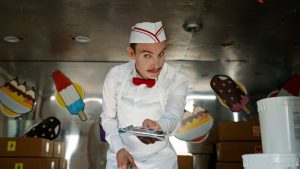
This is a hard one. There’s so many martial arts movies that I love and influence me so much but if I had to say I would say – it’s Meals on Wheels, The Prodigal Son and Drunken Master.
What are your two favorite fight scenes in film history?
Another tough question because there’re so many fight scenes that are memorable and have influenced me even to this day.
But if I had to say it would be Benny the Jet versus Jackie Chan in Meals on Wheels, that epic fight scene in the dining room.
And the fight scene in Prodigal Son between Lam Ching-Ying and Frankie Chan-Fun-Kei in the middle of the movie where they’re fighting outside the restaurant on the little wooden bridge area. The one where at the end of the fight, Lam Ching-Ying’s character has an asthma attack. I thought that exchange was very memorable.
Which three recent action movies would you recommend watching?
Another difficult question to answer because there’ve been so many recent movies, action movies that elevated and evolved the genre to what we see today.
Off the top of my head I think a few notable game changers would include the Raid series. I think you can see its influences in much of the action choreography that you see today especially with brutality and fast-paced hardcore action.
Another game changer I would have to say would be Kenji Tanigaki’s Kenshin series in which you can see a new way of capturing sword play and anime-styled movements filmed for live action.
The way he uses wire work, the way he moves his camera, you see a lot of that influence much of the choreography in movies that you see today.
And also very notable is the Ip Man series which showed traditional kung fu to a new audience in a way that’s appealing and while still respecting the traditions of the past, bringing a whole new generation of people to appreciate kung fu movies.
The post Philip Ng Exclusive Interview appeared first on Budomate Magazine.