By
By 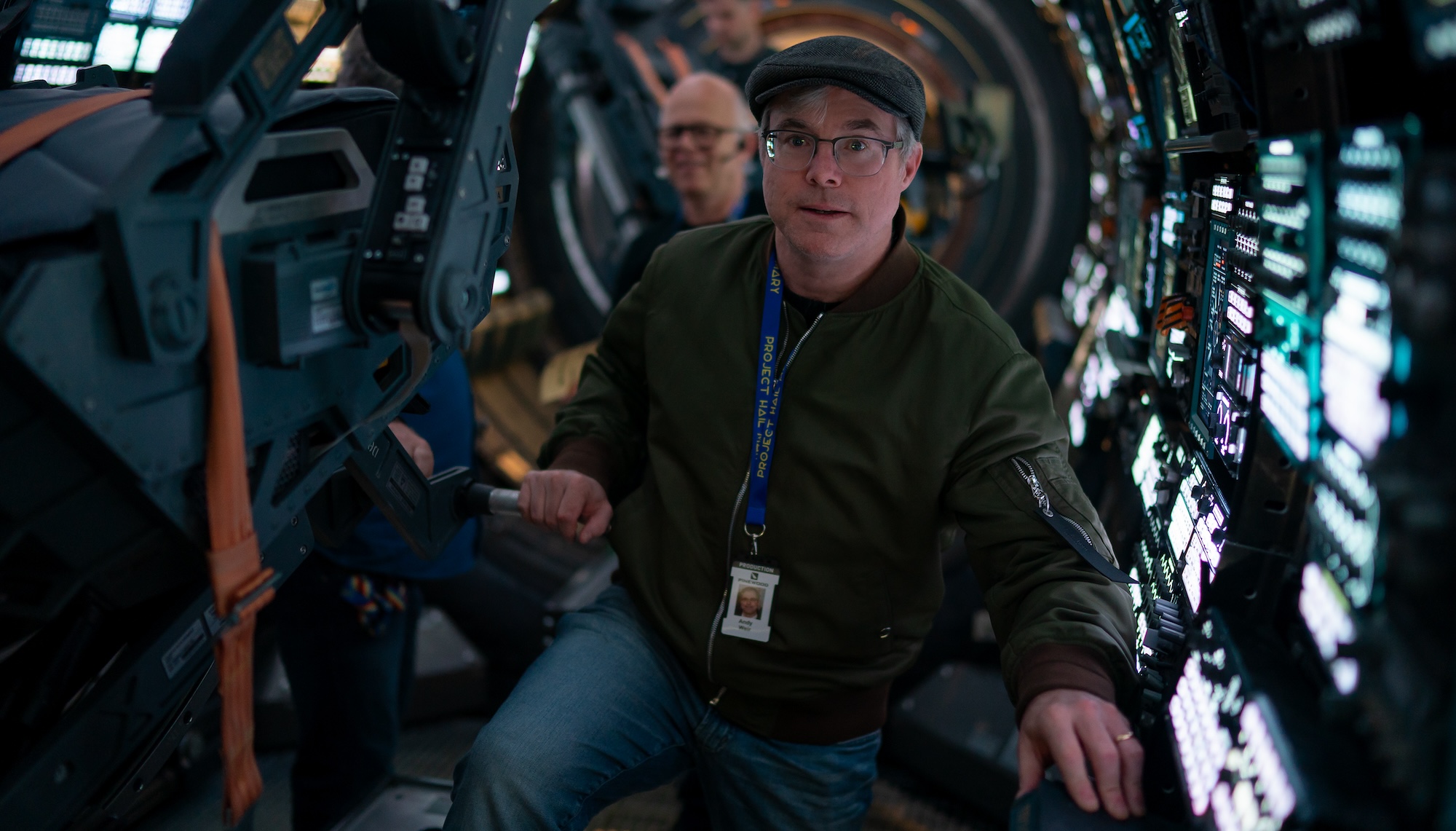
The way author Andy Weir sees it, he doesn’t set out to write books that can make good movies. Yet two of his first three novels, The Martian and Project Hail Mary, have turned into exactly that—and the third, Artemis, is still in development. Furthermore, if you are reading the near universal praise for Phil Lord and Christopher Miller’s adaptation of Project Hail Mary, you might understand why the sci-fi bestseller seems pretty confident when we sit down to discuss the new flick.
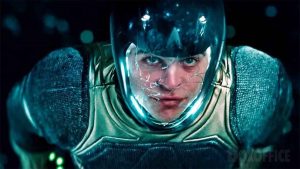
Project Hail Mary is indeed a bold gamble both for Lord and Miller—who have not made a finished live-action movie since 22 Jump Street in 2014—and Amazon MGM Studios, which is releasing the sci-fi epic in theaters. The film imagines a future where due to an intergalactic microbe dubbed “astrophage,” our sun is dimming by the minute. It’s a bold premise, but one which gives turn to an even grander one when substitute-astronaut Ryland Grace (Ryan Gosling) is tasked with traveling across the cosmos to find a solution for Earth… and ends up meeting a fellow traveler: a sentient alien he nicknames “Rocky.”
Unlike in the novel, where the existence of Rocky and his budding friendship with Grace was kept a secret in the book’s marketing, the Project Hail Mary movie has been upfront about its unlikely buddy comedy premise. We talk to Weir about giving away the novel’s biggest secret in the trailer, as well as where the terrifying idea of astrophage came from, and finally what Gosling, Lord, and Miller bring to his out-of-this-world material.
So what came first? The idea of the astrophage or doing a meet-cute with an alien named Rocky?
[Laughs] Astrophage came first. It actually came from an unrelated book idea that I was working on and then abandoned because it sucked. But I wanted to think about what would happen if we, in the modern day—not a thousand years from now—had access to a mass conversion fuel.
So how did Rocky come into that narrative?
Well after a while, I decided I wanted it to be a first contact story where they’re both trying to save their planets, so I needed an alien. I don’t like the science fiction tropes where the alien is comfortable in our atmosphere and looks kind of like a human with forehead bumps and stuff. I wanted my alien to be truly alien. So I started with the homeworld that I’d chosen, the exoplanet that I picked for them, and then I built up a biosphere that would work there. Rocky’s species is what I came up with for the intelligent life on the exoplanet.
It sounds like you based the science of the species on what we know about this type of exoplanet planet. So how do you decide that such a species could master interstellar travel but not know about radiation?
Well, they were desperate, right? They barely had any sort of space travel or anything at all going before they ended up acquiring astrophage too. So they were just desperate to figure out a solution to the problem. They didn’t understand relativity or radiation, even in their own world. So their planet, in order to maintain a thick atmosphere and be that close to a star, would have to have a tremendous magnetic field. So that means it has to spin very fast.
And with a magnetic field like that, even during their early experiments into low orbit, they wouldn’t have encountered radiation. And of course being at the bottom of a 29 atmosphere thick layer of ammonia between them and space, they didn’t get any radiation on the surface either. They just never discovered the concept.
When I read the book, I did not know it was a first contact story. That was a very pleasant surprise when I got to that point in the novel. Do you like that the film’s marketing is a little more upfront about what the story is about?
Well, books and movies are different media, and they’re different methods of storytelling, and they’re very much different methods of marketing and publicity. There is just absolutely no way that we would have been able to keep the first contact aspect of this a secret. I mean, there’s already been millions of people who have read the book. Nobody’s going to walk into that theater not knowing about Rocky, even if we’d hidden it from the previews.
Also while it is a twist that caught the readers off guard, it’s not like some huge twist at the end of a story. The meat of the story is the relationship between Ryland and Rocky, and we wanted to make sure that the potential film viewers would know that this is what this movie is about.
At the same time, you said the story started originally with the astrophage, and I’m curious is the idea of something like that theoretically possible, or is that something you came up with?
So you get down to the quantum level, I invented the idea of super cross-sectionality of the astrophage cell membrane that can actually reflect neutrinos. Normally with neutrinos, you have 100 trillion neutrinos passing through you every second. They pass clean through Earth without hitting a single atom, but somehow, astrophage cell membranes can just completely contain them like a balloon. And then also astrophage has the ability to turn heat into neutrinos and turn neutrinos back into infrared light.
So that’s s all the stuff going on down there, but having accepted those MacGuffins, everything else flows from that with real physics.
Obviously when you wrote The Martian, you had a story to tell and you were just writing it. But given the success of the movie that came afterward, when you were developing this did you think at all in the back of your head how Project Hail Mary could work as a movie?
No. Or I definitely tried not to. Advice that I give to every writer and advice that I try to take for myself is if you want to write a movie, write a movie. Write a screenplay, go for it. But if you’re gonna write a novel, you need to write a novel. Your consumer is a person who’s gonna read the novel. If somebody wants to make a movie out of it later, great, but it’s their problem to adapt it.
In a novel, you want to take advantage of all the tools you have, and when you’re writing a novel, you have a much larger canvas to paint your story with. You can go off and have side plots, you can have exposition that you can explain things in greater detail than you ever could in a film. So you should be taking advantage of all the tools that novel writing gives you when you’re writing a novel and not thinking about any sort of adaptation.
What are the key differences between Ryland Grace and The Martian’s Mark Watney?
Well, Mark was an astronaut, right? He beat out probably tens of thousands of other really qualified candidates for a seat on a mission to Mars. So he really has the right stuff. He is absolutely qualified for the job that he finds himself in. He ended up with a really tough time, but he is a guy who was chosen for this mission. Whereas Ryland was just kind of chucked into it at the last minute, and he’s not at all anyone’s first choice for this mission, especially his. So these are very different people.
Do you appreciate that you made them both, and for that matter Artemis’ Jasmine, single people who are still worthy of being heroes?
Yeah. They’re all different. Like you can almost not call Mark a hero. He just is a guy who didn’t want to die. He didn’t save anyone. He just didn’t wanna die.
Jasmine chose heroism kind of toward the end to undo a problem that she herself had created. And then Ryland is actually going out there and trying to save the entire human race, but would rather not be doing it. So they each have their own little way of backing into heroism.
But you seem to be playing with perceptions. In the case of Ryland Grace, everyone looks at him as expendable. ‘You don’t have a family, you’d be perfect for this!’
[Laughs] Yeah, but he certainly doesn’t think of himself as expendable.
What was it like working with Lord and Miller on this one?
Oh, it’s fantastic. So we knew that the story was going to live and die on the representation of Rocky. We had to get Rocky right. And Lord and Miller have a long and extensive history of animation, so they know how to take seemingly inanimate objects and make them awesome, and make you empathize with them and make you love them. They were the right team for this job. I can’t imagine it being done by anyone else.
They figured out how ‘so Rocky doesn’t have a face and talks in whale song’ but he’s still got a body. He’s got body language, and you can tell from moving him around this way, moving him around that way. Oh, he’s sad; he’s happy. They figured out how to make this work, and they absolutely nailed it, so I couldn’t be happier with the result.
Was there anything they did with Rocky that surprised you?
Not really. I was involved in every step of the way, of course, so there weren’t any huge surprises. But I thought it was cool they came up with a bunch of stuff. Within the book, Rocky just has vents, just kind of like holes in the top of his carapace for air transfer, but the Rocky in the movie, the vents are actually kind of these little rocks that move up and down to let air in and out. And that helps give him some kinetic motion while he’s doing things. So there’s more going on than just his body moving around.
Tell me a little bit about what Ryan brought to his character, and did he find dimensions or something that surprised you or intrigued you about Grace?
Oh, absolutely. So I’ve always considered one of my biggest weaknesses as a writer is my character’s depth and complexity. I feel like I’m always trying to get better, and I’m a very plot-driven author. So with Ryland, I tried to give him some complexity and depth, but he’s still kind of a little bit more shallow than I’d like. But then in comes Ryan, and he adds all these layers that I never envisioned before. He’s just really good at riffing and ad-libbing and stuff like that, and oftentimes he’ll come up with much better ways of doing something than the screenplay even had.
So what’s awesome is people are gonna watch this movie, they’re going to see this well-rounded character of Ryland Grace, and that’s largely because of Ryan’s performance, and then I’m gonna get credit for having come up with such a well-rounded character. So thanks to all of Ryan’s hard work, I’m going to get all the credit, and that just absolutely works for me. [Laughs]
Given the names Rocky and Adrian in this story, how happy were you that this ended up at MGM?
I know! That was a really sweet coincidence. That was really nice. We liked that. That felt good. [Laughs]
We didn’t need to show any clips if we weren’t able to [get the rights]. We still needed to secure rights from Stallone specifically to be able to show even him on screen at all. So we did.
You could’ve just had Ryan do his Stallone impression.
Right! Like we didn’t need to actually show clips from Rocky, but it was nice to be MGM so we get it for free.
Project Hail Mary opens in theaters on March 20.
The post Project Hail Mary: Andy Weir Talks About Giving Away Book’s Biggest Secret in the Trailer appeared first on Den of Geek.