By
By 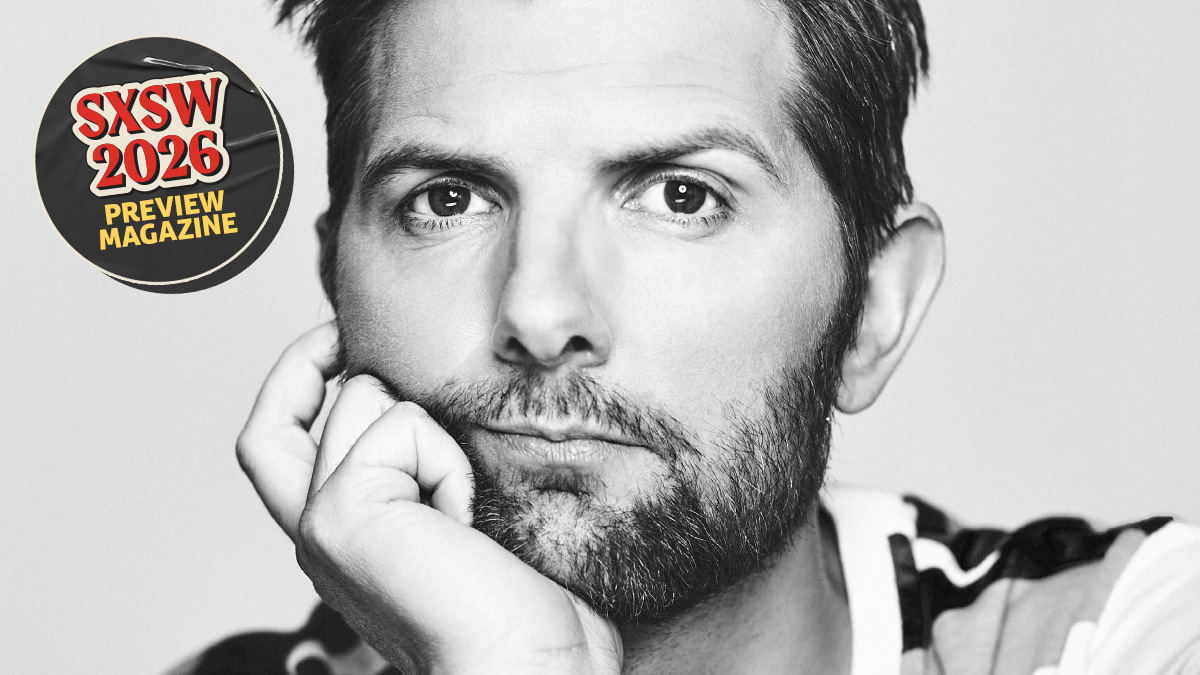
This article appears in the new issue of DEN OF GEEK magazine. You can read all of our magazine stories here.
Severance star Adam Scott takes a detail-oriented approach to his showbiz career—right down to the very name he pursues it under.
Eager to stand out as a “serious actor” in the vein of Robert De Niro or Al Pacino, a young Scott once considered changing his relatively common surname to the more flowery “Quardero,” a shortened version of his mother’s Sicilian maiden name “Quartararo.” He ultimately opted against the rebrand and embarked on an acting career successful enough to condemn all other Adam Scotts to “for other uses, see Adam Scott (disambiguation)” status on Wikipedia.
Still, when Scott sits down with us to discuss the success of his hit Apple TV sci-fi series Severance, a starring role in upcoming SXSW midnighter Hokum, and his career at large, we ask him to consider a “sliding doors” scenario in which the first moniker stuck.
“I wonder what Adam Quardero would be doing right now,” he muses. “Hopefully, the exact same thing… except everyone would always be asking him how to pronounce his name.”
Indeed, Adam Quardero would be immensely fortunate to have Adam Scott’s career. After getting his start as high school bully Griff Hawkins on coming-of-age sitcom Boy Meets World, Scott transitioned into the world of comedy: appearing as the douchey Derek Huff in the film Adam McKay’s Step Brothers, struggling as actor-turned-caterer Henry Pollard in Starz’s comedy Party Down, and former boy mayor, Ben Wyatt, in NBC’s Parks and Recreation.
But it was the premiere of the Dan Erickson-created, Ben Stiller-directed Severance, in 2022, that elevated Scott to dramatic leading man status. Over two critically and culturally acclaimed seasons, Scott has embodied Mark Scout, a Lumon Industries employee who has undergone the “severance” procedure to bifurcate his consciousness between his work life and home life.
Now, between seasons at Apple, Scott is set to dip his toe into the world of horror (he appeared in Krampus and Piranha 3D back in the day), starring in Irish auteur Damian McCarthy’s latest feature, Hokum. The project takes Scott’s troubled novelist character, Ohm Bauman, to a honeymoon suite in a remote Irish inn where he’ll encounter all manner of…well, hokum.
What intrigued you about Hokum as a project?
I love Damian and I loved Oddity. That movie burrowed itself in, in ways that we’re not seeing much currently in horror or suspense. It’s an incredibly patient movie and entirely character-driven. The script [for Hokum] itself was super interesting, and I liked that the lead character wasn’t asking for any sort of sympathy or forgiveness. In fact, quite the opposite. You get to kind of go through it with him and learn along the way why he is that particular way.
Much of Hokum is fairly claustrophobic for your character and presents a lot of upsetting imagery. I know it’s a job, and you’re just “playing pretend,” but was there any element on set that was genuinely horrifying to you?
It was more or less one large room we were working in. It’s dark in the film, and it was literally dark when we were in there making it. It was pretty clear that this was going to be unsettling. I thought the witch was frightening. To see her kind of go in and start running around is genuinely unsettling.
But more than anything, it was exciting to see what would be frightening. I knew that this was going to be effective because the set was so beautifully made. Damian had his eye on every single detail, down to those little guys that strike the bells on the clock, and the unsettling expressions on their faces. As an actor, since your control is limited, you never know really how something is going to turn out at the end of the day. Having so much faith in Damian and seeing all the components they put together on set, I knew there was a chance that this could work.
Are you usually drawn to horror? I believe your first major movie role was actually in Hellraiser: Bloodline, right?
It was, yeah. And I’ve been in a few horror movies over the years, but I’m not particularly drawn to them as an actor more so than any other genre. As an audience member, I do like horror movies, but it all depends on whether they actually frighten me or not. If I’m gonna see one, I want it to be something that really, really freaks me out. Hereditary was a perfect example of that, or The Strangers—movies that really pinpoint these nightmarish scenarios and then don’t look away. I’m not there to just see the most imaginative kills (which I also enjoy). I like them in the context of something that’s really working, character- and story-wise.
What does your work life look like between seasons of Severance? It seems as though you’ve kept very busy this year with Hokum, The Saviors, which is also premiering at SXSW, and the upcoming crime thriller, The Whisper Man, with Robert De Niro.
Severance is something we’re always discussing and getting ready for, which is what we’re doing right now, actually. I like working, and I enjoy being busy. My wife and I have a [production] company we run together, so when I’m not acting in something, we’re busy developing a lot of TV and movie stuff. We have an office that we go to; it’s like an actual job.
It’s great because I never want to go back to my early years of sitting in my apartment twiddling my thumbs, never knowing where that next job is going to come from. Every actor who started out from nothing has that in the back of their head as the thing they never want to go back and touch again.
How has Severance changed the way that people interact with you? It’s a very popular show that invites a lot of interpretations and feelings, and you’re the lead of it.
It’s funny, because I was in the States for the first two episodes [of Severance season two] and then I went off and made Hokum in Ireland. When I came back, right when the finale aired, I could tell Severance had really broadened out. People usually recognize me from Parks and Rec or Step Brothers. You get to know the pockets of people that come up and say hello, which is always really nice. Suddenly, it wasn’t just the demographics that I’m used to; it was everyone.
The show has really reached out and grabbed a lot of people, which is terrific. But it was certainly an adjustment. We kind of all collectively stopped and took a breath in London once when we were in the midst of the press over there. We all looked at each other and were like, “Holy shit, this is crazy.” It’s exactly what you want when you work as hard as we do. You want as many people as possible to see it.
What was your hardest day on set for Severance so far? [Director] Ben Stiller has you running around a lot!
Probably the fight that I have with Mr. Drummond in the [season two] finale. Darri [Ólafur Darri Ólafsson] and I really went for it because it was fun, and we had a blast choreographing it with the stunt team. It was completely my fault, but as Darri was swinging me around into the wall, I didn’t get my arm up in time to absorb the slam. I hit it head-first and got a bit of a concussion. That was probably the hardest day, but the whole thing was challenging. We were exhausted by the end of it. For me, “challenging” isn’t negative. I love things that look impossible at first. That’s often what Severance is.
Are there any lessons that come to mind from playing Ben Wyatt on Parks and Recreation? I imagine learning experiences abound on the set of a well-executed sitcom like that.
[Creator] Mike Schur is a master of storytelling. It sounds like I’m talking about [screenwriting guru] Robert McKee. I would love it if that comparison stayed with him because he stapled calzones onto me for life. He and the writers had this economic way of telling a story that was able to squeeze into 22 minutes every week and not take any shortcuts, so you never felt short-shrifted.
There was this trick that Mike taught me early on, and I think of it constantly when I’m working on something. In any successfully written TV show (and some movies), you should be able to take all of the characters’ names off any page of the script and know exactly who is saying what. If you’ve drawn these characters properly, like in Cheers or Golden Girls, or any of these great comedies or dramas, that is what you’re trying to achieve. That’s one of the many lessons I learned over there that I’ll never forget.
I’ve always found your Starz comedy Party Down to be an oddly resonant viewing experience. Because at the end of the day, it’s a series about young actors trying to make it in Hollywood—who are all played by young actors trying to make it in Hollywood. What emotions are associated with that show for you?
It was a really special time. A lot of us were in a similar position to the characters, so not in the midst of these flourishing, incredible careers. We were all lucky to be there and felt a bit like outsiders in showbiz. We found each other on this show and didn’t quite know if it would work or what it would be. At the time, Starz wasn’t making TV shows, so we weren’t even sure who was going to see this.
It really came together in the “Singles Seminar” episode. That is when we all really locked in. We looked at each other and were like, “Oh, this is great. This is fun, and who cares if anyone sees it? This is about each other; defining ourselves for ourselves. It’s the most fun we’ve ever had.” We all really just started making the show for each other.
I think it’s important to have moments like that in any business, but particularly in show business where you’re always perceiving yourself or being forced to perceive yourself according to how others perceive you. When you start finding yourself with a group of people, you come to realize it doesn’t matter what anyone else thinks. Your self-worth changes.
Do you think doing Step Brothers added a lot to your comedic toolbox? There are still certain “Derek from Step Brothers” moves I can see in your work to this day, even the dramatic stuff.
I didn’t even really have a comedic toolbox at that point. It was before Party Down, and I hadn’t had the opportunity to be in a big comedy like that. Getting that role was a bit of a fluke. When I got there, I didn’t totally know what I was doing; I had to learn on the job. But I slowly came to realize that I never wanted to go back to anything else. This is where it was at. Seeing how [director Adam] McKay and Will Ferrell and John C. Reilly work, by the time it ended, I felt like I had figured it out a little bit. I realized this was what I wanted to do. That was an incredibly instructive moment.
Is there a role in your career that you look back on particularly fondly that doesn’t often come up in interviews like this?
Something that was a huge deal for me and sort of changed the way I perceived myself was a movie called The Vicious Kind. This really talented writer-director, Lee Krieger, cast me in his movie, and I didn’t even know why. I had just finished shooting Step Brothers, but it hadn’t even come out yet. Then I got the lead role of this little indie, and I loved making it. It was a really emotional role and it had everything I always wanted to do in movies.
When it was done, I was like, “Oh God, I wonder if this is going to be embarrassing.” I remember inviting everyone in the Party Down cast and sitting down to watch it with everybody and realizing, “Wait, I think this might actually be good. I might have pulled this off.” That really changed everything. That period of time had me doing The Vicious Kind, Step Brothers came out, Party Down was out there, and I had just gotten the Parks and Rec job. That was when an actual career came together and solidified.
Your name tends to come up frequently when the internet comments on people who have not yet hosted Saturday Night Live but should. Would you be interested?
Of course! The funny thing is, people often think that I already have. It’s probably because of the people I’ve worked with or am friends with, and they just assume that I’ve hosted SNL. But yes, I would love to, of course.
I think you have a good sense for men’s fashion. You attended the InStyle Imagemaker Awards last year and Comedy Bang! Bang!’s Scott Aukerman once said you were the only person he knew who owned a tux. Who taught you to tie a tie so cleanly and snugly?
YouTube, honestly. I’m sure my dad taught me a long time ago, but I remember needing to tie a tie, and it had been 15 years since I had. I learned a few different knots on YouTube, and they made it pretty easy. You could do a double Windsor or whatever, but I like a smaller, tighter knot. You see a lot of Wall Street guys with this big fat triangle at the top. Or a lot of the MAGA politicians have that big knot, like [Secretary of Defense Pete] Hegseth. It’s a pet peeve of mine, seeing people on television with sloppily tied ties. I’m like, “Did no one see that that thing is about to come loose? You just gotta give it a tug, and it will look 70 percent better!”
I assume that you consented to this interview because you fondly remember talking to Den of Geek back in 2017 for a magazine feature about your Fox sitcom Ghosted. How does it feel to return to the pages of Den of Geek magazine, and more importantly, should Ghosted be rebooted?
It feels great! [Laughs] First of all. And should Ghosted be rebooted? Absolutely. I think it should be rebooted every year. It should be a national holiday every time they reboot it. That goes without saying.
Hokum premieres on May 1 nationwide.
The post Unsevered: Adam Scott Talks Hokum Horror, Severance’s Success, and Wanting to Host SNL appeared first on Den of Geek.