By
By 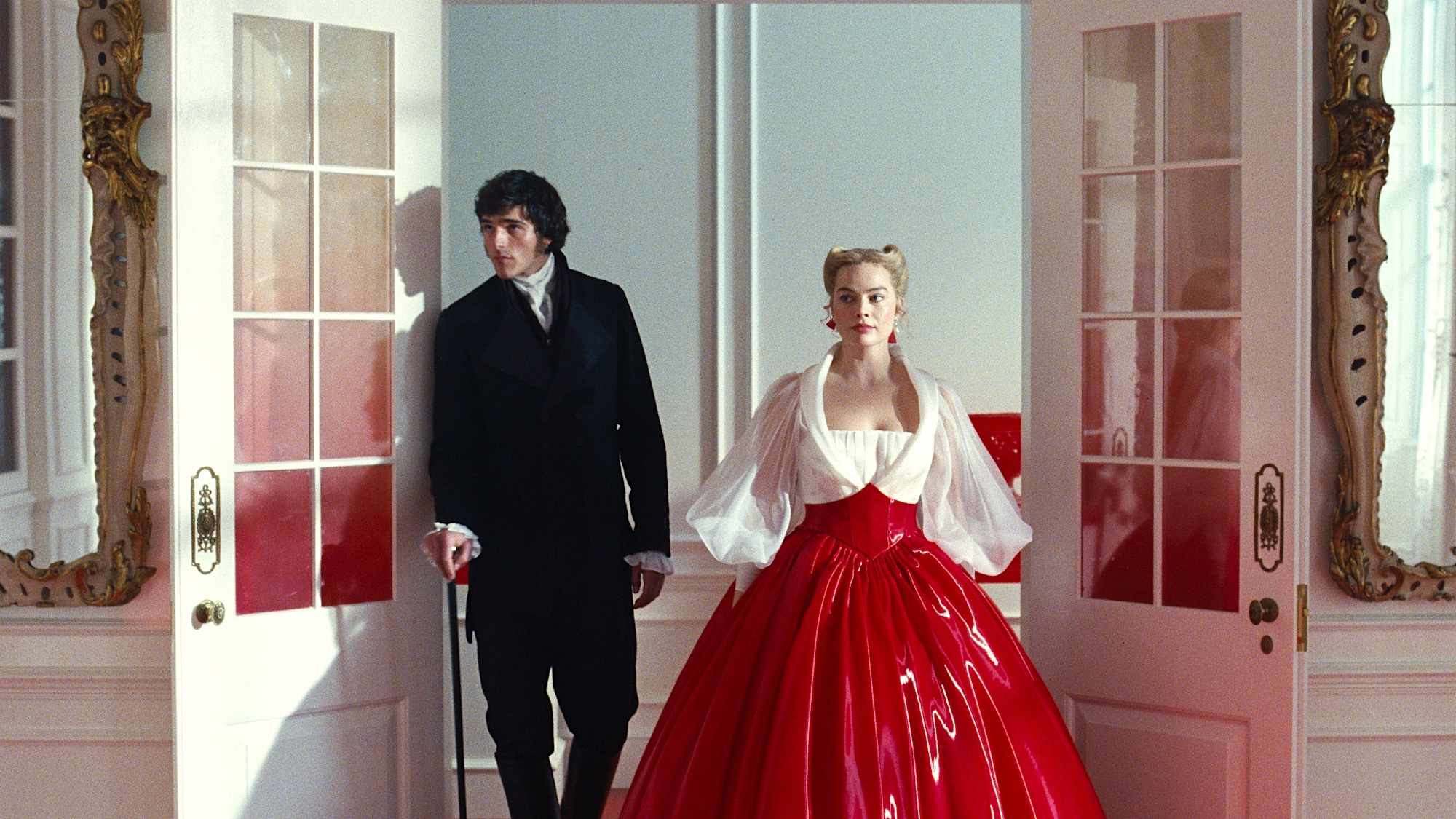
Emily Brontë’s Wuthering Heights is not a novel for the faint of heart. Dark and transgressive, especially at the time of its publication in 1847, the story features intentionally cruel protagonists, a toxic central relationship, and an almost shocking amount of physical and psychological violence. It wrestles with themes of class, generational abuse, trauma, and revenge. And while Brontë’s prose drips with all-timers in terms of memorable quotes (“Whatever our souls are made of, his and mine are the same”), it’s not an especially easy read.
Fittingly, perhaps, director Emerald Fennell’s 2026 feature film adaptation is also not a film for the weak of heart. Bursting with colorful anachronisms, gorgeous butterfly-bright gowns, and sensual audiovisuals, it’s often an adaptation in only the loosest sense of the term, a movie that’s more about vibes than stringent adherence to its source. (That it gets those vibes exactly right is the film’s primary saving grace.) But to bring her vision of putting “the greatest love story ever told” to the screen, Fennell had to make some fairly radical changes to Brontë’s story as we know it. Here are 10 of the biggest.
Emerald Fennell Cuts Out the Second Half of the Story
In Wuthering Heights, Catherine Earnshaw dies in Chapter 16. However, the book has another 18 to go before we bid adieu to Heathcliff and Thrushcross Grange. Which is to say about half of Brontë’s book takes place after its hypothetical heroine is no longer part of the story. At least directly so. The remainder of the novels follows Heathcliff as he achieves his supervillain final form on a revenge quest that encompasses not just the lives of himself and his established rival/brother-in-law Edgar Linton, but the next generation as well: Cathy’s daughter (also named Catherine), Heathcliff’s son (Linton), and Hareton Earnshaw (the son of Cathy’s brother Hindley, who gets excised from Fennell’s movie entirely).
In terms of adaptation choices, this isn’t as big a swerve as it sounds. Historically, most cinematic interpretations on Wuthering Heights tend to avoid its darker and more uncomfortable back half, which involves everything from child abuse to enforced marriage. The full breadth of Brontë’s book was even’t truly attempted until Andrea Arnold’s 2011 miniseries version. Still, an exploration of cycles of abuse that sees Heathcliff literally pass his own trauma down to his and Cathy’s children is not exactly peak romance material. Which might be why like other Hollywoodized nips and tucks, including most famously William Wyler’s 1939 iteration starring Laurence Olivier and Merle Oberon, Fennell just decided to skip all that buzz-killing stuff.
Everyone Is a Whole Lot Older Than They Should Be
Both Cathy and Heathcliff are much younger in Brontë’s text than they are in Fennell’s film. She’s just 15 when she accepts Edgar Linton’s proposal and about 19 years old when she dies. In many ways, her youth is an explanation for much of Cathy’s behavior—didn’t we all have an ill-advised bad boy period at her age?—and adds to the tragedy of her death.
Though the actress herself is 35, Margot Robbie’s Cathy seems meant to be in her mid-to-late 20s. Cathy’s age is hinted at throughout the film, with Nelly calling her “well past spinsterhood” at one point. The film also leans into the Earnshaws’ poverty, repeatedly underscoring the social pressures she faced as her father’s only heir with limited prospects. To Robbie’s credit, her performance absolutely makes Cathy’s childish, obsessive nature central to her character, which often makes her feel as though she’s younger than she actually is.
Cathy’s Missing Brother (and Heathcliff’s Greatest Enemy)
Perhaps most dramatically at the start of Fennell’s movie is the absence of Hindley, Cathy’s older brother who, admittedly, sucks. He’s Heathcliff’s primary tormenter throughout the story, a cruel bully who makes his life miserable and is extremely jealous of the other boy’s close bond with Mr. Earnshaw. (In the book, Mr. Earnshaw is actually quite kind to Heathcliff, doting on him more than his own children, hence the self-loating sadism of Hindley). Heathcliff’s abusive treatment at Hindley’s hands is a big reason for his growing into the monster he ultimately becomes. Their overt, ongoing hatred of one another is also fairly significant plot point in the latter half of the novel, with Hindley being the ruined drunk that Heathcliff bankrolls into a nearly grave in exchange for Wuthering Heights. Hindley, in turn, fantasizes about murdering Heathcliff and makes several attempts before his death, which leaves his only son left to be raised and denied an education by his worst enemy.
In the film, young Cathy mentions she had a brother who died—in fact, she even claims to have named Heathcliff after him!—but he is otherwise never referred to again. Much of Hindley’s story, particularly the alcoholism, excessive gambling, and his poor treatment of Heathcliff, is transferred to Cathy’s father, but his absence also allows Fennell to soften some of her hero’s rage. Hindley and Mr. Earnshaw’s absence when Isabella arrives to Wuthering Heights, also deletes some of the more Gothic and eerie detours in Brontë’s tale.
Cathy Meets the Lintons as an Adult
Book Cathy and Heathcliff meet their neighbors the Lintons as children. It occurs when Cathy is roughly 12 or 13. Bitten by a dog, Cathy stays at the Lintons to heal. Isabella is Edgar’s pampered sister and roughly Cathy’s same age.
In Fennell’s take, Cathy sustains a similar injury but she’s a grown woman and falls from a garden wall after attempting to spy on the new residents who’ve just moved into the neighboring estate. (The Lintons are demonstrably, lavishly rich and Isabella is now, curiously, Edgar’s “ward”.) It’s a shift that not only speeds up the marriage plot, which ultimately divides Heathcliff and Cathy, but also makes Edgar a relative stranger when she decides to say yes to his proposal.
There’s a Whole Lot of Sex
The literary version of Cathy and Heathcliff never explicitly consummate their relationship, and most of the heat between the two is generated through Brontë’s outstanding prose. The pair finally shares a passionate embrace only as Cathy is literally dying.
Fennell’s film is bursting with sex, from the opening moments in which the sounds of a man hanging could be easily mistaken for the throes of passion. Soon thereafter, Cathy and Heathcliff are banging constantly: on the moors, in a bed, out in the rain, even in a carriage, Bridgerton-style. She cheats on her husband with full awareness of the moral implications of her actions, and Heathcliff even offers to kill Edgar for her at one point. But this Wuthering Heights’ horniness isn’t limited to its central couple. There’s BDSM play, masturbation, and multiple inanimate objects that exist only to be penetrated in some form or other.
Heathcliff Is A Much Bigger Dirtbag In the Book
Let’s just get it out of the way: The literary Heathcliff is a villain. We can’t really argue about it. He’s a monster, one admittedly shaped by trauma and tragedy, but his choices are ultimately his own. And he repeatedly chooses cruelty and revenge, making much of his life a quest to punish those he believes have wronged him, up to and including his own son. Yes, there are reasons for this: His loss of Cathy, lingering pain from the abuse he suffered at the hands of Hindley, Linton, and even Cathy herself, a lifetime of being told he was lesser, and an awareness that his position prevented him from being with the woman he loved. There are moments of grand tragedy that if one were to, ahem, stop the story at its midpoint would render him a complex Byronic hero. But he’s not, and probably shouldn’t be, anyone’s dream man.
Fennell’s take on Heathcliff is much more in line with the Byronic hero archetype. Her Heathcliff is moody, angsty, frequently shirtless, and fully obsessed with Cathy. (Plus, he’s played by Jacob Elordi, who can literally pick Margot Robbie up by her corset laces.) We’re only given glimpses of his cruelty and pettiness, primarily through his treatment of Isabella. (And ditching the second half of the novel means Fennell doesn’t have to wrestle with how to present him at his absolute worst.)
Nelly Becomes the Story’s Villain (Sort of)
Nelly Dean is the narrator of Brontë’s Wuthering Heights, a housekeeper who serves three generations of the Earnshaw and Linton families. Less a character and more a narrative device, she doesn’t have a terribly active role in the story or much agency of her own.
Fennell turns Nelly into something that comes quite close to the story’s villain, howver: she’s a bastard taken in to serve as a companion and maid to Cathy. She’s resentful and jealous, both of her charge’s close friendship with Heathcliff and her social position. The Earnshaw family finances aren’t great at the time of this story, but they’ve been landowners in Yorkshire for hundreds of years. She has a great deal more agency than her book counterpart, but in Fennell’s adaptation, she’s the deliberate cause of multiple misunderstandings and seems to work to keep Cathy and Heathcliff apart.
She’s aware that Heathcliff’s listening at the door when Cathy says being with him would “degrade her” and doesn’t tell her what happened, even in the face of her charge’s devastation over his disappearance. And she burns all of Heathcliff’s letters to Cathy following his marriage.
Isabella Is a Willing Participant In Her Own Degradation
Outside of the sex—which is admittedly a big deal—Fennell’s reimaging of Isabella Linton is probably the movie’s biggest swerve from its source material. Edgar’s privileged younger sister is transformed into his socially awkward ward, a complete weirdo who collects ribbons, keeps an elaborate dollhouse, and occasionally outfits her dolls with real human hair. A complete freak from start to finish, she’s openly attracted to Heathcliff, fully okay with it when he explains to her all the ways he’ll treat her terribly and use her to make Cathy jealous, and willingly engages in BDSM play that seems designed to humiliate, complete with a dog collar and chain.
In the book, Isabella marries Heathcliff on the assumption that he might somehow manage to become a real gentleman one day. Brontë is pretty clear that she’s subsequently a victim of domestic violence, with her self-narrated arrival to Wuthering Heights being some of the most outwardly Gothic and horrific passages of the book. Her exit from the story is to eventually flee into the night and move to London where she tries to hide the fact that she gave birth to Heathcliff’s child. She dies young, and Heathcliff defies her reaches by raising the child up as his own back at Wuthering Heights. There is zero puppy play.
Cathy’s Death
In the book, Cathy gives birth to her and Edgar’s daughter just before she dies, and Heathcliff delivers his whole “Haunt me then!” rant to Nelly (and a tree) outside. Importantly, however, Heathcliff does manage to see Cathy before she does, and the two share their (first!) embrace.
Elordi’s Heathcliff doesn’t make it to Thrushcross Grange before Cathy shuffles off this mortal coil, which means they technically never speak again after his marriage to Isabella. In both versions, however, Cathy’s death is essentially self-induced. Refusing to eat or leave her bed, she deteriorates rapidly, and it’s implied, causes the miscarriage that ultimately kills her. In the book, however, she lives long enough to warn Heathcliff she’ll never let him forget her and that she wishes she could “hold you till we were both dead.’”
There’s a Distinct Lack of Ghosts
Lastly, a significant thing that’s lost in Fennell’s decision to emphasize the physical and carnal of hte story is that Wuthering Heights is haunted. Literally. Cathy’s ghost is a recurring character in the book. We, in fact, meet her ghost before we meet Cathy as the story begins when Heathcliff is already an old man, and a new neighbor has the misfortune of looking out her childhood’s bedroom window one night, and to feel her icy hand grab his as she begs to be let back into her home after being cast out in the dark so many years. Her spirit recurs again throughout the novel’s back half as a reminder of the inescapable sins of the past, haunting Heathcliff until he dies from presumably self-induced starvation, just as Cathy did.
The novel begins as a ghost story and ends in bitter regret. Fennell’s movie begins with the living getting off at the sight of death, and ends with the audience presumably encouraged to do much the same. They’re drastically different takeaways from the same material.
The post Wuthering Heights: The 10 Biggest Book Changes Emerald Fennell Made appeared first on Den of Geek.