By
By 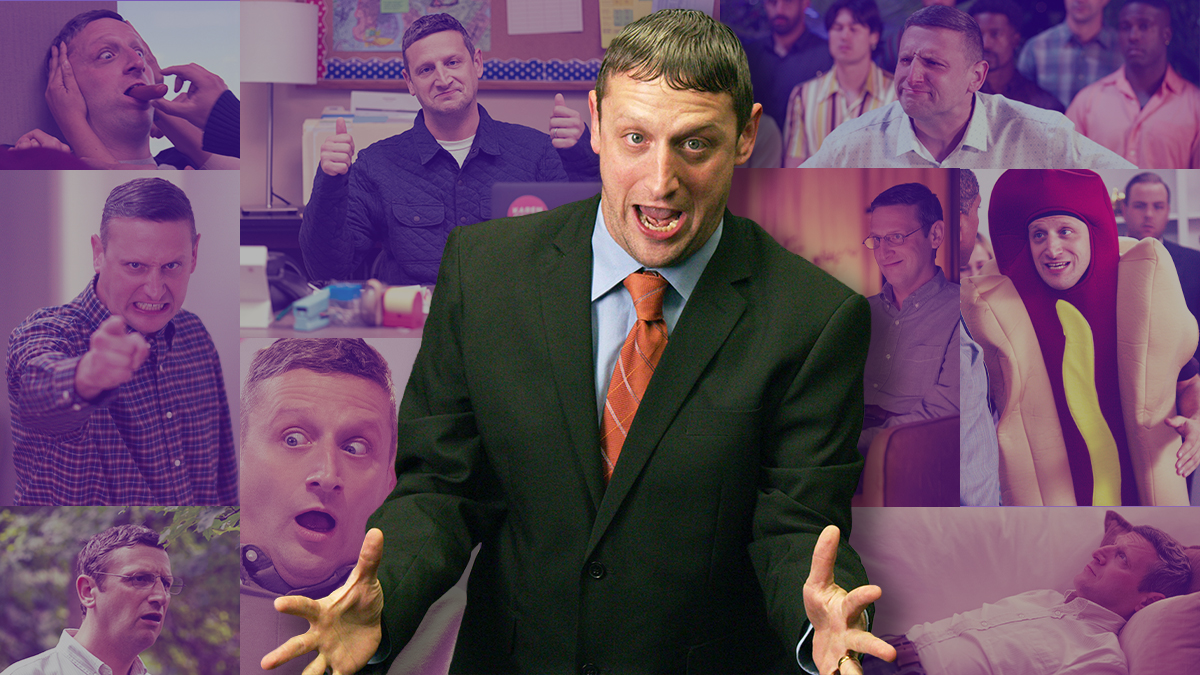
For as long as human beings have communicated with each other, the concept of “cringe” has plagued social interactions. Defined by Oxford Languages as “an inward feeling of acute embarrassment or awkwardness,” cringe is an emotion most commonly felt by those who are gaining social consciousness while learning how to live in changing bodies – in other words, teenagers.
As the first generation to spend those teenage years in the panopticon of social media, Generation Z is even more sensitive to feelings of cringe than preceding generations. Forbes even reported that Gen Z employees perform worse than their older counterparts in the workplace due to a fear that trying too hard or caring too much will make them come off as cringe. So, when a performer emerges whose caricature is eccentric, obnoxious, and has a knack for creating uncomfortable situations, why is it that Gen Z audiences can’t look away?
Tim Robinson began his comedy career while the youngest members of Gen Z were being born, first at The Second City and then working his way up to a performing and writing gig on Saturday Night Live. In these early years, he asserted his mastery of awkward body language and an inability to read the room, as seen in sketches like “Roundball Rock” and “We Present Her To You” in Season 38 of SNL. However, his style of uncomfortable comedy may have been too much for a live studio audience to stomach and resulted in the brevity of his time at SNL.
After his single-season run at Studio 8H, Robinson went on to create the cringey, yet somewhat more standard sitcom Detroiters, co-starring his long-time friend Sam Richardson. Then, he achieved new levels with the apocalyptically cringe sketch series I Think You Should Leave With Tim Robinson on Netflix. Both shows have found a second life in short-form social media clips due to the brash, high energy impact Robinson leaves within a matter of seconds. Any Gen Zer with an Instagram account has seen a meme of Robinson’s face or heard someone referencing his drive thru order from “Pay It Forward.”
While the sketches have a rich afterlife as online memes, the first watch of sketches like “The Ghost Tour,” in which Robinson’s character ends up in tears after unleashing a load of obscenities during an adults-only tour of a haunted house, can be excruciating.
Robinson’s popularity among Gen Z is certainly due in part to the “memeability” of his comedy style, but it still doesn’t account for how he, alongside his SNL writing partner and co-creator of Detroiters and I Think You Should Leave, Zach Kanin, has managed to make cringe funny for a generation that is intrinsically averse to discomfort and humiliation.
“It’s probably the same reason people enjoy horror movies,” Loren Soeiro, a clinical psychologist based in New York City, said. “People like to receive certain levels of stimulation in a safe way. They’re scared, but they’re actually not going to be murdered. They may identify with somebody being murdered or under threat of murder on the screen, but that feeling is something they can ride and enjoy the highs of in the context of safety, because it’s not fun at all to feel scared if you don’t feel safe. And I think cringe comedy is the same thing.”
In his article for Psychology Today, titled “The Psychology of Cringe,” Soeiro writes that “most of us are programmed – neurologically speaking – to feel bad if we do things that cause pain or embarrassment.” Using anecdotes like calling a teacher “mom” or making a crass joke in front of the wrong crowd, Soerio explains that humans are wired to see these moments as threats to our social health.
“Going through something like that is very unpleasant, but it’s very relatable as well and it’s easy to identify with somebody going through it,” Soeiro said. “In terms of comedy, to see a situation like that, carefully sketched out and then escalated and escalated and escalated until it’s extremely heightened, that sounds entertaining.”
The careful curation and escalation of a “cringey” moment is exactly where Robinson shines as a comedian, although he frequently declines to comment about the nature of his comedy style. Almost all of the bits in I Think You Should Leave are a result of his character intensifying a situation to outlandish levels. His most recent project, The Chair Company, follows a project manager who, after a slightly embarrassing moment at work, finds himself wrapped up in a corporate conspiracy.
All of these jokes and plotlines are carefully designed to make audiences feel better about their own reactivity in uncomfortable situations. Robinson takes relatable moments that could happen to anyone and shows the audience just how much worse it could get. If Gen Z is more self-conscious of being cringe than any other generation, it makes sense that they are most likely to find comfort and solidarity in that kind of comedy on screen.
Seb Laspiur is a fourth-year fine arts student at the University of Cincinnati, a diehard fan of Tim Robinson, and a contributor at Skit Pit, a sketch comedy show created by a group of UC students in 2023. One of Laspiur’s acting credits is in the show’s comedy music video “DE2ROIT,” in which a date is derailed by Laspiur’s counterpart insisting that the date cannot proceed until they watch an episode of Detroiters.
As a real-life fan of Detroiters, Laspiur said the video was “really fun to shoot,” and is not the only one that takes inspiration from Robinson’s comedy. Laspiur’s discovery of Robinson began, as it so often does, with seeing clips on social media that were too jarring to ignore. This led Laspiur to give I Think You Should Leave a try.
“I ended up binge watching it and loving it, just the whole nonsense of it,” Laspiur said. “How do they even come up with this stuff that makes no sense, would never happen in real life, but is so funny?”
Laspiur recognizes that cringe comedy wouldn’t be as effective without other elements for the audience to cling to. For Robinson, that extra angle comes in the form of a ridiculousness that borders on surrealism.
“I think it’s the combination of cringe and the sort of abstract humor that really connected with Gen Z, with all the abstract and surrealist memes that were popular for a while,” Laspiur said. “I think he just encapsulates a lot of Gen Z culture and comedy in a lot of different ways … especially coming from this older, kind of ridiculous looking guy, it just strikes your funny bone real hard.”
The post How Tim Robinson Made Cringe Palatable for Gen Z appeared first on Den of Geek.