By
By 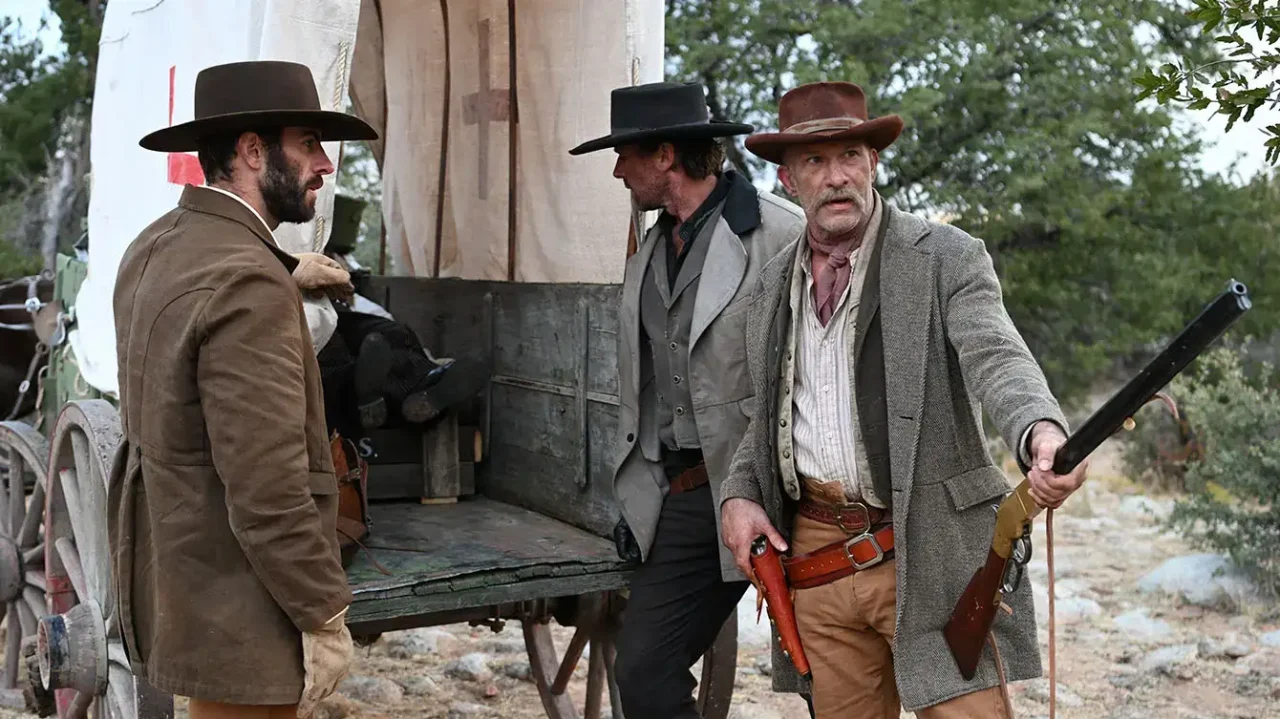
Frontier Crucible following a lone gunman tasked with escorting a wagon of vital medical supplies through hostile territory, where moral codes are tested as harshly as survival instincts. Set deep in Apache land, the story centers on a journey that quickly becomes less about distance and more about trust, as danger closes in from both the surrounding wilderness and the people riding alongside it.
The film’s stoic anchor is Merrick Beckford, played by Myles Clohessy with deliberate restraint and physical authority. Beckford is a man defined by silence and principle, a drifter carrying an unspoken past and a rigid sense of duty that drives him south toward the town of San Carlos. Clohessy channels classic Western archetypes without parody, grounding the character in resolve rather than bravado.
Opposing him is a trio of outlaws whose true intentions remain deliberately opaque. Thomas Jane delivers the most textured performance of the group, disappearing into a weathered Southern drawl and embodying a calculating opportunist who understands patience as a weapon.
Ryan Masson plays volatility and recklessness, while Armie Hammer’s quieter antagonist leans into cruelty through implication rather than overt menace. Their collective presence turns the wagon into a pressure cooker, where every mile heightens the threat of betrayal.
Emotional grounding arrives through Beckford’s bond with Valerie, portrayed by Mary Stickley with an earnest vulnerability that contrasts sharply with the cynicism around her. Her relationship with Beckford introduces stakes beyond gunfire, reinforcing the idea that survival in the frontier is as much about protecting innocence as it is about drawing first. The dynamic between protector and passenger provides the film with its most human moments, allowing stillness to carry as much weight as confrontation.
Director Travis Mills, whose previous work has favored intimate genre storytelling over spectacle, approaches Frontier Crucible with restraint and confidence. He avoids over-scoring scenes, often letting silence and ambient sound dictate tension, which proves effective as distrust builds among the characters. Mills understands the Western as a genre of pauses and glances, using time itself as a narrative tool rather than rushing toward violence.
When action does arrive, it is grounded and purposeful. Gunfights are brief, sharp, and consequential, with no indulgence in excess choreography. Stunts emphasize realism over flourish, reinforcing the fragility of life on the frontier. The camera remains close during moments of violence, denying the audience the comfort of spectacle and instead forcing engagement with cause and effect.
Cinematographer Maxime Alexandre elevates the film visually, capturing sweeping desert landscapes bathed in saturated oranges and piercing blues. These vibrant vistas stand in stark contrast to the moral decay unfolding within them, creating a visual irony that strengthens the narrative. Wide shots establish isolation, while tighter frames during wagon scenes heighten claustrophobia and suspicion.
Frontier Crucible does not reinvent the Western genre, nor does it attempt to dismantle its conventions. Instead, it executes them with discipline and respect for character-driven tension. This film will resonate most with viewers who appreciate slow-burn Westerns built on moral conflict, restrained performances, and atmosphere over novelty. Fans of classic frontier tales will find a sturdy, well-crafted journey worth taking, even if the destination feels familiar.