By
By 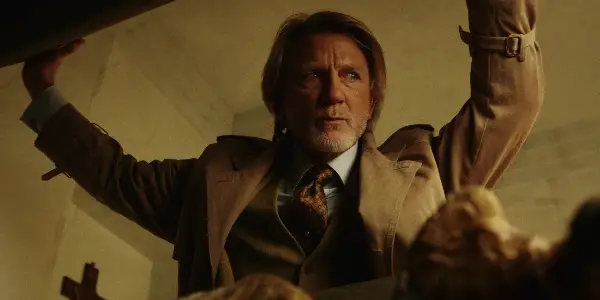
A dead priest, an impossible murder, an obvious suspect, and half a dozen suspicious characters. It sounds like a great setup for a detective story — the perfect next case for writer-director Rian Johnson, whose Knives Out series represents the best modern whodunnits. His third film, Wake Up Dead Man, has all of the clockwork writing, engaging characters, and ornate structure you’ve come to expect from these films. But what elevates it above its peers is its thematic depth as it earnestly investigates the nature of faith.
Every Knives Out film is about wealth, power, corruption, and the crimes that desperate people will commit to hang onto that wealth and power just a little bit longer. In every film, private detective Benoit Blanc (played with a squawking Southern accent by Daniel Craig) mysteriously arrives at the scene of a crime and then picks, prods, and pokes at the guilty people until he truffle-pigs a murderer out from their midst. The first film focused on a wealthy dead patriarch and his brood, and the second a powerful and powerfully stupid billionaire and his small group of hangers-on.
In Wake Up Dead Man, asshole priest Monsignor Jefferson Wicks (played with deliciously noxious sleaze by Josh Brolin) is a patriarch of a different sort, a commanding small-town preacher with connections to the six most influential people in town. However, Wicks is killed in the middle of his own service — stabbed in the back alone in a closet. Fingers point to Jud Duplenticy (Josh O’Connor), the new assistant pastor who’s quickly made an enemy of Wicks. Blanc swoops in to assist the local sheriff Geraldine Scott (Mila Kunis) with solving the case and, hopefully, exonerating the new pastor.
Benoit Blanc Plays Second Fiddle Again
Detective Blanc always worked best, for me, as a supporting character. Ana de Armas’ good-natured nurse Marta Cabrera is the protagonist of the first Knives Out film, as well she should be — that film’s themes of the corruption of wealth, the manipulation of vulnerable immigrants, and the hollow promise of the American Dream only really work if Marta is our main character.
“Wake Up Dead Man: A Knives Out Mystery” (2025) – source: Netflix
While it’s fun to see Craig take center stage throughout Glass Onion, the character is a little too resolute and static to be an entertaining lead for more than one film. Thankfully, he’s very much playing second fiddle again in Wake Up Dead Man. Taking the lead role, O’Connor gives one of the best performances of his career as the embattled priest at the heart of the mystery.
O’Connor’s Jud Duplenticy is a jumble of interesting contradictions: He is a former boxer who entered the priesthood after killing a man in the ring. He’s a lanky, squirrely-looking guy, but he can give as good as he gets — and he often does. And while he wants to honestly help the parishioners and nurture their faith in God, he also recognizes that one of them is likely Wicks’ murderer, and he seems to delight in helping Blanc nail whoever dunnit.
Supporting O’Connor is a strong cast of suspects. The call sheet includes Kerry Washington, Cailee Spaeny, and Thomas Haden Church, who are each wonderful albeit a little underused and underwritten. Andrew Scott is vivacious and sarcastic as ever as a has-been sci-fi author, and Jeremy Renner plays well against type as the drunk town doctor. None of them are particularly memorable characters, but they at least have more dimension than the least-developed of the bunch in Glass Onion.
The real heavyweights here are Daryl McCormack, playing a failed politician who’s trying to become an influencer, and Glenn Close, as Wicks’ devoted assistant and confidante. McCormack doesn’t have an enormous role in the drama until much later, though the actor displays range and straight-faced comedic timing that I wasn’t aware he possessed. Close, meanwhile, is unbelievably good as a ridiculous, histrionic character whose layers of bilious hate are steadily stripped away. Her performance here reminded me why her name is often bandied about in the conversation of our greatest living actors.
Exploring Religion and Faith
The Benoit Blanc mysteries have always — for better or for worse, depending on who you ask — had their fingers on the pulse of modern society. The first film heavily references Donald Trump’s first term as president, one of the characters is a Neo-Nazi who enjoys trolling people online, and Toni Collette is playing a character who’s basically just Goop CEO Gwyneth Paltrow. The second film is a long lambasting of Elon Musk and the Silicon Valley tech world, with references to such quintessentially 2020 cultural touchstones as Jared Leto, hard kombucha, Among Us, the COVID-19 pandemic, and manosphere influencers.
“Wake Up Dead Man: A Knives Out Mystery” (2025) – source: Netflix
Wake Up Dead Man is far less comedic than its predecessors, with Rian Johnson’s sharp, cutting dialogue focusing on weighty themes like religion rather than easy swipes at clueless tech billionaires or racist in-laws. That being said, we do get a few references to modern rightwing American politics and a joke or two about Blanc’s technological illiteracy — it wouldn’t be a Knives Out film without them! But under the hood, the film is much smarter than Johnson’s previous work, and like the eat-the-rich wealth critique of Glass Onion, the religious themes of Wake Up Dead Man resonate deeply with modern American politics.
It’s no secret that American society as a whole is pulling away from organized religion. Since the Silent Generation, every new generation of Americans has been reportedly less religious than the one before. Yet in our increasingly tribalized and terminally online society, the people who believe in religion are more vocal and more visible today than they were 30 years ago, and the Republican Party has essentially weaponized its majority-Christian base to use religious dogma as an excuse for barbaric domestic policy. Statistically, we might be less religious than ever, but religion continues to be a powerful and dangerous component of American life and politics. Even in the tiny Upstate New York parish of Wake Up Dead Man, we’re reminded that in America, religion usually comes with political baggage.
I’m surprised that Johnson chose to focus on religion at all and equally surprised that he approached it in such a mature manner. It would be easy in 2025 to make a Knives Out film where Benoit Blanc runs into a church, owns all the good Christian sheep with facts and logic, exposes a few acts of abuse from a priest or cardinal, and then credits roll. But that isn’t Wake Up Dead Man. Instead, you can feel Johnson working through his complicated feelings on faith. The writer-director was raised Protestant but moved away from religion over time. He has Jud Duplenticy within him somewhere, and Benoit Blanc, too — Wake Up Dead Man is about those conflicting viewpoints on faith and religion butting heads on the long winding road toward salvation and truth.
This is where Johnson’s writing really shines. The man knows how to write punchy, character-driven dialogue, as he’s shown in Knives Out and Glass Onion. He can structure a compelling mystery and craft an exceptional climactic monologue. But the dialogue in Wake Up Dead Man is simply about more than the dialogue in his other films — the characters are each talking about storytelling, faith, guilt, love, and blind obedience. It’s the only one of these films where Blanc’s perspective is not necessarily the correct one, and as a result, the religious debate he has with Jud that lasts nearly the entire film winds up being far more engaging than the murder mystery.
“Wake Up Dead Man: A Knives Out Mystery” (2025) – source: Netflix
Ultimately, Wake Up Dead Man acknowledges the value of religion while also denigrating the people like Wicks who preach the teachings of Christ as though the world is a constant battle between the faithful and the faithless. Wicks’ demented, us-versus-them approach to Christ’s teachings stokes the flames of hatred and preys on the guilt of his congregation. He preaches from a place of ego rather than faith. As a counterpoint, Wake Up Dead Man also shows us Christianity as it ought to be — Jud’s wholesome desire to make the world a better place by reaching out to the people who need His love most, lifting them up, supporting them, and guiding them. We’re left with the sense that God — underlined in the film’s closing song, Tom Waits’ cover of “Come On Up To the House” — accepts everyone, regardless of their beliefs or background. God loves the innocent as well as the guilty.
The Road to Damascus
The title “Wake Up Dead Man” obviously refers to Brolin’s priest, supposedly resurrected on Easter Sunday — but I feel it equally applies to our two protagonists, Benoit Blanc and Jud Duplenticy. At the start of the film, Jud is fighting — he socks a fellow priest in the jaw and goes to Our Lady of Perpetual Fortitude ready to combat Monsignor Wicks, whose ignoble reputation precedes him. Jud doesn’t realize it yet, but he’s forgotten why he wanted to be a priest in the first place. It’s not until later that he has what he calls his “road to Damascus” moment — a realization that what he needs to do, what he’s been put on this Earth to do, is heal divides, care for broken people, love them even when they’re guilty, and lead lost souls back to the path of light.
The scene, which comes about 80 minutes into the film, is beautiful, and in it, Wake Up Dead Man ascends from a really good film to a genuinely great one. Jud calls Louise (Bridget Everett), who works for a construction company crucial to the mystery. Blanc is waiting for him to find out the essential information, a little impatiently, urging him to end the conversation and hang up. But then Louise says, “Can I ask you something?” And she asks Father Jud to pray for her.
Something shifts within Jud. He’s no longer a novice detective, but he’s a priest once again. The assistant pastor listens, holding the phone to his ear, while Louise tells him about her troubled relationship with her sick mother. Blanc, unblinking, watches him from across the room — as though he can’t believe that Jud just put his murder investigation on hold to speak to a random woman on the phone. But if Blanc is upset, he doesn’t say anything. There’s a silent respect Blanc seems to have in this scene, as though he’s learning for perhaps the first time what true faith means.
“Wake Up Dead Man: A Knives Out Mystery” (2025) – source: Netflix
Jud’s eyes go to the Jesus figurine that he and Blanc had, just moments earlier, gleefully smashed apart looking for clues — now just a broken talisman on the desk reminding Jud how far he’s strayed from the path of God. Jud tells Louise that he’s there for her. Then, without saying a word to Blanc, he turns and leaves the room, closing the door behind him. Blanc clucks his tongue and sighs but waits — hours — for Jud to finish the call. When the two reconvene, Jud is a changed man. It’s as though he’s woken up.
Blanc experiences an awakening as well. We’re so used to the character being an unchanging fortress of objective truth in a storm of backstabbing and idiocy — his role in Knives Out and Glass Onion is mostly a static one. After all, the investigators in detective fiction rarely experience character arcs as a result of their cases. But Blanc changes in Wake Up Dead Man. For the first hour and a half, he repeatedly expresses to Jud that he doesn’t believe in God and perhaps looks down on people who do.
“It’s like someone has shown a story at me that I do not believe,” he tells Jud on their first meeting, in the empty church hall. “It’s built upon the empty promise of a child’s fairy tale filled with malevolence and misogyny and homophobia, and it’s justified untold acts of violence and cruelty while all the while, and still hiding its own shameful acts. … I want to pick it apart and pop its perfidious bubble of belief and get to a truth I can swallow without choking.”
Yet in the climax, Blanc is in the middle of one of his characteristic monologues where he lays out all the puzzle pieces and pins them to the killer, but he stops short of the point. “Damascus,” he whispers, looking into a golden ray of light. “I cannot solve this case,” he says as he slumps down on the steps of the altar.
“Wake Up Dead Man: A Knives Out Mystery” (2025) – source: Netflix
He doesn’t suddenly start believing in God — “God is a fiction,” he insists to Mila Kunis’ local police chief. But something has changed within Blanc. A light has come on in a formerly dark corner of his mind. He stops short of actually reifying this change, only telling Geraldine Scott that he realized that Father Jud taught him to have “Grace for my enemy. Grace for the broken. Grace for those who deserve it the least but who need it the most.”
Blanc experiences an awakening — even if he doesn’t agree with Jud’s belief in the Almighty, he understands that even the guilty need our empathy and grace. He realizes the meaning of Christianity as Jud practices it and the importance of respecting those beliefs. The film appropriately ends with Blanc instructing Jud to take the killer’s confession and, finally, deliver last rites.
Conclusion
It might seem that I’ve talked a lot about what Wake Up Dead Man is about without explaining why it’s good. But you know you’ve seen great cinema when you can write 2,000 words about its depiction of faith and stance on religion. What elevates Wake Up Dead Man above Knives Out and Glass Onion is not the plotting or the characters, which are as first-rate as Rian Johnson has ever written, but that additional layer of religion and faith. These films are all about something beyond the basic murder mystery, but Wake Up Dead Man allows Blanc to express an opinion — it allows him to be wrong — and in the process it winds up offering a really moving perspective on the importance of belief.
There are precious few references within Wake Up Dead Man to the larger sociopolitical climate the characters exist within. But we aren’t stupid — we know that the question of faith’s purpose in the modern world has everything to do with society and politics. Those who preach hate hide behind the words of gospel as though they’re an impervious suit of armor. People like Wicks and his opportunistic flock of sycophants are some of the most dangerous people in America today, because they claim that they’re doing the Lord’s work when, really, they’re serving themselves.
Wake Up Dead Man is about what Christianity is, what it’s turned into, and what it should be. Religion should not be a castle, shut up with a drawbridge with a moat around it. It should support anyone who needs it, whether you’re a killer, a shitty sci-fi author, or an atheist detective. Leave your prejudices at the door, and take a pew. Come on up to the house.
Wake Up Dead Man is now playing on Netflix and in select cinemas.
Does content like this matter to you?
Become a Member and support film journalism. Unlock access to all of Film Inquiry`s great articles. Join a community of like-minded readers who are passionate about cinema – get access to our private members Network, give back to independent filmmakers, and more.