By
By 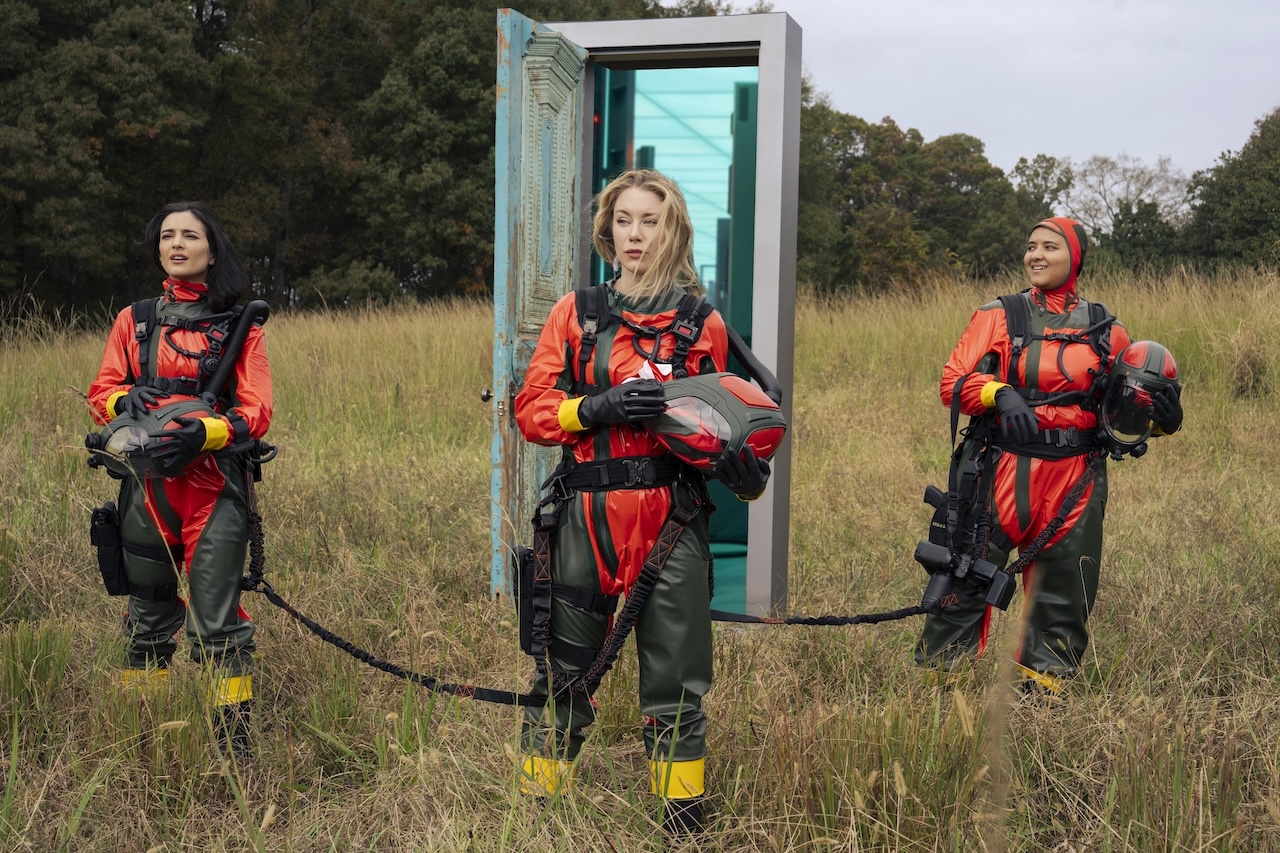
In the canon of DC Comics, the multiverse includes worlds in which talking animals are superheroes and multiple realities ruled by evil Superman. But we’re just getting to know the multiverse of the DCU, which makes its first appearance in season two of the series Peacemaker. How do you visualize dimensions beyond the superhero-filled reality of the DCU?
For production designer Kalina Ivanov, it all comes down to having the right tone. “I approach it as a comedy,” Ivanov tells Den of Geek in an exclusive interview. Calling herself the “the coincidental superhero designer,” Ivanov confesses, “That’s one genre I never intended to do.” And yet, she couldn’t pass up the chance to work with James Gunn (“He’s a pleasure,” she enthused), collaborating with the DC Studios co-head to bring to life to new universe’s multiverse.
Ivanov comes to the project with her own multifaceted set of credits. Her work can be found in everything from Smoke and Blue in the Face, two gritty New York movies that bring together indie director Wayne Wang and author Paul Auster, to rom coms Uptown Girls and Made of Honor, to the more heightened worlds of the HBO series Lovecraft Country and The Penguin. HBO is also where Ivanov found her greatest success, earning a Primetime Emmy award for her work on the 2009 biopic Grey Gardens.
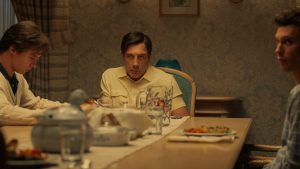
Varied as those experiences were, only Peacemaker presented a unique challenge. In the show’s second season, Peacemaker Chris Smith (John Cena) enters a doorway to another world, in which he’s loved by his father Auggie (Robert Patrick) and accepted as a superhero. Late in the season, both Chris and the viewers discover that his perfect world, dubbed Earth-X, is actually controlled by Nazis. The revelation gets worse when intelligence organization ARGUS sends Chris’s friend Emilia Harcourt (Jennifer Holland) and others to explore the alternate realities, sometimes with horrific results.
To bring the worlds to life, Ivanov had a task much less dangerous, but no less difficult. She had to create sets that fit in with a Nazi world, but she could not include obvious tells, keeping the swastika flags and even a giant Hitler mural off screen.
“In Auggie’s mansion in the alternate world, we used German things for the set decoration, such as German furniture and German mugs,” she reveals. “But it wasn’t overt or in your face.” The challenge for Ivanov was acknowledging the reality of a world conquered by Nazis without letting the story get too heavy.
“I looked at it like we were making The Producers,” Ivanov says, drawing a comparison to the Mel Brooks farce about Broadway grifters staging an intentionally bad musical about Hitler. “There’s a Nazi here, but it’s funny!”
Ivanov could also rely upon guidance from James Gunn, who included all of the set details in the script. “It was all scripted, and we only executed that,” Ivanov explained. But she did point out one details in the alternate world about which Gunn was particularly concerned, which appears in the other Chris’s bedroom.
“The posters of the bands were very important to James,” emphasizes Ivanov. In addition to making sure that the group Hanoi Rocks spelled their name “Hanoi Roxx,” Ivanov points out that Gunn really cared about the Def Leppard poster. “That one we did with “Def” spelled ‘D-E-A-F’ and we wrote “Pour some honey on me” versus “Pour some sugar on me.’ But the rest of them he left up to me, so I went to town on the others, the Scorpions, the Cruel Intentions,” she says with a smile. “We had a lot of fun.”
“Fun” is a word that Ivanov uses a lot to describe the process of making Peacemaker, even when Gunn’s script calls for something difficult to imagine. To make the brightly-colored reality in which Harcourt and other ARGUS agents get attacked by imps, Ivanov needed to do some extra research.
“The first thing I had to do was get the game Candyland, but then James showed me his design for the imps. He has these very interesting sketches that he does, they’re really scratches, but they’re very evocative. He said, ‘It’s a six inch creature and I want it to run through the grass. You don’t see it at first, but when you do, it’s cute at first and suddenly it’s awful.”
Based on those two sources of inspiration, Ivanov and her team created the imp world by building a practical set and augmenting it with CGI. “We had a lot of samples of grass for James, and we went through a lot of pinks to find the exact shade of pink he wanted,” she pointed out.
As much she emphasizes Gunn’s involvement and control in the creation of Peacemaker, Ivanov also points out that he’s open to collaborating with his team. For example, when the script for episode three required Chris to enter a building by jumping from a rooftop, Ivanov pitched the idea of having him jump off of a nearby billboard. “James loved it, and he made it a rock band [The Mighty Crabjoys from Superman]. It was a tiny detail, but it was really personal.”
Likewise, the zombie world that the ARGUS agents find was “originally designed to be an open road,” Ivanov points out. “But then we found an old village modeled after the 16th century that was built for another movie, so we made that the zombieland.” Although the change required her to throw out everything she had initially designed, Ivanov insists that it’s “always a joy” to go through the creative process. “As long as we end up with the right decision, everything is up for grabs.”
It’s that type of openness to experimentation that makes Ivanov such a good fit for Gunn’s universe. But it also allowed her to bring to life another corner of the DC world, one not part of the mainline universe.
Opposed to the open greens and well-lit office buildings of Peacemaker is the Gotham City of The Penguin, which Ivanov designed for the spinoff of The Batman. Set after the Riddler’s attack in that film, The Penguin features a particularly run-down version of Gotham City. Drawing from her own memories of living in New York City after Hurricane Sandy, Ivanov grounded the comic book metropolis in real destruction.
“The Penguin is about a city in decay, a city that’s been left by the rich people,” Ivanov points out. “They all live in the suburbs and the city is left to the poor, and the have-nots. To make a city in disrepair, “we brought in forty tons of dirt to create the destruction.”
With Gunn, Ivanov has to prepare for another type of destruction, the mayhem of the fight scenes he stages. “James will be the first to tell you this, but he considers himself a stunt director,” she points out. “Once you know that, you know that the stunts will be the most important part of the episode.”
For Ivanov, that meant she didn’t have to match Gunn’s knowledge of the comics, or even study the comics themselves. “I mostly approached Peacemaker a comedy, but I considered Peacemaker a real character, and I even fought for the Art Directors Guild to classify the show as contemporary [for their annual Excellence in Production Design Awards], even thought they listed it as a fantasy.”
Thanks to Ivanov’s work, we viewers see Peacemaker as something real, even when Chris’s adventures take him to other realities.
Every episode of Peacemaker is now streaming on HBO Max.
The post Peacemaker Production Designer Talks Earth-X Easter Eggs, Gotham City, and More appeared first on Den of Geek.