By
By 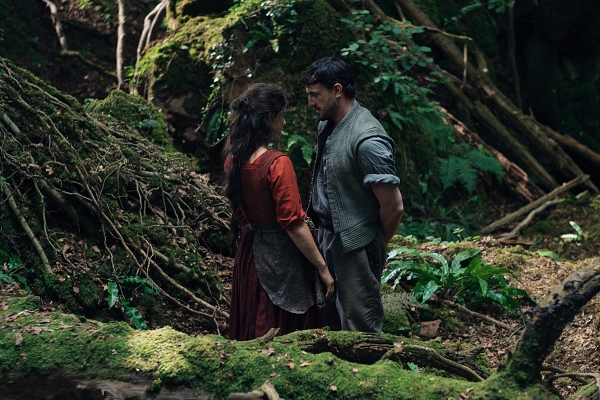
The therapeutic power of art reverberates through both creator and observer. There’s something that stirs the human spirit in encountering it, especially when it comes carved straight off the bone of the soul. And no emotion strikes deeper than the sorrow born of tragedy. In Chloé Zhao’s powerhouse of a dramatic tearjerker, Hamnet, tragedy and art are married through a human tapestry of love and loss. Buckle up and bring the Kleenex.
Jessie Buckley and Paul Mescal star as Agnes and William, each their own brand of outcast in the domesticity of their small hamlet. He’s a tutor and aspiring playwright, son of a disapproving leather craftsman; she’s an enigmatic seer, rumored to be the daughter of a woodland witch. The film tracks their burgeoning romance, beset on both sides by disapprovals but ultimately bested by love. Still, Agnes’ visions of her future children bear ill tidings of what’s to come.
Beautifully made and strikingly told, Hamnet sees Zhao return to her deeply humanist roots after the blockbuster-sized misfire that was her foray into the MCU with the all-around unfortunate Eternals. Adapted from Maggie O’Farrell’s 2020 historical fiction novel of the same name, Zhao’s latest finds the auteur operating at peak power: intimate, lyrical, and emotionally unflinching. Hamnet is as much a story about the depth of love as it is the tragedy of life. Agnes and William’s fledgling romance burns with passion and as they come to welcome children into the world, that passion grows. But William’s artistic aspirations have grown also and being stuck out in nowhere is not suitable to the livelihood of an artist so he strikes out for London. Agnes, worried over the health of their growing flock of children, is hesitant about a move to the city with its disease and dangers. Tears in the fabric of the family begin.
Jessie Buckley and Paul Mescal are both fantastic in the lead roles. Mescal, who’s built quite an alluring résumé since his debut in Normal People, channels the simmering intensity and quiet desperation required of William. But it’s Buckley’s turn as a metaphysically-sensitive mother that proves the real showstopper. Her performance is a tour de force of minxy flirtation and raw emotionality. She moves through the stages of Agnes’s life with such lived-in clarity, her feelings seem to drip off the screen, offering what is easily one of the year’s best performances through the highs and lows of Hamnet.
12-year old Jacobi Jupe is quietly remarkable as the titular Hamnet, bringing a specter-like sensitivity that exceeds his years, connecting the tangible world to something just out of reach. Through him, the film channels the metaphysical undercurrents that we intuit through Agnes but never fully see. His is a performance that deepens the film’s emotional pull and underscores its more haunting, otherworldly qualities. And though Hamnet left me deeply moved, its weight settles in the body like a bruise. This is the kind of aching beauty that may resist return visits. As a parent especially, it is a film that is hard to shake and even harder to face twice.
So too does Zhao deliver a masterclass in directorial prose with Hamnet. Every beat of this thing pulses with energy and emotion. For a film so subtle in its aims, it still manages to wallop you over the head. She’s assembled a truly impressive menagerie of outstanding production craftspeople: 1600s-appropriate costumes from Malgosia Turzanska (The Green Knight, Pearl), a sparse but effective score from composer Max Richter (Arrival, The Leftovers), lush and haunting cinematography from Lukasz Zal (Ida, The Zone of Interest), and period-accurate production design from Fiona Crombie (The Favourite, Beau is Afraid) that serve to help fill in the margins about these characters. The whole film feels transportive and meticulously thought through as no single detail is left to chance; Zhao’s vision is complete and is frequently quite stunning.
[READ MORE: Our review of ‘Eternals‘ directed by Chloé Zhao and starring Gemma Chan]
While it’s no secret that the novel and film serve as an imagined origin story for Shakespeare’s Hamlet, Zhao’s focus isn’t on tracing breadcrumbs. It’s on psychology, on building out relationships so layered and intimate that the emotional impact far exceeds what a film about writing a play usually dares to reach. This isn’t really a story about where Hamlet came from. It’s about the absolution of art through the lens of a very specific family tragedy.
Sometimes we endure things so horrifying they break us down completely. We lose everything that once defined us, disappearing into the fog of grief, ghosts unto ourselves. Rebuilding becomes painstaking, brick by brick, piece by piece, trying to feel whole again. Like the Japanese art of kintsugi—broken pottery repaired with gold—what emerges from our fractures can be more beautiful than what came before. That’s Hamnet: beauty, undoing, overcoming. Tragedy may not be conquered, but it can be contextualized, understood, even transformed into growth. Zhao welds personal devastation with artistic legacy in a way that’s profoundly moving and sure to bring any cineplex to a symphony of sniffles.
CONCLUSION: A profoundly moving portrait of family, tragedy, and how art binds us, ‘Hamnet’ is a stunning return to form for director Chloé Zhao, boasting one of the year’s best performances from Jessie Buckley and sure to leave you emotionally hammered.
A-
For other reviews, interviews, and featured articles, be sure to:
Follow Silver Screen Riot on Letterboxd
Follow Silver Screen Riot on Facebook
Follow Silver Screen Riot on Twitter
Follow Silver Screen Riot on BlueSky
Follow Silver Screen Riot on Substack
The post The Tragedy of ‘HAMNET’ and the Absolution of Art appeared first on Silver Screen Riot.