By
By 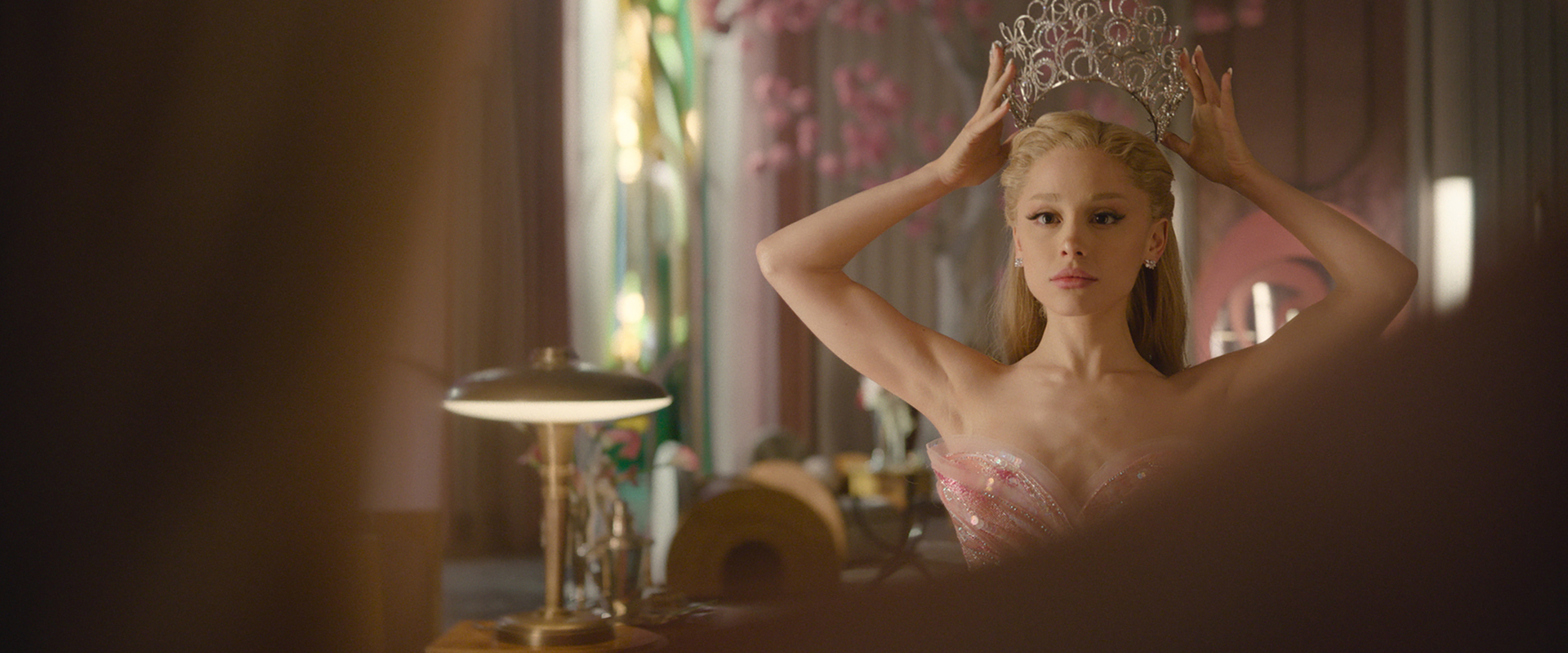
Wicked: For Good (2025)
You will be changed.
When a stage play is divided into two halves, the structure still holds — Act I and Act II each carry weight, and the emotional and musical peaks are naturally spread across them. But when a beloved stage musical is adapted for the big screen and then split again into two cinematic instalments, the dynamics sometimes shift. The best-known songs and the most dramatic beats can end up concentrated in the first film, leaving the second to function largely as connective tissue and aftermath. That imbalance is evident throughout Wicked: For Good, the concluding half of Jon M. Chu’s two-part adaptation of the hit Broadway musical Wicked, originally created by composer–lyricist Stephen Schwartz and writer Winnie Holzman, and itself based on Gregory Maguire’s 1995 novel. What follows is a slower, uneven continuation — replete with reprises, structural padding, and without any truly memorable musical moments to match its predecessor.
In the sequel, we pick up some time after the events of the first film. Elphaba Thropp (Cynthia Erivo), now branded across Oz as the “Wicked Witch of the West,” lives in hiding on the outskirts of the land, continuing her quiet efforts to protect Animals and expose the corruption behind the Wizard’s regime. Glinda Upland (Ariana Grande) has risen to prominence within the Emerald City, taking on a highly visible role as the public symbol of “goodness” under the Wizard’s increasingly manipulative rule. Their friend and mutual romantic interest, Fiyero Tigelaar (Jonathan Bailey), finds himself drawn into the widening divide between them, unsure where his loyalties lie as political tensions escalate.
Green, grim, and ready for a better movie.
Meanwhile, Nessarose Thropp (Marissa Bode) governs Munchkinland under growing pressure, and the Wizard (Jeff Goldblum) tightens his control as mysterious forces — both familiar and new — begin to converge on Oz. As Dorothy’s arrival and the legendary flying house set off a chain of events that reshape the land, the central figures are pulled back into one another’s orbit, setting the stage for the fateful confrontations that bring the Wicked saga to its conclusion.
Visually, the film is a spectacle: director Jon M. Chu handles the sets and large-scale staging with considerable flair. Oz appears grand and immersive, rendered through sweeping camera movements and lavish production design, even if the color palette remains surprisingly bland for a world meant to burst with magic. Still, the overall visual scale confidently delivers what’s expected of a blockbuster musical sequel. The CGI work is consistently strong as well, integrating cleanly with practical environments and giving the fantastical elements of Oz a polished, expansive sheen. On the surface, at least, the film checks the requisite “big screen event” box.
But beneath that surface the story begins to unravel in its handling of tone and narrative cohesion. The decision to adapt the second half of the stage musical as a standalone feature means that many of the strongest songs and emotional turning points were spent in the first instalment; this sequel inherits the burden of tying up threads, reframing earlier events, and forging a bridge to the established mythology of the 1939 Wizard of Oz. That connection is ambitious but ultimately feels strained. For viewers unfamiliar with the original classic, fundamental elements arrive without introduction: Dorothy appears with little context, a flying house descends from the sky with minimal explanation, and key story beats rely on outside knowledge never supplied. For those who do recognize the references, additional inconsistencies emerge — most notably the fact that the events in the 1939 film are famously framed as a dream, a detail that destabilizes the reality of this adaptation’s events and complicates the continuity it attempts to establish. Furthermore, instead of enriching the material, the reliance on inherited myth pushes major story beats into the margins or leaves them under-explained.
Ariana Grande, doing more heavy lifting here than the entire screenplay.
Plot points increasingly feel disjointed as the narrative attempts to reconcile the Wicked mythology with that of the 1939 Wizard of Oz. The Cowardly Lion — famously portrayed by Bert Lahr in the original — is reimagined here as a fully CGI, realistically rendered lion, a shift that clashes with both tone and continuity. The Tin Man, originally portrayed by Jack Haley and played here by Ethan Slater, is likewise reconfigured: instead of the gentle, rust-prone figure introduced in the classic, he is briefly depicted as a frenzied, pitchfork-wielding aggressor leading a mob to burn the witch, only to vanish from the narrative entirely.
Fiyero’s transformation into the Scarecrow is the film’s most conspicuous muddle. Jonathan Bailey’s interpretation is clearly intended to align with Ray Bolger’s iconic Scarecrow, yet the connection never truly coheres. The character presented here bears little resemblance — tonally or emotionally — to the wistful, loose-limbed figure who once sang “I would dance and be merry, life would be a ding-a-derry, if I only had a brain.” The canonical implication that this Scarecrow is the same individual who loved Elphaba further complicates matters, as the film never convincingly shapes Bailey’s character into someone who would later occupy Bolger’s place in Oz mythology.
Nessarose’s arc is similarly fraught. In this adaptation she governs Munchkinland, but her death carries no thematic or narrative alignment with the jubilant “Ding-Dong! The Witch Is Dead” sequence from the 1939 film; she is neither wicked nor feared, making that cultural echo perplexing within the continuity the movie insists upon establishing.
Swinging high, even as the script swings and misses.
The longstanding “water kills the witch” motif — iconic but logically fragile — is handled with even less internal coherence in this adaptation. Within the film’s own timeline, Glinda has spent years in close proximity to Elphaba: walking through storms, sharing living spaces, witnessing entirely ordinary interactions with water. Nothing in their history supports the notion that water poses any danger to her friend. This makes the climactic assumption that Elphaba has been fatally melted not only implausible but dramatically inert. Glinda’s belief in such an outcome collapses under the weight of everything she should already know, leaving the story’s most famous twist feeling unearned and nonsensical.
Together, these choices reveal a film caught between two canons and unable to satisfy either, resulting in a narrative fabric that frays every time it reaches back toward the 1939 legend it hopes to emulate.
Performances are decidedly uneven. Ariana Grande emerges as the undeniable center of gravity, offering a vibrant, sharply defined Glinda whose presence enlivens nearly every moment she occupies. She brings an effortless blend of theatricality and emotional precision, grounding the story whenever it risks drifting into visual excess. Cynthia Erivo, meanwhile, finds her strongest footing in the quieter exchanges, especially in scenes opposite Grande, where her restrained intensity and vocal power cut through the surrounding clutter. Beyond those moments, however, she is underserved by material that too often sidelines her in favor of plot mechanics. Michelle Yeoh struggles to locate a coherent register for Madame Morrible, a role that requires a degree of menace and slippery charm the screenplay never quite allows her to express. Her scenes land with an uncertainty that mirrors the broader tonal confusion. Jeff Goldblum, by contrast, leans into the Wizard’s theatrical bombast with a playful ease, and his rendition of “Wonderful” provides a rare spark of genuine levity.
Pay no attention to the man behind the curtain — or the plot holes.
Musically the production struggles. The two new songs, “No Place Like Home” and “The Girl in the Bubble”, arrive with the promise of expanding the emotional terrain, yet neither leaves a lasting impression. They feel functional rather than inspired — numbers designed to move the plot along rather than deepen its resonance. Part of the issue lies in the nature of this second instalment. With most of the iconic numbers already claimed by its predecessor, For Good inherits the connective tissue: reprises, transitions, and narrative bridges rather than the soaring centerpieces that defined Wicked’s stage legacy. The score seldom builds to genuine release or catharsis, and what should be emotional peaks often register as mild plateaus.
Without new musical heights to scale, the experience begins to feel elongated and rhythmically slack. Scenes drift instead of crescendo; songs pass without commanding attention. A musical of this scale demands at least one moment that stops everything in its tracks. Wicked: For Good never quite finds it, leaving its second half feeling more like an obligation than an occasion.
Themes that should resonate — identity, friendship, power, corruption, and the shifting nature of “good” and “wicked” — are all present, but the delivery is inconsistent. The film appears eager to explore a moral inversion in which the “good” and the “wicked” trade places, yet because Glinda is never convincingly shown committing meaningful wrongdoing, that arc never fully lands. These thematic ambitions are further weakened by the adaptation’s reluctance to embrace the original book’s inversion of moral binaries — the notion that those labeled “wicked” may ultimately guide the ostensibly “good” toward genuine moral clarity. Here, that concept falters because the script never portrays Glinda as morally compromised enough to necessitate such transformation; without a substantive starting point, her trajectory lacks the dramatic tension needed to sustain the theme.
A crowning achievement — in a film short on achievements.
Elphaba’s journey, meanwhile, is constrained by the constant need to align itself with the mythology of The Wizard of Oz, which repeatedly distracts from her internal conflict and prevents her storyline from developing on its own terms. Instead of forging a compelling standalone arc, the narrative remains tethered to its predecessor and to the legacy of the 1939 film in ways that feel more obstructive than expansive.
Ultimately, Wicked: For Good is a shambles. It works as a visual spectacle and perhaps as fan-service for those deeply invested in the world of Wicked, but as a standalone piece of cinematic musical theatre — or a satisfying link to the 1939 Wizard of Oz film — it’s a disaster. Ariana Grande’s Glinda is the bright spot, shining amidst the drift. The rest feels like a noble attempt that fails to capture the vibrancy or clarity of the original material. Fans eager to revisit Oz and the witches’ saga will find isolated moments to enjoy, but anyone seeking a robust, self-contained adaptation will encounter a film that seems to tread water rather than soar. In short: the first film may have defied gravity; the second merely struggles to stay airborne.
2.5 / 5 – Alright
Reviewed by Dan Cachia (Mr. Movie)
Wicked: For Good is currently streaming on Universal Pictures Australia