By
By 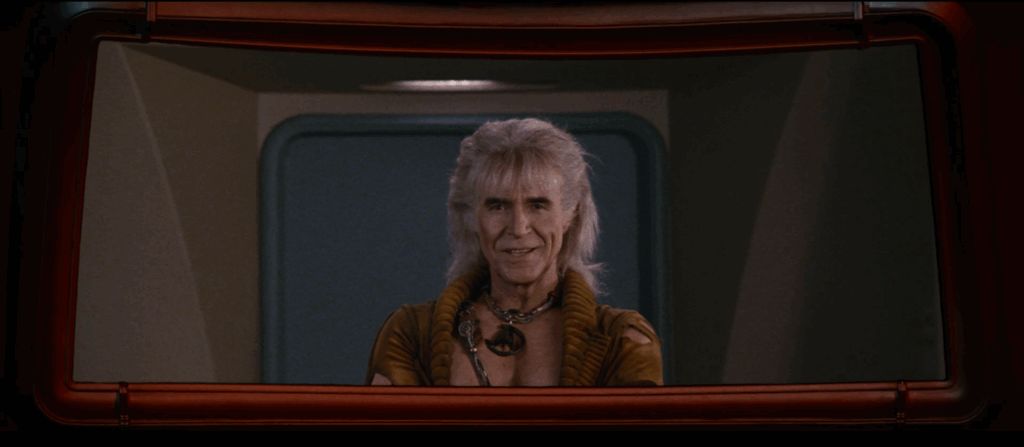
Title: Star Trek II The Wrath Of Khan
Release Date: 6/4/1982
Plot Summary
The Wrath Of Khan begins some 10 years after the V’ger affair. Kirk is still an admiral and training recruits. The Enterprise has become a training vessel and most of the crew is teaching young cadets to be fine Starfleet officers. It’s his birthday and he’s miserable. Spock is now captain of the Enterprise. Bones, Uhura, Scotty, and Sulu are all trainers. Chekov is on assignment on the USS Reliant to find a lifeless planet for the Genesis experiment.
We start out with the ship doing a patrol of the Klingon neutral zone when they get a distress call from the Kobayashi Maru. It’s hit a mine and is stuck in the zone.
Saavik, a Vulcan in command, orders the ship into the zone to rescue the crew but gets surrounded by Klingons who are not in the mood to talk. As the ship takes one hit after another, each of our senior crew dies. As she orders the remaining crew to abandon ship, the viewscreen wall opens up revealing that this is all a training exercise, no one has actually died.
Kirk emerges, revealing it was to test a commander’s mettle, as well as the rest of the trainees, in the possibility of a no-win scenario. Saavik is not happy about the test but Kirk tells her that it’s something that any commander may face. How we deal with death is at least as important as how we deal life, he says.
Bones asks Kirk why they don’t just put an experienced crew back on the Enterprise but Kirk, depressed about his birthday tells him that space travel is for the young.
Bones comes to Kirk’s place that night to celebrate his birthday, but mostly to try to break through his funk. He bluntly tells him that he needs to get back to being what he does best. Before he really does get as old as he thinks he is.
Meanwhile Chekov is first officer of the Reliant, serving under Captain Terrill. They come to Ceti Alpha VI to see if it’s a suitable planet for the Genesis experiment. It’s been a long assignment and he, along with the rest of the crew, are bored and frustrated. It must be a lifeless planet and of course lifeless planets are in abundance. However finding a completely lifeless planet, one that is in the proper distance from the sun, one that is a certain size, and various other requirements is turning out to be a lot harder than expected.
The leader of the project, Carol Marcus, tells them from their laboratory on Regulus I that there can’t be any life. What if it’s something that might be the beginnings of a planetary evolutionary process? What if someone came to earth when it was a volcanic hellpit and just messed around with it? Then again, it might be a planet at the end of it’s life. Chekov has found a possible life sign on Ceti Alpha VI and suggests it can be something they could transplant. She reluctantly agrees.
Her son is worried and doesn’t trust Starfleet, knowing that what they are working on can be turned into a dreadful weapon but Carol has a much more trusting view of military, having worked in it long ago.
Kirk has finished the grading of the cadets and begins the inspection of the Enterprise before taking them on a training cruise. There he meets Peter Preston, Scotty’s nephew who impresses Kirk with his enthusiasm. Spock has Saavik pilot the ship out of spacedock, something she’s never done, just to tweak Kirk a little.
Chekov and Terrill beam down to find a crashed ship. As they investigate, Chekov realizes that the ship is the Botany Bay, the ship Kirk and Enterprise found 15 years ago and left on Ceti Alpha V, along with the genetically enhanced superman from the 20th century, led by the ruthless Khan Noonien Singh. Turns out Chekov and Terrill are on the wrong planet. Ceti Alpha VI exploded just a few months after the Enterprise departed.
Ceti Alpha V has become a desolate wasteland. Khan is a bitter man now, consumed by his hatred of Kirk. He demands to know why Chekov and Terrill are there, realizing they didn’t expect to find them there. In order to get their cooperation, he releases the only lifeform that managed to survive on the planet, Ceti eels. They burrow into the victim’s ear and make them susceptible to suggestion before finally killing their host, as one did to Khan’s wife.
From there they take over the Reliant and find out about Genesis. Khan uses Chekov to pretend to be ordered to take Genesis to Starfleet, causing Carol to try to reach Kirk. Her message is garbled and Kirk is quite mystified why she thinks he ordered the confiscation of Genesis. He notifies Starfleet and is ordered to investigate, unaware that the Reliant—now under Khan’s control—is already en route.
When the two ships encounter each other near the Mutara Nebula, the Enterprise is caught completely off guard. Thinking the Reliant is friendly, Kirk hails them—only for Khan to strike without warning. Phasers and torpedoes slam into the Enterprise, crippling her instantly. Several cadets are killed, including young Peter Preston. As smoke fills the bridge and systems fail, Khan finally reveals himself to Kirk. The hatred in his voice is unmistakable.
Kirk tries to stall, playing on Khan’s arrogance while Spock quietly works to restore limited power. Using his experience and cunning, Kirk tricks Khan into lowering the Reliant’s shields—his first taste of victory in years. The Enterprise strikes back, forcing Khan to retreat to make repairs. Both ships limp toward the nearby Mutara Nebula, where shields and sensors will be useless—an even playing field.
Before the final confrontation, Kirk and Carol reunite on Regulus I, where he meets her son David. The revelation that David is his child hits Kirk hard, adding another layer of reflection to his midlife turmoil. Carol and David explain Genesis in full: a device capable of reorganizing lifeless matter into living worlds—but just as easily capable of obliterating existing life. Realizing the danger, Kirk vows to stop Khan at any cost.
Inside the nebula, the battle becomes a deadly game of cat and mouse. The Reliant and Enterprise trade blind shots through swirling gases, each side hunting the other by instinct. Kirk’s experience ultimately prevails—he anticipates Khan’s linear thinking and strikes from above, crippling the Reliant. Mortally wounded, Khan refuses to accept defeat. With his dying breath, he arms the Genesis device: “From hell’s heart, I stab at thee! For hate’s sake, I spit my last breath at thee!”
The Enterprise’s warp engines are down, and the countdown to Genesis detonation begins. In the engine room, Spock silently makes his choice. He enters the radiation-filled chamber and repairs the warp core by hand, saving the ship but dooming himself. As the Enterprise speeds away from the blast, the newborn Genesis planet ignites in a cascade of light and creation.
Kirk races to engineering, only to find Spock dying behind the glass. Their final exchange is quiet and devastating:
“Don’t grieve, Admiral. It is logical. The needs of the many outweigh… the needs of the few.”
“Or the one,” Kirk replies softly.
“I have been, and always shall be… your friend. Live long and prosper.”
As Spock collapses, Kirk presses his hand against the glass, whispering hoarsely, “No… not this time.”
At Spock’s funeral, the crew gathers as his casket is launched toward the Genesis planet. Kirk struggles to speak through his grief, finding the words only at the end: “Of all the souls I have encountered in my travels, his was the most… human.”
The camera pans across the reborn world where Spock’s torpedo rests amid lush greenery, suggesting hope beyond tragedy. The narration closes as his voice—calm and familiar—echoes once more:
“Space… the final frontier. These are the voyages of the starship Enterprise…”
A story of vengeance, sacrifice, and rebirth—The Wrath of Khan reaffirms not just the price of command, but the enduring power of friendship and the human spirit.
Risk Is Our Business
This is as much Kirk’s story as anyone’s. He’s hit 50 years old and is just miserable. But it’s not about age, as McCoy tells him, it’s because he’s not a captain. Unlike The Motion Picture, here he’s much more subdued. He does take command of the Enterprise, much like TMP, but has to be almost bullied into it. He goes to Spock and Spock pretty much talks him into it.
He gets reading glasses because he’s allergic to Retinax and they make a nice metaphor for where he is in his life. Once Khan finally reveals himself, Kirk is just knocked back on his heels. At times he second guesses himself, wondering if he still has what it takes, even though there’s nowhere he’d rather be.
Add to that he meets his son. That is a reminder of the road not taken. All of this finally collapses on him with Carol, lamenting he is old, worn out.
But the reveal of the genesis cave, life renewed so to speak, sparks him. Of course he already had a plan in motion but the bite of the apple and reveal that he was talking to Spock in code is the thematic catharsis to show Kirk is back.
Logical
Spock is much more laid back, for Spock anyway, in this movie. He’s settled into his role as teacher. He’s been promoted to full captain and is technically the captain of the Enterprise. But, as has been shown time and time again, has no real desire to command a working ship. He wants to be at Kirk’s side and is fully content with that. So in many ways, he’s probably the most worried about Kirk, and is insistent that Kirk take over as it should be, at least in his opinion.
He also has a pseudo father relationship with Saavik, something that is only lightly touched on in the movie. Of course his big moment is his death. It’s heartbreaking and brings a tear to every Trekkie’s eye, no matter how many times they’ve seen the movie.
He’s Dead, Jim
Bones has a nice moment with Kirk at Kirk’s home to celebrate his birthday. As was seen on the show, Spock gives Kirk a nice gift in uniform and on-duty. It’s a more formal moment. Bones however brings Kirk liquor and his antique glasses. He then doesn’t beat around the bush, telling Jim to get over himself and get back his command.
Later on he reveals to Saavik the Kirk is the only cadet to ever beat the no-win scenario. Finally he gets mind-melded with Spock just before Spock goes to his death, a moment that will have massive ramifications later.
Helm Sluggish Captain
Sulu, along with the rest of the crew, are now part of the training cruise. It appears all of them are training cadets in their various disciplines. Sulu gets a few moments, one when he tells Kirk he’s delighted for the inspection, he’ll take any chance to get aboard the Enterprise. Later when Kirk takes command, he wryly comments, “so much for the little training cruise.” Finally at the end he comments that they aren’t going to make it if they don’t get warp.
Hailing Frequencies Open, Sugar
Uhura has a moment she muses “What’s the supposed to mean?” when Kirk says “Galloping around the cosmos is a game for the young.” The rest of the time she basically does what she always does, communications shit.
My Wee Bairns
Scotty has his nephew die, something the viewer would only know if they watched the director’s cut. He really is broken by it for a bit but comes back and does his duty keeping the ship together.
At the beginning Kirk mentions that he looks better to which Scotty replies that he had a “wee bout” that McCoy helped him out with. The only explanation was “shore leave.” Perhaps a nasty hangover, perhaps space herpes. You be the judge.
Nuclear Wessels
Chekov has the most to do in this one. First Officer on the Reliant, he’s a full commander now. He’s on the most boring mission ever, trying to find a lifeless planet for Genesis which is turning out to be much harder than expected. Sure, lifeless planets abound, but one that’s close enough to the sun, the proper mass, and various other factors is actually a bit harder.
He gets a good and proper Chekov scream when the ceti eel digs into his ear. Definitely one of the most, if not the most, creepy and horrific moments in all of Star Trek. He then spends a good portion of the movie as Khan’s meat puppet.
He doesn’t die like most of Khan’s people when the eel exits but I chalk that up to McCoy being there with a medkit that Khan didn’t have on a dustbowl of a planet. He finally gets back to the bridge to man the weapons console. He’ll stick with the crew from now on which is a shame as he was a first officer but it’ll be like he’s demoted. I have theories on that but I’ll wait until the next movie.
I Know That Guy
John Winston returns from the original series as Kyle. He was a guy on about a dozen or so episodes but never more than a background guy so his inclusion here was almost an easter egg. Still, nice to see. Never got Eddie Paskey as Leslie though.
Ike Eisenmann plays the doomed Peter Preston. You may remember him from the Witch Mountain series in the 70s. He did a lot of child roles back then and really never got much beyond this.
Paul Winfield plays Captain Terril. He’s been in a ton of stuff. I remember him most from The Terminator as a compassionate cop who gets shot to hell by Arnie. He would return to Star Trek in the classic TNG episode Darmok.
Bibi Besch plays Carol Marcus. Though she had a lot of work, this was her most well-known role. The only thing I can recall seeing her in was the over dramatic TV movie Doing Time On Maple Drive. Bet some GenXers will have an “ooooh yeah! I remember that one!” moment.
Merritt Butrick plays David Marcus, the son of Jim Kirk. Butrick would play the part again in Star Trek III and return in TNG’s Symbiosis, one of the very few decent 1st season episodes. He also had a regular role on the show Square Pegs in the 80s. Sadly he passed away in 1989 due to AIDS complications.
Judson Scott plays Joachim. He was named in Space Seed and I would assume it’s the same character. Scott played games with the producers trying to get better billing and ended up getting no credit in the movie. Oops. Apparently there were no hard feelings as he returned with Butrick in the same episode of TNG, Symbiosis. I remember a show he starred in called The Phoenix which ran for one season in 1982. It was my favorite show ever even though I can remember nearly nothing about it. He returned to Star Trek one more time in Voyager’s Message In A Bottle.
Kirstie Alley plays Saavik and really nails the role. It was a shock to me that she moved on to Cheers as there wasn’t much in the role that suggested she was such a great comedy actor. Obviously she became an A-list actor on TV and even had several movie roles. Sadly she died in 2022. Turned out she was based which made it even more of a loss. I admit to having a huge crush on her back in the day.
Finally, of course, Ricardo Montalban returns as Khan. And boy does he nail it. Picking up right where he leaves off, he lays into the role and it’s friggin awesome. I mentioned his credits back in Space Seed, there’s a ton.
Here he’s basically the same guy wanting power but changed by the 15 years of living in basically hell. His hair is white and wild, the clothing all messed up. He took off a glove and never took off the other one, giving a visible hint of being out of balance. And everyone knows that it was his real chest. This is one of those damn things where everyone everywhere can’t wait to let everyone know that it wasn’t a prosthetic chest but I can’t find anyone who thought that in the first place.
He chews the scenery and his back and forth with Kirk is amazing, considering they were never actually on set together. His hate and desire for revenge is nearly a physical thing, bursting from his already massive frame. He commands every scene he’s in. Montalban puts his all into it and it shows.
Canon Maker
Lots of canon made in this movie, some of which still resonates today.
The Kobayashi Maru test. What a great addition to the lore. JJ Abrams missed the entire point by saying the test was to “feel fear.”
No it wasn’t. It was to deal with failure, with loss. Kirk never really had loss. He didn’t like to lose and he lost to Khan. Yes he defeated him but at great cost. The test itself is awesome. The instructors all die and the cadets are left to fend for themselves. There is no escape. How do you handle it? What choices do you make? This makes a great psychological test as well. Sure, everyone knows it’s a test but they take it seriously and try to beat it.
I imagine a lot of people treat it like JJ Abrams does, making it a joke because everyone knows it’s the “no-win scenario.” But I disagree. The cadets have been in school awhile, they’ve been prepped and taught why this was the way the test was conducted. It makes so much sense, one wonders if the military should adapt it or has something similar for its commanders. It has been used for computer security training to get people to think like the enemy.
The uniforms have been changed from TMP and they are awesome. Burgundy suit coats, black slacks and boots, with a colored turtlenext to denote what division they are in. All I’m certain of for the colors are white for command. The rest are consistent but I always have to look them up.
The rank insignias are more consistent from admiral to captain all the way down to ensign. There is also a less formal variant that seems to be used by lower deckers, so to speak. In addition there’s a nice coat they break out for away missions. The engineering work suit is the only thing still retained from TMP.
One of my friends griped about how Admirals would take the captain’s chair, that’s not a thing that should ever happen. However so far on my rewatches, this really doesn’t happen. A few Commodores do but I understand that they usually have a ship and command a couple of others. Kirk taking the Captain’s chair was more about Spock looking out for his friend than a breach in protocol.
The Starfleet Academy has been referenced before, Kirk had to fight Finnegan in Shore Leave who bullied him in the academy. We don’t see it here, but this is as close as we’ll get as we see this training cruise is made up of cadets. At least in this era.
Carol and David Marcus become a big part of Star Trek lore. The fate of Kirk’s son will actually have some ramifications on the future of the galaxy.
TMP took place about 3 years after the end of the 5 year mission. Space Seed takes place in the first season but it’s unclear how far they are into the mission. Given that Khan says they were marooned on Ceti Alpha V 15 years ago, my guess is that this is about 10 years after TMP. This will get very muddled in the next movie.
Canon Breaker
So I really hate to do this. This movie is so beloved but there are several overlooked issues.
One is Spock’s death. The room he’s in is a complete mystery to what it is. A big plexiglass room with a pylon in the middle. It doesn’t exist in any other starship or for that matter, in any other movie. Even in this specific version of the Enterprise it’s not there in either ST:I or ST:III.
It’s solely constructed just to give Spock his very poetic death, as well as separate poor Kirk from him in the last moments of his life. Does it work story-wise? Wildly well. Does it make sense in Star Trek in general? Not in the slightest.
Two is that they can’t get away without warp. Really? It only took them a few minutes to get from Regulus to the Mutara Nebula. In the previous movie, they hit impulse engines and were out of the solar system in minutes. They for some reason can’t get out of the nebula though, once the dramatic tension calls for it.
It is clear in the novels, and there was nothing in the movie that even hinted differently, that Regulus wasn’t caught in the blast. So I don’t buy they couldn’t get away. Story-wise it’s magnificent. Star Trek-wise, not so much. Maybe after a few more exchanges of fire in the nebula, the impulse engines weren’t in the best condition. It’s all I can think of.
Three, how the heck does Chekov and the Reliant mix up Ceti-Alpha 5 for Ceti-Alpha 6? Yes I get the shock shifted the orbit of V, maybe even moved it out to VI’s orbit. But it’s been shown time and time again that they enter a solar system and can tell exactly how many planets there are. The numbers are whichever is closest to the sun on out. So for instance, Mercury, Venus, Earth, Mars, and Jupiter would be Sol 1, Sol 2, Sol 3, Sol 4, and Sol 5 in that order. Ceti-Alpha 5 would still be the fifth planet from the sun. So why did they think it was Ceti-alpha 6? Did another planet move in between 4 and 5 to make CA-5 now 6? Once they identified it, the first thing to do would be to check the library computers and history. Oh shit that’s Khan’s planet. Better move on.
Four. “We’re the only ship in the quadrant.” Really? A quadrant is a quarter of the galaxy. Ok, that’s a nitpick, we could just say Kirk meant “sector” or was being hyperbolic. But the real point, and ALL of Star Trek does this, is that there are always “no other ships close by.”
It’s always a throwaway line used for dramatic effect so they just HAVE to be the ones to go. And sure, if they are on the edges of the Federation, maybe I could buy that. But they just left friggin Earth. There has to be a pile of ships around. You’re sending out essentially a school bus at this point?
Five. Why isn’t the Enterprise in Spacedock? Why is it still in the same exact construction frame it was in from the Motion picture? When they get back in ST III, they go to the actual spacedock. Ok, I know the reasons. The movie creators needed to save money and there were a ton of reused shots from TMP. I get it. But unfortunately for this movie, it gets a little screwed over retroactively. In canon, it doesn’t make a lot of sense.
Six. David accuses Kirk of never having to have faced death, to which Kirk agrees. Yeah except for the tons of people he lost on the show. How about his brother and sister-in-law? His friend who got murdered by Kolos’s daughter? Miramanee? EDITH KEELER? Kirk has faced a ton of death.
So while I have no doubt that Spock’s death may have hit Kirk as hard as any of them, and I’ll even admit it would be the hardest one of all, to say that Kirk has never “faced death” is just patently false.
Seven. The prefix code is a great idea I’ll get into later. The simple six digits however is stupidly simple for a computer to break, even today’s computers. Later on Data would create a passcode to lock out the computer that was absurdly complex and mixed words, numbers, and faked Picard’s voice to enact it, making it virtually uncrackable. In today’s day and age, the six digit code is quaint.
Speaking of which, why stop at lowering the shields? If you have computer control, set off sleeping gas too. Hell, set the self-destruct if you have to.
Eight (I don’t know why I started numbering but I’m trapped now.) I mentioned the Kobayshi Maru test above and why it would be so effective, as well as why the cadets would take it seriously. However, if I am correct on all that, then why does Saavik seem surprised that there was no way to win? I highly doubt she didn’t know what she was getting into. I do believe she would miss the point of the test or have a hard time understanding its lessons. But to be completely unknowledgeable about the way the test would go seems to stretch believability.
Technobabble
Oddly this is the only Star Trek movie of the first 6 that the Enterprise fires phasers. Every other one they use the photons. The phaser fire doesn’t come out in beams but in bursts, like blaster fire. I almost put that as canon-breaker as never before or since has phasers shot like that. They’ve always been one continuous beam. But we only see the movie Enterprise fire these once, and the rest of the ships are different, soI can’t say that this is incorrect. Just weird.
The flip communicator makes its return. Not sure why they didn’t stick with the wrist communicators, clearly they were on the path to getting rid of handheld boxes you had to carry, eventually evolving into the comm badge.
Speaking of which, it appears communications are not encrypted at all. So anyone can listen in. This seems odd but maybe it was because Khan was on a federation ship. It might not be as easy on a Klingon ship, for example.
The yellow alert gets them to “energize defense screens.” My understanding is that it’s like charging a capacitor. The shields aren’t up but are ready to go when you need them. Obviously not fast enough.
I mentioned that each starship has a prefix code that allows another ship to remotely control the ship. This makes a ton of sense. A ship that is abandoned or has some sort of viral contamination that doesn’t allow them to board but they do need to get it under way. I could think of a ton of reasons why a remote code is a good idea, not the least of which is getting a vessel that’s held by an enemy to lower its shields.
We get to see a photon torpedo before it’s fired, basically a 6 foot long casket looking box. Convenient for the ending. It would continue to look like that throughout the TNG movies and beyond.
Kirk has to get access to the Genesis information by use of a retina scan. It’s a good concept.
Warp speed looks different as it now leaves a blurry streak of pink and blue. Except the first time they go to warp where they re-used a TMP shot. It would be how it looks for the rest of the movies.
Transporters have changed again, they lose the original sparkling effect as well as the blue cylinder of the movie and instead have light blotches and rays that move vertically from the center out. They have some red and blue highlights to the brilliant lighted areas. It would mostly look like this for the rest of the movies.
Library Computer
Regulus lab is basically an upside down version of the space station Kirk and Scotty left from in TMP.
There are a lot of shots that are reused from TMP, including when we first see the Enterprise, Kirk’s trip in the pod, and even the final shot of the Enterprise above Genesis, the close up of the bridge is the same. The “failure” of TMP (debatable) not making the money they expected caused a drastic cutback on the budget. Surprising as there were so many space battle shots that needed to be filmed. So anywhere they could, they re-used old footage from the previous movie. It doesn’t show, a compliment to ILM.
The demonstration of how Genesis would work was one of the very first photo-realistic CGI images in film, if not the first. It wasn’t the first CGI ever in movies, but probably the first to look so realistic. Previous efforts were more computer generated images that looked, well… computery. The team that worked on it eventually went on to create Pixar. It still holds up.
Gene Roddenberry is producer in name only. Harve Bennet took over and really was the force behind making Trek what it became. Not just with this movie but moving forward for the rest of the series. There is a case to make that he saved Star Trek. If this hadn’t been successful, there’s a real question on what would have been made after that.
A Novel Approach
Vonda McIntyre took over the novel adaptations and continued on through Star Trek IV. She does a masterful job of it and really fills in a lot plot and character points. She expands on things we see and puts in things that we never saw that become canon. Although it was in a different novel, she did give Uhura the first name of “Nyota.” for example.
There are so many expansions on this so I’ll break it up a bit and highlight various character and plot bits.
Sulu
Sulu’s name is not only added but he had already been promoted to captain and was to take command of the Excelsior. Recall that this is 2 years before the Excelsior was even on screen. Why he didn’t get it until VI will be expanded upon in the future novels. She had also written The Entropy Effect where Sulu had a relationship with a security officer on the Enterprise named “Flynn.” This is where she named Uhura and also gave the first name of Sulu as “Hikaru.”
By the ST:II novel, Flynn had been promoted to Captain and had taken command of the new Galaxy class ship. BTW, the Galaxy class of the 23rd century were smaller and faster for long range exploration. Kirk was a bit envious.
Sulu also gets gravely injured during the final battle and David Marcus has to perform CPR on him which saves his life.
Saavik
Saavik’s inner monologue is greatly expanded here as well as her history. She is half-Vulcan and half-Romulan. Spock found her on a planet called Hellguard and took her under his wing. It was a brutal existence, I have to wonder if Tasha Yar’s backstory was inspired from this history. She has a lot of differences with Vulcans. She very much attempts to adopt the Vulcan way, no emotions and such, but struggles against it. Like Vulcans, she has a tough time understanding human humor. Unlike Vulcans, she could never quite be a vegetarian. She would prefer a raw steak but settles on a bland egg dish at one point early in the novel.
Saavik’s interactions with Kirk are even more confusing to her than in the movie. She beats herself up quite a bit on the Kobayashi Maru test and is pretty shocked when Kirk gives her a very high efficiency rating, something she felt she didn’t deserve. It took her some time to really understand what the point of the test was.
She and David got on after some initial bad interactions in the Genesis cave. They started the beginnings of a relationship.
She also tutors Peter Preston in space algebra or something. She has a very affectionate relationship with him, like a big sister. Her childhood was so bad that seeing a bright 14 year old who’s full of enthusiasm and had a happy upbringing kind of gives her a lot of hope that maybe brutal horrific evil isn’t the norm in the galaxy.
Peter Preston
Speaking of which, that cadet that barely has two scenes in the movie gets a whole side story of his own. While Saavik sees him as a little brother, he has a bit of a crush on her. More importantly, he is very upset that Scotty mentions that he’s his nephew. He didn’t want any special treatment. The scene in the director’s edition where Kirk teases Preston about the Enterprise being in ship shape is expanded upon. Preston hates being teased, something Kirk forgot he himself hated when he was a cadet. Peter goes and gets a tool which he formally presents to Kirk. Kirk asks what is it and Preston says “Why it’s a left-handed spanner, sir.”
Kirk and Bones break out laughing while Scotty is shocked and embarrassed. He rides Peter hard after that but Kirk muses with Bones how he hated being teased when he was young and he deserved it. He took a bit of shine to Peter after that. Scotty on the other hand pushed him hard. We find out that Peter has a big sister named Dannan who gave him a lot of advice, some good, some not so good. Scotty mentions she’s nearly been drummed out of Starfleet for insubordination but Peter idolizes her.
Peter did indeed stay at his post when the trainees ran, specifically his friend Grenni. He inhaled a bunch of engine coolant, a substance McCoy cursed when trying to treat him later. He was the back up operator to make sure auxiliary power was brought up. He actually saved the ship. Kirk and Spock went down in the turbo lift to engineering to discover Scotty holding Peter and helped get him to sickbay as soon as possible.
Spock went back up to the bridge and made up an excuse, knowing Saavik’s relationship with Peter, to go down to sickbay but she didn’t get there in time to say goodbye. She lost all composure and went to a conference room and totally trashed it, she was so distraught.
Kirk mentions in the movie that “we’re only alive because I knew something about these ships he didn’t.” He adds in the book “and because one fourteen year-old kid…” He was really messed over because of it.
Space Lab Regulus I
In the movie, we only know Carol and David but in the book all personnel are given names and have little moments for the reader to get to know them. Vance Madison and Del March are two brilliant scientists whom Spock mentions as having met. Kirk asked if they were students of his but Spock said no, they were so brilliant in their field that he was a student of them.
The two had grown up together and had a comedic relationship together. They both had a soft spot for Lewis Carroll. They had created a gaming company in their youth and being stuck on the station built a game called Boojum Hunt. They had named the particles they had discovered “Snark” and “Boojum.”
There was also the Deltan couple Jedda and Zinaida. They were brilliant mathematicians. And finally there was Yoshi and Jan, both of them station personnel who did the daily maintenance. Yoshi was the cook who was convinced that if he took a vacation, the scientists would all poison themselves without him there.
We see them trying to figure out how to hide Genesis from Starfleet when Khan shows up and things go south. Del manages to dump the entire memory core into space except for the game Boojum Hunt which enrages Khan. We see in brutal detail Khan killing those who were still on the station while Carol, David, and Jedda escape to the planetoid. It puts a whole lot more weight and emotion to their deaths. The movie only shows the aftermath.
Khan and Joachim
Joachim remains loyal to Khan as in the movie but is far more disturbed by Khan’s actions. He attempts to intervene somewhat to save the lives of the scientists but to no avail. He also speaks up a bit more challenging Khan. He fervently believes that if Khan is just able to kill Kirk, things will calm down. When Joachim dies and Khan says “I will avenge you!” Joachim replies with his last breath that he wishes no revenge. Khan just repeats his declaration, showing to the end Khan was obsessed and Joachim still trying to talk to him down. I feel like it added just a touch more tragedy to the whole thing.
Other Odds and Ends
Although not seen in the movie, Christine Chapel was serving with the rest of the crew during this whole ordeal and was assisting McCoy wherever necessary.
McCoy and Captain Terrill had served with each other some time ago and were still pretty good friends. It was pretty hard on McCoy to watch him phaser himself later.
Not all of Reliant’s crew were sent back to the planet. Khan killed about 10 of them and kept the engineering crew, all had Ceti eels in their brains.
For some reason, “Ceti Alpha” planet names are transposed to “Alpha Ceti” all throughout the book.
After David had done CPR for Sulu, the med team administered the medication to revive him but commented that it wouldn’t have worked if David hadn’t done what he did. He went back to down to sickbay where Chekov, seeing Sulu arrive decided to go up to the bridge to help, though he could barely walk.
David helped him back up to the bridge. Kirk thanked David for saving Sulu, telling him he was proud of him. David reacted angrily, “What the right do you have to be proud of me?” When all dust settled, with Genesis exploding and Spock dead, David’s scene telling Kirk he was proud to have him as his father has extra weight to the reader.
What’s The Score?
James Horner replaces Jerry Goldsmith to create a very different score for STII. It’s far more melancholy in some places and really ratchets the tension in other places. It’s a great score overall but lacks the memorable theme Goldsmith created in TMP. It’s more of a score that reflects the emotions of the scene, rather than driving it. Horner of course went on to have a great career, often collaborating with James Cameron. Titanic, Apollo 13, Willow, and of course the next Star Trek movie just to name a few.
His opening score over the credits is the weakest bit in my opinion, I think it reflects Horner’s need to create music to what he sees on screen, and the credits just don’t have a lot going on.
Here is score that’s homaged in Picard Season 3, the departure of the Enterprise. It’s playful, as Spock was being playful in screwing with Kirk by having Saavik pilot them out of spacedock. It’s also grand, giving you a different perspective on the exact same scene from TMP. It’s a nice contrast between the two movies as you rarely get the ability to have a direct comparison of different music.
Then you have Khan’s introduction and putting eels in Chekov’s and Terril’s ears. It’s suitably creepy and terror inducing.
But the cream of the crop is the surprise attack followed by Kirk’s reply. These two are the centerpiece of the soundtrack and it’s great. Both are mirrors of each other. They both keep slowly building up, adding more and more anticipation to the viewer. First the tension ramps up to a final terrible end, Khan’s attack. Then there’s a breather as Kirk and Khan talk. Then Kirk begins formulating his plan and once again, the tension ramps up. But the climax is triumphant this time. It’s all great.
Overall Horner brings a really good score to Star Trek that’s nothing like what’s been before. It perfectly fits this movie and is memorable in it’s own way. Much of what was created here gets re-done in ST:III. Horner has a reputation of cutting and pasting various cues, many of which are from this movie.
What It Means To Be Human – Review
First let’s not bury the lead. This is the best Star Trek movie to date. While I spoke so highly about TMP, the truth is that it’s only been growing on people over time. STII was a hit from the get go and has only cemented its classic status over time. It’s not just a great Trek movie, it’s a great movie period.
There’s so many themes that it touches on. Kirk’s search for purpose and dealing with age. Loss. Khan’s inability to grow beyond his need for revenge.
One of the best moments that people kind of crap on now is when Spock notices that Khan’s tactics indicate two dimensional thinking. This isn’t just how Khan deals with space battles, it’s his whole problem. For all his being a genetically superior being, he’s trapped. He cannot grow beyond what he is. His single minded obsession with Kirk is an example of that. Even when his most trusted friend tries to stop him, he’ll hear none of it. It’s a subtle nod to how Kirk is growing in this movie and Khan isn’t.
The Enterprise being relegated to a training vessel has the air of being put out to pasture, a fact that is not lost on Kirk and where he is in his life. It’s all headed to a rebirth of Kirk symbolically which of course is represented by Genesis.
The special effects are astounding given that the movie went from a 44 million dollar budget with TMP to an 11 million dollar budget. While there was a ton of reused shots from TMP to save money, they spent it well on the various space battles, not to mention the sets. From Ceti Alpha sandstorms, Kirk’s home (I love his fireplace), the Genesis cave, and the mutara nebula. The new uniforms are great and don’t look cheap at all. The Reliant bridge is just the Enterprise bridge slightly redressed but it works. And let’s not forget the CGI Genesis demonstration, cutting edge at the time.
The story is tight with zero wasted time. Every scene has something going on behind it, either symbolically, a form of foreshadowing, or just good old fashioned character development.
The emotional moments all work. Of course Spock’s death is the big one, the gut punch for all Star Trek fans. How effective is it when you know exactly that Spock comes back in future movies and you still are moved to tears when you rewatch it? It’s that good. But let’s not forget Kirk’s journey through a mid-life crisis of purpose. Finding a son he has never met.
The addition of Saavik was a good one. She has her own learning to go through and helps deflate the idea of the super-Vulcan that sometimes happened on the show. Spock was always saving the day and always knew what to do. She’s young and while she may be unemotional and smart, she makes mistakes. She doesn’t understand why things are the way they are. She knows regulations but has to have the idea of prefix codes spelled out to her. She’s learning but it makes Vulcans more accessible. Alley does a phenomenal job.
The director’s cut is a must have, adding a little more to Kirk’s and Bone’s conversation at his home, and most importantly revealing that Peter Preston is Scotty’s nephew. It also expands a bit when Peter dies and Scotty’s reaction to it. It definitely makes the moment far more impactful.
Finally of course, you have the death of Spock. It’s magnificently played between Kirk and Spock. There’s no crying, no insane emotional displays, just two friends having a final moment between each other ending with Kirk slumping to the ground with a weak “no.” Everyone can suck it that Shatner’s an over-actor or a bad actor. This was restrained and powerful and these two played it beautifully.
This is still a masterpiece. The Wrath of Khan may have nits to be picked, and I picked plenty of them above. But the emotional cores of the film hold it together perfectly and the nits are just that, nits. There is nothing that brings the movie down to the point that it fails. Some of the nits are in service to the story so I forgive all of it. If you haven’t seen it in a while, take a look with fresh eyes.
The post Trek On: STAR TREK II THE WRATH OF KHAN appeared first on Last Movie Outpost.