By
By 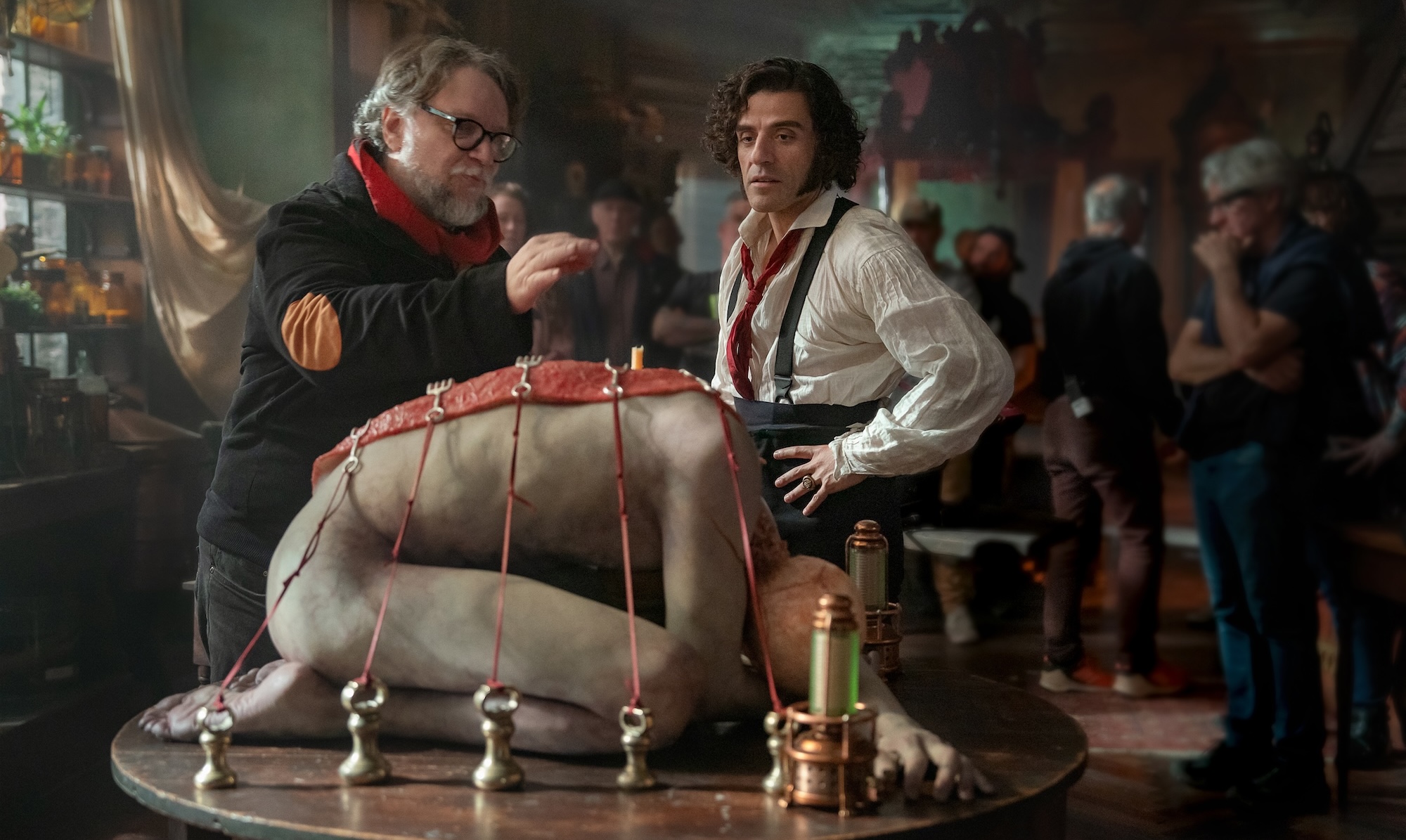
This article contains some spoilers for Guillermo del Toro’s Frankenstein.
Frankenstein might be the most pedant-friendly horror franchise. It’s not just that some love to point out that the name Frankenstein refers to the human Victor Frankenstein and not the Monster he made in lab, but also that the iconic green-skinned pyrophobe which Boris Karloff portrayed is a far cry from the erudite Adam in Mary Shelley‘s 1818 novel Frankenstein, or The Modern Prometheus.
Storytellers have taken all manner of creative liberty with Shelley’s 200-year-old source material, and Guillermo del Toro is no different. While del Toro will happily admit he is obsessed with the novel and Shelley, and his sumptuous new movie for Netflix certainly hews closer to her work than the Universal Monsters movies that James Whale made in 1931 and 1935, the Mexican filmmaker injects his own voice in places both expected and surprising. As he told Den of Geek in a digital cover story, “At the end of the day, I say adapting is like marrying a widow. You can pay respect to the late husband, but on Saturdays, you gotta get it on.”
So without further ado, here are five of the biggest deviations from Shelley, and why they matter so much to del Toro’s vision.
The Crimean War Setting
Shelley set her novel in what was then the recent past. While the book was published and begins around 1818, much of it is a flashback occurring during the tail-end of the 18th century and the Age of Enlightenment (a movement both of her philosopher parents were famously present for). Conversely, del Toro moves the action up by about 50 or 60 years, to take place during the Crimean War (1853—1856). On a plot level, this shift gives Victor (here portrayed by Oscar Isaac) a regular supply of bodies to work with. Unlike his earlier counterparts, he doesn’t have to rely on the services of grave robbers.
One might guess that del Toro had two reasons for the time shift. First, the Crimean War takes place firmly within the Victorian era, which looms in the popular imagination as the setting for the classic stories associated with the Universal Monsters. Plus, that gives the director and his art team an excuse to fill the screen with gorgeous costumes and luscious sets. The other reason, however, is probably thematic. Del Toro’s Frankenstein finds the madness of Victor in warmongers and war profiteers. These would-be victors seek immortality by attempting conquests across Europe, leaving their own trail of bodies behind.
Henrich Harlander, the Money
The thematic shift from the change of setting is most clearly articulated in a new character that del Toro created for the film. Early in the movie, Victor gives a passionate defense of his methods and theories to the Royal College of Surgeons of Edinburgh, in which he partially reanimates a corpse. This catches the attention of Henrich Harlander (Christoph Waltz), a man made rich by the various wars of empire in the 19th century. Harlander agrees to fully fund Victor’s research, with one requirement, which he does not disclose until later.
It is only at the moment of Victor’s discovery, right before he gives life to the Creature, that Harlander reveals he’s dying of syphilis and demands to have his brain put in the Creature’s body, so that he might live forever. By 2025, Waltz can play a charming villain in his sleep, and almost does so in Frankenstein. But there’s something undeniably horrifying when Harlander’s wig falls off and we see the simpering, diseased man this warmonger has become. Victor blanches from the begging Harlander, refusing to accept how similar the two truly are.
Del Toro is not coy about why the character was created. If the filmmaker’s Frankenstein only sympathizes with Victor when he is in an act of creating—the artist attempting to bring a masterpiece into the world—then Harlander represents every big moneyed interest who whispers honey into an artist’s ear only to renegotiate the contract often at the worst time for maximum leverage. Del Toro is open about meeting such slippery forces in Hollywood and the filmmaking industry throughout his career, previously telling us making Mimic for the Weinsteins’ Miramax was “my worst experience in show business… by a mile and a half!”
The Frankenstein Family
One of the more subtly striking distinctions between the two stories occurs within the Frankenstein family. In Shelley’s telling, Victor is the son of dutiful public servant Alphonse Frankenstein and his wife Caroline. The kind and respected Alphonse has three children with Caroline: the eldest Victor, gentle middle child Ernest, and the much-younger William, who is only a child during the main events of the story. Alphonse and Caroline also adopt Elizabeth, who they raise as both Victor’s cousin and (eventually) his expected bride… It was a different time?
Del Toro’s version leaves out Ernest altogether, making William (Felix Kammerer) closer in age to Victor while retaining all the literary version’s sunny disposition. Like Shelley, del Toro has Claire Frankenstein (as she’s named here) expire at an earlier point in Victor’s life, so that the doctor develops a passion for conquering death at a young age.
The most significant of these changes involves the temperament of Victor’s father, renamed Leopold by del Toro to underscore the theme about fathers and sons, which is much more explicit in del Toro’s film. Played by Charles Dance, Leopold domineers over his son, beating him during their anatomy lessons to teach not just the specifics of the human body, but also a worldview in which only the powerful survive. He also instills in him a resentment for a father who states plainly he only cares about Victor “because you have my name.” Well, consider that when Victor has his own progeny in the Creature, he gives it no name other than the chance to parrot when he says “Victor.” Like his own father, Victor only sees the Creature as a reflection of himself.
Mary ShelleyElizabeth
Thus far, one might think that del Toro has largely forgotten about Shelley, but the opposite is actually true. Perhaps counterintuitively, del Toro honors Shelley by inserting her in the story, modeling his version of Elizabeth, played by Mia Goth, on the author.
In the original book, Shelley describes Elizabeth as good-tempered and deeply affectionate, and as a maternal figure who cares for the family after Caroline’s death. Del Toro makes Elizabeth into Harlander’s niece and William’s fiancée, and gives her a far more challenging temperament. She immediately proves herself Victor’s intellectual equal and has little interest in him beyond their philosophical sparring matches. She eventually gets engaged to William, but her true great love is the Creature himself because, you know, this is a del Toro movie.
Of course del Toro’s hardly the first person to insert Shelley into the story in such a way. James Whale’s 1935 Bride of Frankenstein begins with a frame story in which Elsa Lanchester plays Shelley, coming up with the Frankenstein story to amuse fellow Romantic authors Percy Bysshe Shelley and Lord Byron. Later in the film, Lanchester also plays the Bride, who Victor creates for his Monster.
The Creature
To the surprise of no one, del Toro puts his most distinctive stamp on Frankenstein’s creation: the Creature. In that way, del Toro walks in the footsteps of most who adapt Frankenstein. Shelley imagined Victor making a fully-formed human, someone who names himself Adam and tells his own story. Whale and Karloff forever cemented the image of the Creature as a hulking child, barely able to say more than “alone, bad.”
Del Toro retains elements of all these different versions in his Creature, but because he loves his monsters, del Toro makes the Creature a pure soul. Played by Jacob Elordi, the Creature begins as a pure innocent, only able to call his creator’s name. He eventually gains greater speech capacities and, more notably, commits acts of horrific violence. But del Toro handles that violence in a manner very different than anything from Shelley. Elordi’s Creature only acts in self-defense, ripping off the jaw and tossing around those who attack him. But he just wants to face Victor, not to kill wantonly. Shelley’s creature is more willing to kill, taking the life of Elizabeth, young William, and Victor’s best friend Cleval (whom del Toro did not bring to the screen). These are coldly premeditated murders as well for the large part, including when he frames the slaughter of the child William on an innocent young woman named Justine. These actions are done to inflict maximum sorrow onto Victor.
Ultimately, Shelley uses the Creature to punish Victor for tampering in God’s domain. Or at the very least, the Creature does these things because Victor failed to raise him or show him any love, and thus he lashes out as only an abandoned child could. But del Toro, who often sees humans as the true perpetrators of suffering, recasts the Creature as purely the victim, brought by Victor into a world dominated by war-loving men and cursed to never die. He is a tragic hero who can only find absolution when his selfish father can at last acknowledge his existence.
Frankenstein is now streaming on Netflix.
The post Frankenstein: The Biggest Changes Guillermo del Toro Made from the Book appeared first on Den of Geek.