By
By 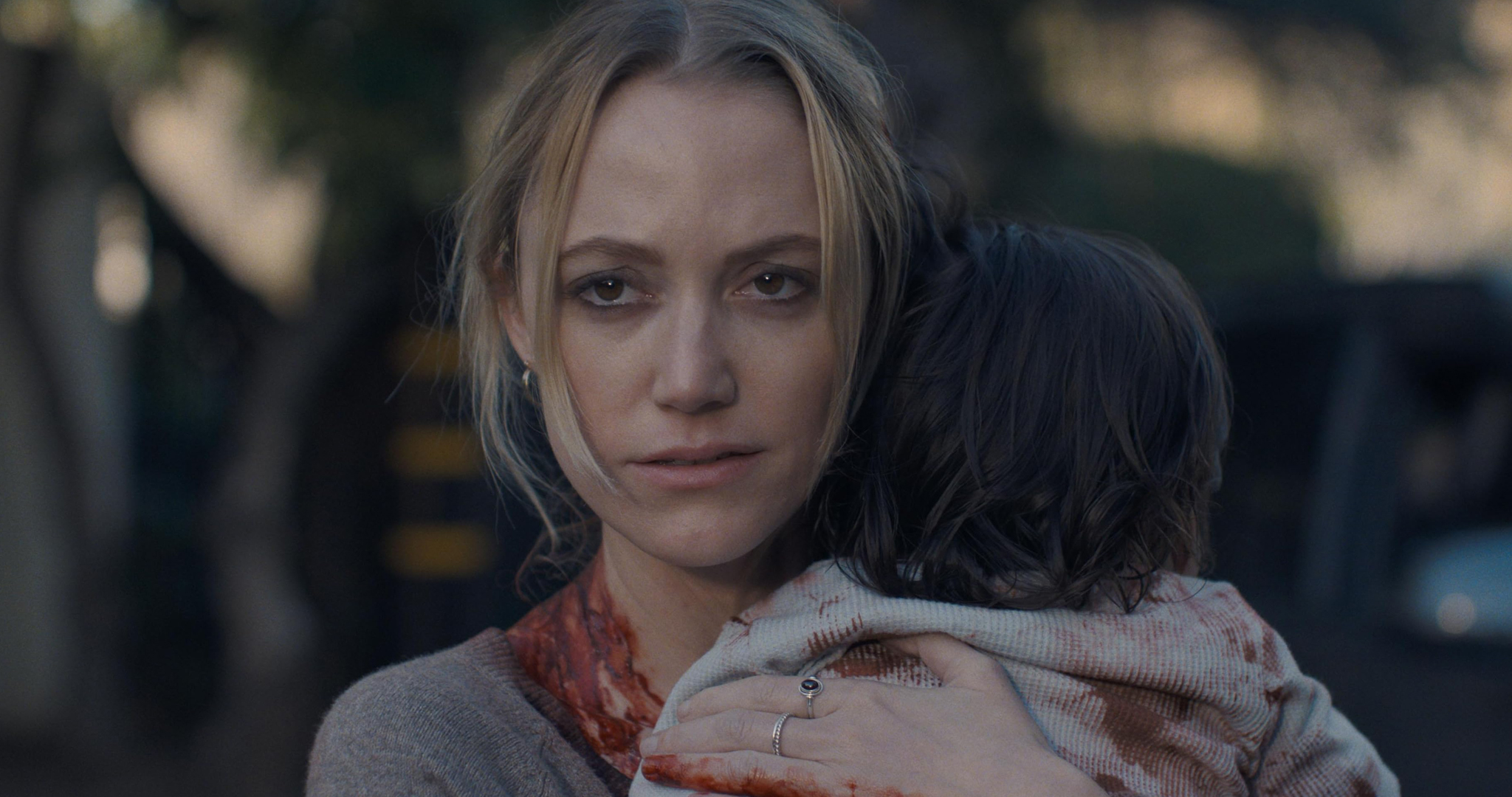
The Hand That Rocks the Cradle (2025)
Good help is hard to find.
There’s always a question that lingers when a studio announces a remake of a well-loved feature: why now? In the case of The Hand That Rocks the Cradle (2025), it’s clear the filmmakers weren’t interested in a simple retread of Curtis Hanson’s 1992 classic. Instead of leaning on nostalgia or the familiar “evil nanny” beats, this reimagining wants to reframe the terror through a contemporary lens — one that confronts the inherited weight of trauma, the fragility of modern parenting, and the silent guilt that seeps through pristine suburban walls. It’s an admirable attempt at evolution. But with great ambition comes greater risk — and while the film is good, it doesn’t quite escape the shadow of its superior predecessor.
Split between who she pretends to be and what she’s about to do.
The film opens with Caitlin Morales (Mary Elizabeth Winstead), a high-powered lawyer adjusting to life with a newborn while also juggling her demanding job and caring for her older daughter, Emma (Mileiah Vega). To regain some balance, she hires Polly Murphy (Maika Monroe), a seemingly caring nanny facing eviction, to help with the family. As Polly embeds herself into the household, her benign exterior gradually gives way to unsettling behavior: she manipulates Caitlin’s children with sweets and sugar, undermines Caitlin’s confidence, and quietly erodes the family’s sense of safety. This ultimately gives way to a reckoning of past, buried trauma that ties her to Caitlin in unexpected ways. What begins as an act of support slowly curdles into obsession, turning Polly from a trusted helper into a threat — one that forces Caitlin to confront not just her nanny’s past, but her own.
Director Michelle Garza Cervera brings a steady, ominous hand to this remake, and the cast are uniformly strong – Winstead delivers a layered performance as a mother pushed to the edge, Monroe is quietly chilling as Polly, while Raúl Castillo, as Caitlin’s husband Miguel, and Martin Starr as family friend Stewart add depth to a typically two-dimensional scenario. Production-wise, the film is assured: cinematographer Jo Willems frames suburban serenity with a creeping undercurrent of dread, the sound design is taut, and the editing by Julie Monroe keeps the tension simmering rather than exploding.
Should have checked more than one reference.
Thematically the film diverges significantly from the 1992 version: while the original is a psychological thriller rooted in a revenge plot driven by a nanny’s perverted maternal instincts and classic “bad-nanny” motif, this 2025 update leans into inherited trauma and guilt, shifting the antagonist’s motivation from pure malice to a distorted sense of claim and equivalence. Motherhood, identity, the illusion of safety in the suburban home — these are all given a more modern, complex look. The film’s “look” matches this shift: pastel-toned interiors, immaculate lawns, polished kitchens, and yet the camera lingers on shots in a way that signals unease rather than jump scares. It’s more psychological horror than straight thriller now, trading pace for atmosphere.
However — and this is where the film undercuts some of its promise — those thematic shifts and motivational changes are not as clearly telegraphed as they might have been. Because audiences expect the “bad nanny” arc as in the original, the new motivation comes across as somewhat jarring rather than revelatory; the film doesn’t fully set up Caitlin’s past ordeal, or Polly’s inherited trauma, which means the climax lands with a bump rather than a bang. Where the original frames the nanny (played by Rebecca De Mornay) as a clear antagonist with a black-and-white sense of evil, the 2025 version makes Polly ambiguous, even sympathetic — and forces Caitlin to question her own role as mother and protector. Where the original’s horror came from the shocking revelation of the nanny’s identity and straightforward sabotage, the remake’s horror is quieter, more insidious. The contrast between the 1992 film’s straightforward narrative drive and this version’s more introspective ambition works partly in its favor, but partly against it: the original film knew exactly what it was, and did it extremely well; the remake knows what it wants to say, but struggles to fully align its mechanics with its message.
Same cradle, new kind of rocking.
All up, The Hand That Rocks the Cradle (2025) is a good film. It gets by on a strong cast, competent direction, and a fresh spin on familiar territory. But it’s nowhere near as electrifying as the 1992 original. If you come to it expecting the same rush, you’ll find something different — and while that ambition is admirable, it also means the remake ultimately falls short of matching the original.
3 / 5 – Good
Reviewed by Dan Cachia (Mr. Movie)
The Hand That Rocks the Cradle is released through Hulu Australia