By
By 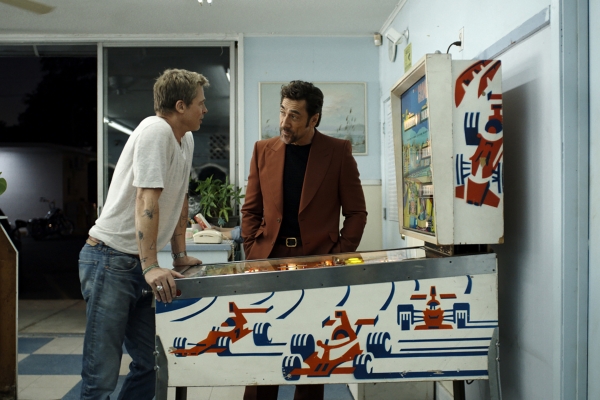
Apple’s high-speed Formula One blockbuster bid to break into large-format moviemaking—complete with Hollywood stars, slick, expensive production details, a deluge of product placement, and a who’s who of behind-the-scenes legends (Jerry Bruckheimer! Hans Zimmer!)—doesn’t crash out in flames, but it hardly mounts the podium the way this $300M movie hopes to. What we get is a largely cliché-ridden sports drama about grizzled veteran driver Sonny Hayes (Brad Pitt) and his cocky rookie partner Joshua Pearce (Damson Idris), who have to overcome their differences to get their new team, APX GP—helmed by Javier Bardem’s unconventional Ruben Cervantes—out of first gear and actually winning races.
This is true also of F1 the movie, which plays like a corporate checklist: launch Apple’s movie arm beyond streaming, convert more American eyeballs to a youth-rebranded Formula One, and satisfy every product placement contract by planting logos in as many frames as possible. For all its costly production polish, F1’s oversized format is undercut by plot and character work that feels like it was scribbled on a bar napkin. The script is riddled with cheesy, monosyllabic dialogue where characters either state exactly what they’re feeling or “withhold” in a way that transparently signals what they actually mean. It’s noticeably hackneyed and, at times, amateurish, especially within such an otherwise expansive-looking production.
The cast, led by Pitt and Bardem, does its best to animate these cardboard characters and bring the dialogue to life, but like a pit crew attempting to revive a Formula One car by swapping out over-worn tires mid-race, once the wear and tear shows, it’s hard to ignore just how soft some of the lines that made the final cut really are. The script from Ehren Kruger—who previously penned a handful of Transformers sequels, the live-action Dumbo remake, and the not-well-received American Ghost in the Shell—is inexplicably bad for someone also credited with Top Gun: Maverick. Overstuffed with tertiary characters carrying phantom-limb arcs, the bloated 155-minute runtime (thank editor Stephen Mirrione) leans hard on the kind of tropes you’d find littering the sports section of a 90s VHS rental shelf. That is to say: old, tired, and long past their last lap, much like Sonny himself.
[READ MORE: Our review of ‘Top Gun: Maverick’ directed by Joseph Kosinski and starring Tom Cruise]
One of F1’s biggest hurdles is making Formula One racing exciting, especially to anyone who doesn’t already live for it. Director Joseph Kosinski, who had no trouble making jets look cool in Top Gun: Maverick, gives Sonny’s laps plenty of stylized camera angles and booming sound design, but the thrill just doesn’t always translate. The steering wheels resemble video game controllers, and whenever we’re outside the cockpit, the races look strangely slow, almost floaty and cartoonish. Fans of the sport will probably get what they’re looking for—sleek cars gliding around curvy tracks, punctuated by dramatic tire swaps. But for the uninitiated, it’s unlikely to convert you to the $16.99/month F1 Sports Package.
[READ MORE: Our review of ‘Bullet Train’ directed by David Leitch and starring Brad Pitt]
Not for lack of trying. Kosinski and cinematographer Claudio Miranda use every inch of the IMAX palette, capturing the racing with immaculate clarity. This thing looks slick as hell. But like a new iPhone model, the surface-level packaging betrays the fact that it’s just the same design, repackaged. The purring sound mix and immersive audio swell over IMAX speakers offer a maximalist sensory jolt, but it fails to leave much of a lasting impression. There’s a hollow core where the thrills should be. On the surface, it’s checking all the boxes, but somehow the final product never adds up to more than the sum of its polished parts.
Pitt injects Sonny with his signature roguish charm. He’s a character who lives in a van by the beach, coasting through semi-pro circuits after leaving behind what once promised to be a star-making F1 career. When old friend Ruben (Bardem) finds him in a laundromat post–Daytona win, he offers Sonny a chance to climb back into the real spotlight: join the struggling, brand-backed APX GP team and go for the glory he left behind. As Ruben pitches it, only in F1 can you say that if you win, you’re the best in the world.
Sonny, true to his principles and perpetually broke, is lured not by money but by the chance to actually be the best, especially as an underdog. So he heads to London to meet the team, where he crosses paths with Kerry Condon’s Kate McKenna, the sport’s first female lead engineer and eventual love interest, and with Pearce (Idris), the influencer-savvy rookie who poses more than he wins races. Pitt, charming as ever, has solid chemistry with Condon, but his dynamic with Idris never quite clicks into gear, hamstringing the mentor-mentee arc the film tries to hinge its dramatic center on.
Sonny brings experience and risk to the APX team, applying his nonchalant, chaotic win-theory—which often involves incurring penalties and favoring overly aggressive racing—to every aspect of the crew in hopes of turning this merry band of never-has-beens into contenders. But Pearce, young, angry, and easily manipulated, sees Sonny not as a teammate but as just another obstacle to overtake before his own rising star fades. The tension between the two becomes the film’s main dramatic engine, even when the wedges driving them apart grow increasingly fictive and contrived. Misunderstandings and jealousies pile up, but they get harder and harder to believe.
The problem with F1 is that it can’t really get out from under the shadow of its sport, because it fails to make the movie about something greater. Sure, it’s about what it takes to be the best — shutting out the noise of accoutrements like fame and fortune to focus everything on winning — but that message is muted by the film’s preference for slick visuals and booming sound over anything resembling emotional depth. The characters don’t talk so much as grunt at each other. It’s a decent enough summer blockbuster that might justify the trip to theaters for devotees of the sport or for those simply craving a non-IP big-screen spectacle, but it’s not the pulse-quickening pop of summer moviemaking we were hoping for.
CONCLUSION: Joseph Kosinski trades in fighter jets for Formula One in this try-hard summer blockbuster. It has all the hallmarks of an impressive summer event-style movie — big stars, flashy production design, high stakes, booming sound design — but can never find the right gear to truly fly. The ratty script is a chief offender.
C+
For other reviews, interviews, and featured articles, be sure to:
Follow Silver Screen Riot on Facebook
Follow Silver Screen Riot on Twitter
The post F1’s Big-Screen Thrills Slicked by a Boneheaded Script appeared first on Silver Screen Riot.