By
By 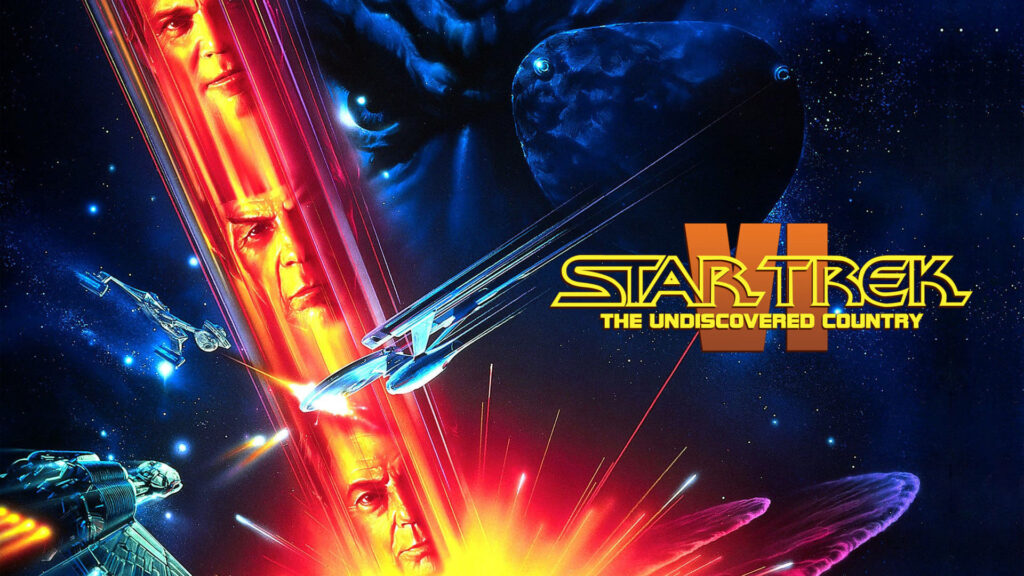
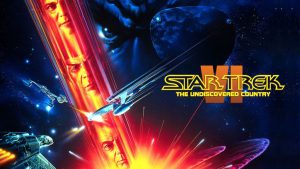
Title: Star Trek VI – The Undiscovered Country
Release Date: 12/6/1991
Plot Summary
Sulu, now in command of the Excelsior witnesses the explosion of the Klingon moon Praxis, their key energy production facility. Quickly Starfleet top brass meets to discuss with Kirk’s crew that the Klingon empire now has 50 years of life left. Spock has opened negotiations with Gorkon, the Klingon leader. He volunteers the Enterprise to escort Gorkon to meet on Earth to remove the neutral zone and begin the peace process.
There are a lot of objections from some of the Admirals and from Kirk himself, who still harbors a lot of resentment to the Klingons for the times he’s had to deal with them, not the least of which was the death of his son. Kirk is furious with Spock for putting him in this position and the rest of the crew is not exactly happy about it, including Admiral Cartwright.
They arrive on the ship to be greeted by a Lieutenant Valeris, a vulcan sponsored by Spock, who volunteered to be their helmsman since Sulu was unavailable.
They arrive at Kronos 1, a large Klingon cruiser and Kirk invites Chancellor Gorkon on the ship to dine. Valeris suggests some Romulan ale to make the dinner go more smoothly but it goes any way but.
Gorkon is genial but his party which consists of his daughter Azetbur, a Brigadier General named Kerla, and a high ranking one-eyed general named Chang. The crew argues and mildly insults the Klingons with the Klingons giving their share of offense as well. Gorkon finally sadly remarks that they have a long way to go.
Kirk is somewhat chagrinned at their behavior and intends to sleep off the ale but Spock urgently summons him to the bridge. There he hears of a neutron energy surge but before anyone can investigate, it appears that the Enterprise fires two photon torpedoes at the Klingons, disabling their artificial gravity and causing them to list badly.
Unbeknownst to the crew, two federation crewman in spacesuits and magnetic boots beam over to the Klingon ship and begin systematically killing their way to Gorkon, where he’s shot and left for dead. The two beam back onto the Enterprise.
Spock and the bridge crew frantically try to understand what happened, with the computers saying they did fire but Scotty’s inventory saying that they are still fully loaded, no missing photons. Meanwhile Chang manages to get the ship repaired enough to bear down on the Enterprise, ready to fire. Kirk issues a surrender and Chang won’t fire on a ship that’s surrendered. Bones and Kirk beam over to help Gokon but unfortunately he dies right in front of them.
Kirk and McCoy are arrested for the crime and brought back to Kronos to stand trial. The president of the federation tries to intervene on their behalf but peace will be impossible if they do anything to stop this trial. Azetbur is named the new Chancellor and will continue what her father started but will not do it on Earth, preferring a neutral location and it be kept secret for security reasons.
Kirk and McCoy stand trial that is broadcast for the whole galaxy to watch, making it a show trial. Kirk’s lawyer does his best but once Kirk’s personal log is used against him where he states that he’s never trusted Klingons and never will thanks to the death of his son. They are not given the death penalty but sent to the penal asteroid Rura Penthe, a frozen wasteland where the prisoners are mining.
Spock and the crew refuse to go back as ordered as they must investigate what happened. Based on the evidence in the trial, the torpedoes the Enterprise could not have fired, Spock surmises that a cloaked ship was able to fire the photons undetected while federation personnel on the Enterprise were able to use magnetic boots to navigate the Klingon ship while its gravity was broken. He must find the perpetrators before they go back and they are able to cover their tracks.
Kirk and Bones are met by a prisoner named Martia, a shapeshifter who explains how to escape this prison but it will only work if they have a ship. Kirk agrees and they set off into the frozen wilderness. Once they get outside the shield, they simply wait for Spock to pick them up with the Enterprise. Before Kirk beamed over to the ship, Spock placed a small viridium patch on his back that can be easily detected and tracked once they got outside the prison shield.
Kirk however is very suspicious of Martia and punches her out. He realizes it can’t be that easy to get out of the prison by simply leaving and that the only deterrent would be to not freeze to death. She admits that she was working with the conspirators to get a full pardon. Kirk and Bones would be killed in a prisoner escape to clean up loose ends.
Fortunately Spock beams them up right before the guards try to shoot them. Spock relays everything they’ve found in their investigation. Chekov found traces of Klingon blood in the transporter room, the gravity boots were found and just as they enter the corridor Scotty brings the missing uniforms stained with the Klingon blood that was floating around when the ship’s gravity was out. Kirk knows who is probably the conspirator on board when they run across the two crewmen who did the killings, dead in a corridor.
Kirk realizes the first rule of assassination, kill the assassins. He sets up a trick to lure the killer into revealing themself. It turns out to be Valeris. She had been working against them the whole time, much to Spock’s fury. He mind melds with her to find out the rest of the conspirators, including Admiral Cartwright and General Chang.
Contacting Sulu, they are able to get his help and the location of the peace conference. The Enterprise arrives first and gets into a one sided battle with the ship they cannot see. Finally the Excelsior shows up to help but cannot detect the bird of prey any better than the Enterprise. Spock realizes that the amount of energy it must take to maintain the cloak and fire would not be able to necessarily be as complete a cloak as it should.
He surmises that the impulse engine exhaust should be detectable. Rigging a torpedo, he is able to launch it where it tracks the cloaked ship, and detonates revealing it. Excelsior and Enterprise then are able to easily destroy the ship, killing Chang.
They beam down to the peace conference where the president is about to get killed. Kirk saves him and Scotty kills the assassin. With a full confession from Valeris, they are able to capture the conspirators and clear their names. Peace will happen.
Kirk and the crew return to the Enterprise and thank Sulu for his help. Starfleet contacts them to return immediately to Spacedock to be decommissioned. Spock wryly suggests that they should respond with “Go to hell.” Kirk smiles and sets course one last time. Second star to the right, and straight on until morning.
Risk Is Our Business
Kirk has some personal growth to do. In the past, it’s been his unhappiness with not being a Captain. Now he has to deal with his inherit hatred of all Klingons. It also finally gives him some closure on losing his son. He finally is able to forgive and that’s no small thing. When he sits in the prison bunk confronting his own demons and realizing what a shit attitude he had to the whole idea of peace, it really shames him. It also helps him realize that if he felt like this but his duty and just general decency as a person wouldn’t let him act badly, he knows that not everyone would be as restrained.
This is the fourth time that Kirk has to deal with a double of himself. First in The Enemy Within, thenWhat Little Girls Are Made Of, and finally Whom Gods Destroy.
Logical
Spock gets Kirk into all this and it goes badly. You can tell he’s deeply affected by almost losing Kirk and Bones. He’d carry this guilt with him all the way into the 24th century.
On top of that, the vulcan protege he sponsored and intended to replace him on the Enterprise turns out to be a traitor. Never seen Spock furious but when he knocked that phaser out of her hand, it was powerful. He was really torn up about it before they got to Khitomer. Kirk on the other hand was turned around, admitting Spock was right.
He did get a few good lines. My favorite is when Scotty mutters “Then we’re dead.” He replies, “I’ve been dead before.”
He’s Dead, Jim
Bones has a rough time this go around. Even worse than the whole Katra thing. He ends up in prison with Kirk and for the third time tells someone to leave him to freeze, he can’t make it.
Although the humor in this really hit or miss, he does get a great moment when Martia kisses Kirk and he just rolls his head back in exasperation. Finally asking Kirk, “What IS it with you, anyway?” putting in-universe voice to fan jokes on Kirk’s womanizing that had been going on for 25 years.
Bones loses Gorkon and is accused of being an alcoholic. Really a low blow by Chang.
Helm Sluggish Captain
Sulu gets his own command! He’s the captain of the Excelsior, introduced way back in Star Trek III. He’s the first to find out about Praxis, since it’s shock wave nearly destroyed his ship. Later on, when the Enterprise is having “difficulties,” he plays along, helping Kirk and crew do what needs to be done. Finally, he gives them the location of the peace conference and comes in to help with the battle.
Hailing Frequencies Open, Sugar
Uhura has a devil of a time dealing with the Klingon language. She also comes up with the idea of using a torpedo to sniff out a Klingon tailpipe. She has a priceless expression on her face when Valeris tries to tell Kirk the regulations.
My Wee Bairns
Scotty just bought a boat. He finds the uniforms they need and is very stalwart in his assertion that they did not fire torpedoes. He’s correct of course. He gets to shoot the would be assassin of the president at the peace conference. Man is strong, he breaks down the entire door.
Nuclear Wessels
Chekov gets the line of the movie “Guess who’s coming to dinner.” He tries to be diplomatic during the dinner. He also is the one who finds the Klingon blood traces in the transporter room. Even though he specializes in security, he seems to have forgotten that there is a phaser alarm.
I Know That Guy
Lots of guests in this. Let’s start with the returning folks:
Brock Peters returns as Admiral Cartwright. You can read up on him on my Star Trek IV review.
John Shuck returns as the Klingon Ambassador, also from Voyage Home.
Mark Lenard comes back for one last time, at least in the movies, as Sarek. We’ll see him again in TNG.
Grace Lee Whitney makes a bit more than a cameo as her final appearance as Janice Rand. Well, not exactly, she’d appear in Voyager too but in a flashback to this very moment in Trek.
David Warner returns to Trek but this time as a different character than the last movie. He really plays Gorkon well, even though his time is cut a bit short.
Newcomer Rosanna DeSoto plays Azetbur, the daughter of Gorkon. She was in Stand and Deliver and LaBamba in the 80s but seems to have stopped acting, only a few roles here and there after this movie and quit altogether after 2005.
Iman appears as Martia the shapeshifter. She did a few features here and there but is mostly known as a supermodel. It’s a shame, I quite liked her here.
Kurtwood Smith was the federation president. He’ll be back in Trek by appearing in Voyager’s year of hell. He’s done a ton of work, probably most known as the 70s dad and Clarence Bodikker on Robocop. I’d give this movie 25 stars if he ever walked onto the bridge and said “Bitches leave.”
Rene Auberjonois played Colonel West, only available on the extended cut. He was in Benson and various other shows but of course he’ll be Odo in DS9 only a year or so later.
Michael Dorn plays Colonel Worf (Colonel West, Colonel Worf? That’s weird) the grandfather of his character on Next Generation.
Leon Russom played the C in C. He played in various movies, worked a bit with the Coen brothers, and returned to Trek as Admiral Toddman in a Deep Space Nine episode.
Paul Rossilli played Kerla. His career pretty much ended after this movie. But his first movie was Midnight Cowboy.
William Shepard played the Klingon Warden. He was already in Trek playing Ira Graves in The Schizoid Man, a part in Voyager, and even part of the Vulcan council in the JJ Abrams reboot in 2009.
Christian Slater makes a nice little cameo appearance waking Sulu and letting him know the Enterprise is not responding and Starfleet is asking. This was supposed to go to Janice Rand, at least according to the novel. His mom was the casting director and he was a huge fan so he got to make this little cameo.
Darryl Henriques plays the romulan ambassador Nanclus. He played the Portal in the first season episode The Last Outpost from Star Trek The Next Generation.
Kim Cattrall plays Lt. Valeris. She was Bambi in Porky’s. As far as I’m concerned there was nothing to top that. But I guess she did a bunch of movies in the 80s like Mannequin and then went on to a very long stint on Sex and the City, a show I can honestly say I have not watched a single minute of.
And finally we have the late great Christopher Plummer as Chang. He and Shatner had been friends and acted together in Montreal back in the 50s. He of course is most known for The Sound Of Music and continued working steadily at a high level until his death in 2021. I mean who could forget the 1987 remake of Dragnet? He is delightful in his chewing of the scenery and spouting off all kinds of Shakespeare.
Canon Maker
I had almost put this under canon breaker but upon rewatch, I realized it really wasn’t. Specifically why was Kirk’s door wide open when we’ve seen doors constantly shut once someone is through them? Well somehow in the 35 years I’ve been watching this movie, I never noticed that Valeris picks up one of Kirk’s bags that he still has in the doorway, preventing the door from closing.
Klingons have developed a prototype ship that can fire while cloaked. To be honest, I never understood why it was a limitation to not be able to fire while cloaked but it’s canon. Now why they never made more is never explained. Maybe the info on how to do it was lost with the ship itself or some other half ass excuse.
How did the Klingon warden know which “Kirk” to kill? Simple, the real Kirk still had on leg chains.
Spock’s ancestor is Sherlock Holmes. Since in Next Gen, it’s firmly established that Holmes is a fictional character, and that was aired before this movie, I will have to assume that he means Arthur Conan Doyle.
Crewman Dax has nothing to do with the DS9 character Jadzia Dax. Most likely it was just a re-used name. However it IS canon that Curzon Dax was at the Khitomer conference. So technically both Dax’s are in this movie.
James T. Kirk’s middle name is formally established as “Tiberius” as first named way back in the animated series. But this officially makes it canon.
Sulu also mentions in his log “Captain Hikaru Sulu, commanding.” This also makes his first name canon, as it was only mentioned in novels before.
We’ll find out later that the tea (or coffee?) Sulu is drinking was given to him by Tuvok, who served on the Excelsior as a young lieutenant at this time.
General Worf is Worf’s grandfather. Mogh is the son of Worf. It was a nice little tie in.
I said in my Motion Picture review that Deltans were introduced and never seen again. This is partially correct. Deltan women were never seen again. The president here is a Deltan, as well as the officer on the Saratoga in Star Trek IV.
Canon Breaker
Even though the open door is properly explained, Kirk should know better to dictate a personal log with the door still open.
Hand phasers are all kinds of weird in this movie. Time and time again, we see either stun or kill. When it’s set to kill, the person disappears, completely vaporized. But here we have Klingons just getting drilled out like an oil well. And boy do we get gushers. Later on, Valeris fires a phaser in the kitchen for dramatic effect and vaporizes a pot but somehow leaves the whisk and food intact. Can you imagine if phasers just vaporized the clothes and not the body? Or worse, just the skin leaving a muscle exposed body screaming in pain? And finally Scotty’s phaser somehow launches the Klingon assassin out the window.
And why is a phaser just on the wall in the galley? We know they have armories and keep the weapons under lock and key. Sure, maybe a few senior crewmembers have one in their cabins in case of emergency, I might grant that. But in the kitchen? What the hell?
For that matter, why do they even have a galley? We know they aren’t quite to replicators yet, but even the original show had food synthesizers.
What the heck is a viridium patch? Apparently it’s well known, Kirk didn’t have to explain how it worked to Bones. If a doctor is well aware of what it can do, surely some of the Klingons noticed this odd purple patch on Kirk’s back? Never seen or used again.
Ok Spock, I know you and Bones understand each other a lot better now since the whole Katra thing, but really? There’s wasn’t a weapons officer down in the torpedo control room that wouldn’t have been a better choice to help you jury rig one up than Bones? Hell Scotty would’ve been better. In fact, Uhura would’ve been better! There’s no reason for Bones to be there other than to give him something to do.
At no point before or after is Klingon blood a weird smoothy grape color. I know, it was because of ratings in theaters, they didn’t want an R rating. But it’s not that fruity taupe and I refuse to call it canon.
Uhura has to take out a bunch of books and sound like an idiot to not tip off the Klingons that they are using the universal translator, something Chekov clearly ADR’d in on that scene. But why? The Klingon empire isn’t just made up of Klingons. Since they are coming in over the border, they could be any number of trading races like the uridians or firengi. In any case, they would be using the universal translator. So just say you’re one of those ships and communicate in a way that doesn’t make it sound like you’re a teenager trying to lie about being on drugs.
Why did Kirk and McCoy need those hand held translators and why did they use real people to do the translations? I know, this whole movie is a cold war allegory and those images from world war II and the UN are indelible. From an artistic standpoint I get it. But in-universe, it makes zero sense. At no point do they need anything like that to understand each other. It’s always understood that everyone is using some sort of universal translator that just works seamlessly.
No idea why the crewmen couldn’t get rid of the uniforms and boots. I’m fairly certain there are a million ways on a starship to vaporize evidence that don’t require a phaser.
Why couldn’t they use a phaser? Because of the phaser alarm we have never before or since seen.
Technobabble
A moon overmined for dilithium can be blowed up real good if you aren’t following OSHA regs.
The viridium patch works and can be detected over 2 sectors away, unless you’re in an energy shield.
Apparently a universal translator can be recognized. I don’t doubt it, but so what?
The shields on the Enterprise in this era are apparently skin tight. You can see the torpedoes kind of bounce off the saucer before shields finally fail and one tears through the primary hull. Later on shields would be more of a bubble which makes a lot more sense.
Library Computer
The president’s office is a redress of 10 Forward from Next Gen. You can tell by some of the bulkheads behind the curtains, the raised level with the piano, and most importantly the entrance doors. The engine room is also clearly the Enterprise-D’s as well as the transporter room. Budget was a big deal on this one after the failure of Star Trek V.
The director’s cut adds a few nice scenes.
One is after the president proclaims he is not above the law. The C in C, Cartwright, and Colonel West come in to outline a rescue plan but the president overrides them so to not mess up the peace process.
Later Scotty and Spock are arguing in a maintenance corridor on the torpedoes when Valeris arrives to inform them that Azetbur has been named the Chancellor. Scotty then says he believes that “klingon bitch” killed her father. He continues on some more actually racist rants on the Klingons which Spock wisely sidesteps. Scotty comes by his anger honestly but it’s a little shocking to see anyone on Startfleet act that way. Sure, he had some moments in Day Of The Dove but he was under alien influence. Anyhow, Valeris lets Spock know that Uhura isn’t able to answer Starfleet because of “issues.” Spock picks up what she’s laying down and they all agree that this conversation never happened.
During the mind meld, they add in images of the ones Valeris names. This is annoying to me but probably a good idea for the more casual viewer.
Finally it’s shown that the Klingon Scotty kills at the end is actually Colonel West. Colonel Worf is the one who unmasks him, recognizing that it’s not Klingon blood.
The Praxis Effect was used a lot after this movie, most notably in the special editions of the Star Wars movies for the Death Stars and Alderaan’s explosions.
Scotty was promoted to Captain in Star Trek III. There are some various issues with insignia in some of the films but in this one, he definitely has the captain’s insignia on his uniform. That makes 4 of the original seven captains in this movie. Kirk, Spock, Sulu, and Scotty.
A Novel Approach
JM Dillard continues the novelization of Trek movies but keeps pulling threads that Vonda McIntyre laid down. She does a great job and I like her just as much as Vonda.
Closing Threads
The beginning of the book has a prologue that lays down a lot of context that helps the movie. One, the Klingons have attacked a Federation colony called Kudao which is all over the news. Then they attack Themis where Carol Marcus is. It’s been 10 years since the events of the Genesis Trilogy and Star Trek V takes place only a few weeks after The Voyage Home. In the last 10 years, Kirk and Carol have reconciled and become friends. He was planning to spend his retirement with her but she got injured terribly in the Themis attack. While in the movie it’s pretty much implied Kirk’s hatred of Klingons is all about David, and it’s a good motivation, it really doesn’t track with Kirk as we know him. Being a race hater is really not in his character and time would’ve softened him a bit, at least in my opinion. Maybe, maybe not. It’s not completely out of left field if you’ve been following the movies.
However in the book, this attack on Carol is fresh in his mind. It’s reopened the raw wounds of losing David and now here they are again hurting the people he loves. It happens just days before he goes into the meeting with the top brass so his anger at Spock is much more understandable than in the movie. It wasn’t completely wrong in the movie per se, but the book just solidifies a bit better with that context. Kudao and Themis are referenced here and there throughout the book, illustrating how fragile things were at this time in Federation history.
It’s also heavily hinted that the ship making the attack is firing while cloaked but no one takes it seriously. It explains why Spock pulled that theory out of his ass in the movie. It wasn’t completely out of left field, people and Starfleet had been speculating on what was happening and that was one of the theories.
Sulu finally got the Excelsior, as seen in the book. He took the temporary downgrade in rank to serve with Kirk after Voyage Home for few years and then took a sideways promotion to work at Starfleet command before finally getting the Excelsior about 7 years after Star Trek V.
Valeris
Valeris has a Saavik like situation with Spock and the crew (more on that later.) Unlike Saavik who is half-Romulan, Valeris is a full Vulcan. But her emotional control isn’t easy for her to maintain. Her backstory is that her parents were pacifists that tried to set up peace with the Klingons when she was a child, setting up shop on a Federation world near the border. Needless to say, it didn’t go well. Her mother was killed and her father began turning away from the teachings of Surak, recommending that you can’t have peace with a culture that’s incompatible. (Sounds more relevant today than in 1991 but I digress.) Anyhow he published a paper saying as much and got drummed out of the Vulcan service. He didn’t keep Valeris up with her vulcan studies and on top of it all, he developed a degenerative brain disease. She was mostly raised by a human housekeeper and as an adult, she had to apply back to Vulcan for her birthright citizenship and start over at an advanced age, at least for when most Vulcans start.
As such her emotional control is not the best combined with a history that pretty much was full of trauma mostly thanks to the Klingons, as far as she was concerned. It does help the reader understand why she got involved with the conspiracy. Spock had seen a lot of Saavik in her and indeed she and Saavik had become friends, even though Saavik never actually shows up in the book. Because Spock took her under his wing, it obviously hurt him a lot.
In the movie, Spock’s forced mind meld is a little disturbing. I wouldn’t go as far as most smug progs and call it “rape” but it’s certainly enhanced interrogation and was probably uncomfortable to say the least. However in the book, melding with Spock’s mind gave her a completely different perspective on peace with the Klingons through Spock’s view of it, not too mention his life and everything he had been through. She cried out not because Spock was causing her pain, but because she had an epiphany on how wrong she had been. She then willingly gave Spock the names.
I honestly am not sure which I prefer. I certainly understand Spock’s anger and given the circumstances, he needed the info. Plus it wasn’t unprecedented, he had done unwilling mind melds to get info on the show once or twice. But on the other hand, the whole message of the movie is that peace is worth it and you can’t blame an entire race for the acts of some of it’s members. Certainly Gorkon and Azetbur were sincere in their attempt at peace and they didn’t get to where they were without a lot of support from a good portion of the people. Spock understood that and getting Valeris to understand that in book seems more in line with the themes of the movie.
Klingons
It’s a little more laid out in the book the details of Klingon politics. If you’ve watched the various shows, by this point Klingon culture is a bit more understood, at least thanks to Worf in the Next Generation. But since this is 70 years earlier, there was some interesting changes they could do without messing up what was to come.
The Organian peace treaty is referenced numerous times throughout the book. What happened to it? The Organians forced peace between the two sides but suddenly now a peace treaty is needed? Why? Well according to the book, the Organians simply disappeared. No real explanation is given but in my mind, based on what Ayelborn told them about the Klingons and the Federation becoming fast friends in the future, one would assume they knew what was coming. They knew about Praxis and decided now was the time to let the two work out their own problems.
(If you really want get fun with speculation, maybe the Organians caused Praxis? That’ll cook your noodle.)
Gorkon was elevated to Chancellor due to the crisis of Praxis. He was a councilman of somewhat high standing but in Klingon society, they aren’t all warriors. Sure the warrior class holds the most power but it’s not the end all be all of Klingons. Hell on DS9, there was a Klingon who ran a restaurant. We know they did opera and poetry, surely these people aren’t all out there swinging Bat’leths. But the warrior class did hold all the power. Until Gorkon and the urgency of the situation.
Azetbur was also on the council. Thanks to all this, Gorkon was well aware that he probably wouldn’t live to see the peace treaty signed. He took steps to make sure that in the event of his death, Azetbur would become chancellor. While it was not strictly against Klingon law that women couldn’t be chancellor, it was pretty much an unwritten rule that they wouldn’t be. So Gorkon was causing all kinds of waves after his death.
Indeed, by the 24th century, it apparently did become law that women were not allowed on the council anymore, making me wonder how bad of a fuck-up she was during her term.
Gorkon’s advisors are General Kerla, General Kamerg the guy who lost his arm, and General Korrd, the same general from Star Trek V. Apparently he had regained some of his former respect and now had the ear of the chancellor. Kerla interestingly was in love with Azetbur and she him. But they couldn’t take the oath of marriage until this whole mess was resolved.
The Dinner
In the dinner scene, some of the dialogue is switched around but more importantly is the rest of bridge crew really ramped up a lot of arguing, throwing in anger over Kudao and other things. In fact Uhura and Bones even argued with each other and there was just generally bad behavior all around that I never felt came completely across in the movie. When Kirk finally muses “Please let me know if there’s any other way we can screw up tonight,” he’s really not wrong after how they all behaved in the book. It definitely goes a step or two past what you see in the movie.
The Romulan ale really lets everyone’s true feelings out and they take it further than they should. Sometimes they are off the mark and sometime they are absolutely right in a “truth hurts” sort of way. Gorkon is also mostly quiet during all this as he’s not only gauging the human’s distrust but also wondering if he can trust Kerla and really doesn’t trust Chang.
Kirk and Carol
As I mentioned Carol was in a coma thanks to the Klingon attack on Themis, an event that really was on Kirk’s mind throughout all this and helps make it more understandable his “let them die” comment. She awakens halfway through the book but doesn’t get told about Kirk and Bones being thrown in prison yet. Unfortunately we never find out how she reacts.
Overall the book does a few things to help explain Kirk’s anger a little better. The recent attacks help put a raw edge to everything.
What’s The Score?
Cliff Eidelman does the score. This was his breakthrough movie though he kinda tapered off by the mid-2000s. This score is good. But like Star Trek IV, it doesn’t scream “Star Trek” the way Goldsmith and Horner did. It’s very tense and grim in areas but the softer moments work well too. A mark of a good score is one you can put in the soundtrack without the movie and enjoy it. This score does well within the confines of the movie but I’m not putting it in the background to listen to. I do that with Horner and most especially the The Motion Picture soundtrack that Goldsmith did.
Here’s the opening credits:
Here’s the Enterprise leaving spacedock.
The first introduction of Rura Penthe is well done.
The final battle does a good job of ratcheting up the tension.
And finally I really liked the ending, pulling on the original theme and having the crew signoff with a final bow, so to speak.
What It Means To Be Human – Review
After the disaster of Star Trek V, it was not clear if there would be anymore movies. But since TNG was doing gangbusters by this time, and the 25th anniversary was around the corner, they decided to do one last one and go out on a high note.
Let me just say that I think this is a quality Star Trek movie and I enjoy it whenever I watch it. However I have several nits to pick. The story literally starts with a bang, the explosion of Praxis is a sublime effect with the Excelsior having to deal with nearly getting ripped to pieces. It mirrors the Chernobyl meltdown, one of the catalysts that brought down the Soviet Union.
For that’s what this is all about, an allegory on the cold war and how old hostilities are hard to put away. It generally accomplishes this. It some of the execution I find fault with.
The good is seeing Kirk just simply hating Klingons as a race and coming to terms with that. The idea of peace with a race that he watched butcher Organians (ok they didn’t but they didn’t know that at the time and they didn’t have any issues with it) when he first met them all the way to Kruge murdering his son… well peace is an idea he can’t believe. He is so wrapped up in hate, he just assumes Gorkon is lying.
And sure we sympathize with him. Losing David and watching how Klingons have acted all his adult life, why wouldn’t he feel that way? Still Kirk is at heart a man of honor. He would not do what the other Starfleet conspirators did, no matter how much he agreed with them. He believed the idea was going to blow up in everyone’s face, and he’d have to pick up the pieces.
The story does a lot to get the wheels turning in the Trek universe to get us where we end up by the time of Next Generation where the Klingons are allies, or at the very least, not enemies. It took another 50 years before it was cemented in place with the destruction of the Enterprise-C, but this was a necessary first step.
My issues are mostly with the stupid humor in an otherwise serious story and a huge missed opportunity. The humor is hit or miss but when it misses… phew. Valeris screwing around with phasers in the kitchen, Chekov forgetting how to be a security chief, Bone and Kirk not really coming across like they are taking their imprisonment as serious as they should… the tone is just wildly off-kilter sometimes.
Then there’s Valeris. When she’s questioning Spock if he’s telling a lie, that’s clearly a callback to Saavik surprised that Spock would lie, to which he simply responded “I exaggerated.” Valeris should’ve been Saavik. Gene didn’t want to wreck a beloved character and if I have to be honest, back when I saw this at 21, I would’ve been pretty pissed. But in hindsight, this would’ve worked out so much better. Saavik would’ve had the history with the crew so if she was the one that turned out to be the traitor, it would’ve been a helluva surprise.
It also would’ve made a lot of sense. She watched David get killed. If you have the novels in you head like I did, she and David had a relationship but even without it, they got close enough and it would’ve affected her deeply that he sacrificed himself for her. She would’ve had a deep sense of guilt that as an officer, she allowed a civilian to die for her sake, rather than the other way around. I get people love Saavik as a character, I do too but I got to think there would’ve been some really interesting ways to write her being discovered as the antagonist that would’ve meant more.
Spock is so angry at Valeris but it would’ve hit harder if it were Saavik. And I’m sure there was something sympathetic they could’ve written to allow for some sort of redemption for her, maybe in a future movie or something.
On the other hand, Christopher Plummer is just awesome. He chews every scene he’s in but you never feel like he’s not a menace. He has the least pronounced forehead ridges (one wonders a leftover when the Klingons looked more human) and yet is the most menacing one the screen. You know he’s dangerous from the moment he appears on screen.
Sulu getting his own command was great to see. All the cast seemed to have more to say and do which was also nice. The final scene with them all going off to the sunset, damn if it doesn’t bring a tear to my eye.
The entire cold war allegory works and it does a great job of changing the universe of Trek at the same time. It understands that TNG is out there and this is a great bridge to that future that we end up seeing on the small screen.
It’s really really good Trek and for the most part it sticks the landing. It’s just some muffed moments in between that keep it from being great Trek.
And so we’ve come to the end of the TOS adventures. We’ll continue on with The Next Generation and beyond. But as much as I love those new series, the original Star Trek will always be first in my geek heart. There was something nearly perfect about the Kirk/Spock/Bones dynamic. Everything that came after was a continuation of what the original Trek laid down. The 24th century adventures always had the characters have an air of reverence and respect for Kirk and the original crew in-universe and that’s the way it should’ve been. The rest of the cast may have been underused, the 60s vibe to the show could be hilariously cheesy and the animated series has plenty of eye rollingly bad animation but the heart and foundation what this cast and writers created made Star Trek the beloved franchise it is today. If I could thank them in person for giving me this world I can visit whenever I want, I would.
I guess I just did.
The post Trek On: STAR TREK VI – THE UNDISCOVERED COUNTRY appeared first on Last Movie Outpost.