By
By 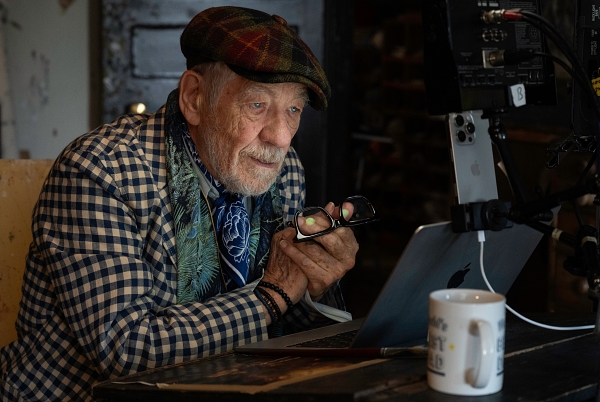
When the ne’er-do-well children of esteemed painter Julian Sklar (Ian McKellen), who has not produced new work in over 30 years, enlist professional restorer Lori (Michaela Coel) to forge an unfinished series of notable works known as The Christophers, a game of cat and mouse artifice begins. The Christophers, from screenwriter Ed Solomon and director Steven Soderbergh, is both a film splattered with rich themes about the avarice surrounding artistry and the uneasy line between principled rejection and self-serving mythmaking, and a classically crowd-pleasing two-hander. It’s just as interested in watching two people at odds slowly figure each other out.
Julian is a mercurial louse, a shut-in who churns out Cameo videos in front of a ring light to afford his hermetic habits. His children, played by Jessica Gunning and James Corden, function mostly as opportunistic catalysts eager to benefit from his legacy well before he’s six feet under. Lori, for her part, carries a quiet, unresolved tension. Though she and Julian are strangers, there is clearly something lodged beneath the surface, some private grievance she refuses to name. Julian, rude and self-involved, volunteers only what flatters his own mythology, a classic narcissist performing himself even in private. And yet, in the gaps between his abrasiveness and her restraint, something like recognition starts to creep in.
Soderbergh frames the film, at least initially, like an art heist. There’s a quiet Ocean’s Eleven-adjacent pleasure in watching the mechanics assemble, the question of whether Lori can convincingly pull this off under the nose of the man she’s attempting to deceive. But that expectation proves mostly to be a feint. What begins as a procedural reverse-heist gives way to something more interior, less about execution than confrontation. The question shifts from whether Lori can pull it off to something far more personal: how Julian has shaped her, first as inspiration, then as a kind of public executioner.
What appears roughshod and spiky at first glance begins to reveal warmer colors underneath, delicate brush strokes, something intimate with purpose. A descriptor of Julian’s art, surely, but also one of the artist himself. While Lori enters expecting to outmaneuver a man she understands only as persona, someone she believes she can finally outwit, proximity complicates that narrative. What she finds is more fragile, more deliberate, and far less easily dismissed.
Sir Ian McKellen, one of the silver screen’s most enduring presences, delivers a performance alive with the very verve that has defined his career, even if awards bodies have historically failed to recognize him for it. His Julian is all cadence and gravel, elevated elocution masking a low, simmering emotional volatility. There is a sharp, sardonic humor to him, though it curdles easily into cruelty. It’s the kind of role that tends to get noticed, and if this is the one that finally lands him an Oscar, it would be hard to argue with.
The latter half of his career has been reduced to judging a local broadcast, a vaguely American Idol-esque program called Art Attack, where he scathingly dismantles the work of aspiring artists chasing their own fleeting relevance. As a younger Lori notes, he both exploded the art world and imploded his own star. What remains is something like a Simon Cowell of the canvas, a figure lashing out at an industry that moved on the moment his gifts began to dull.
[READ MORE: Our review of ‘Logan Lucky‘ directed by Steven Soderbergh and starring Adam Driver]
Julian’s own mythology is built on a supposed rejection of that system. He rails against the art world’s predatory economics, the near-absurd cuts taken by representation, and tells stories of selling works once valued in the millions for a fraction of their worth on the street, a kind of defiant middle finger to the machinery of taste and commerce. But even that rebellion feels unstable. It’s hard to tell where conviction ends and collapse begins, whether this was a moral stance or just the byproduct of a man no longer able to produce what once made him valuable.
The script from Solomon is sharp, barbed, and unapologetically talky. At its core, the film is about two people colliding at the right, or perhaps wrong, moment, their lives intersecting across artistic and personal timelines. Julian’s work and public persona serve as both inspiration for Lori and the reason she withdrew from showing her own. What unfolds between them, the slow reveal of intention, resentment, and reluctant connection, forms the film’s emotional backbone. And while the third act doesn’t entirely earn the depth of feeling that their relationship tilts at, there’s something truthful in that imbalance. To be seen by someone who shaped you, even indirectly, even critically, carries a kind of transcendence. The film gestures toward that idea, even if it doesn’t completely land it.
Even the art itself is withheld. We never see a completed Christopher. Only fragments. Sketches. The underlying architecture of something that is supposed to be transcendent, truly his defining work. We’re left to fill in the blanks, constructing the finished pieces from reputation, description, and Julian’s own carefully curated persona. It’s a familiar cinematic trick, the unseen object that accrues meaning precisely because it’s never revealed, not unlike the briefcase in Pulp Fiction, but it works here. The absence becomes part of Julian’s mystique, reinforcing both his legacy and the nagging suspicion that the reality could never fully live up to it.
Soderbergh keeps things pretty restrained here. He doesn’t push the style to the front, instead letting the performances and the writing do most of the work. It’s a quieter film than you might expect from him, but that restraint fits. You get the sense he trusts Solomon’s script enough not to overwork it.
Solomon, whose résumé swings wildly from the playful (Bill & Ted, Men in Black) to the downright disposable (Now You See Me, Super Mario Bros), delivers something unexpectedly introspective, preoccupied with legacy, with the strange afterlife of influence, and the damage artists can inflict simply by being seen. There’s an irony in that, given his filmography, though he has touched this terrain before with Soderbergh in No Sudden Move. Here, it feels more fully realized, more thematically dense, even if the film itself occasionally struggles to carry that weight all the way through.
Michaela Coel is excellent here in a way that deliberately resists showiness. Where McKellen dominates with theatricality, she anchors the film in stillness. There’s a quiet tension to her performance, caught between a fading artist, his opportunistic children, and her own covert role in the deception. That stillness belies something far more turbulent underneath, and Coel lets it surface only in fragments, which makes it all the more compelling. It’s that interplay between the two of them that ultimately defines the film, not just as a showcase for two great performances, but as a way of grounding its ideas about legacy, about what it means to leave an impression on someone you may never fully know, and how that influence lingers and mutates.
CONCLUSION: Ian McKellen is phenomenal in ‘The Christophers’ – and Michaela Coel more than holds her own – a film that manages to be both thematically rich and genuinely crowd-pleasing. What begins as a professional collision in the art world gradually turns into something more personal, more complicated. It’s one of Steven Soderbergh’s more restrained, human-scale efforts, and it’s all the better for it.
B+
For other reviews, interviews, and featured articles, be sure to:
Follow Silver Screen Riot on Letterboxd
Follow Silver Screen Riot on Facebook
Follow Silver Screen Riot on Twitter
Follow Silver Screen Riot on BlueSky
Follow Silver Screen Riot on Substack
The post ‘THE CHRISTOPHERS’ Paints a Portrait of Artists at Odds appeared first on Silver Screen Riot.