By
By 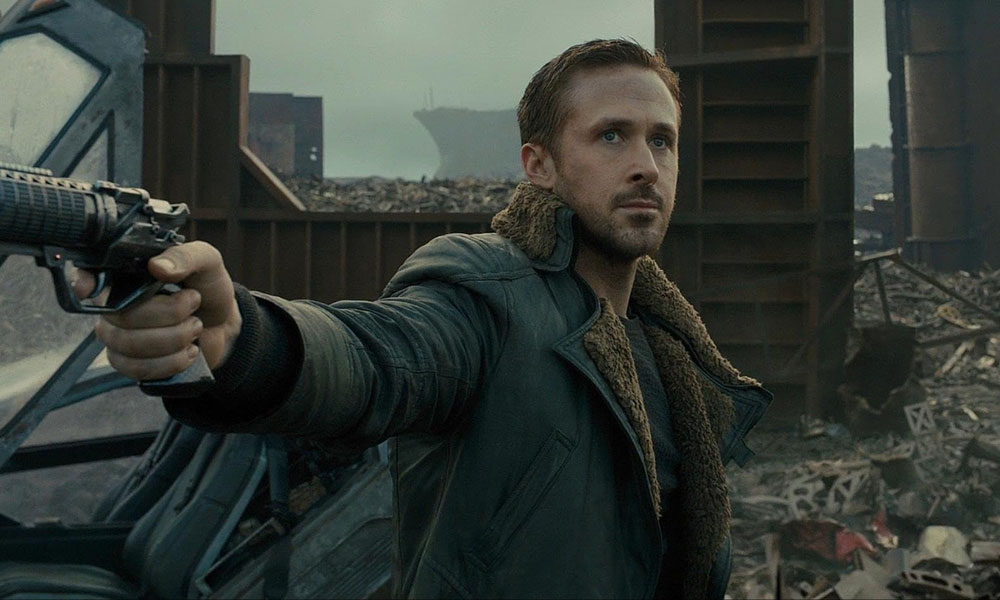
Blade Runner 2049 got a re-review due to all the press the Goz is getting for Project Hail Mary. Hard to believe it is almost 10 years old already. Another 20 years or so, and we will get Blade Runner 2082!
Full disclosure: Blade Runner is an objective classic. It is not a movie I clutch within my heart of hearts, however. If I come across boomers at each other’s throat over whether or not Deckard is a replicant, I don’t even pick a side.
If he was a replicant and the entire point of the movie is negated, fine. If he wasn’t a replicant and flew off into the sunset with Rachel, also fine. I mostly just wanted to see Ford throw Rutger off the Bradbury Building at the end and ask, “Can you fly, Batty?”
Roll credits.
Ergo, when Blade Runner 2049 hit the screen in 2017, I viewed it with the general disdain I afford any sequel to a classic movie 35 years after the fact. It got filed under Cash Grab and How to Make a Legacy Character Another Bitter Old Loser in Three Acts.
I caught Blade Runner 2049 a couple years later, probably during that time when our overlords told us we had to stay home and try not to murder our spouses instead of visiting our grandparents in nursing homes. I remembered little about it beyond a giant nude Ana de Armas and that, although completely unnecessary, the film did about as good of a job as it could with the shoes it had to fill.
This past weekend I watched Blade Runner 2049 again to see if that notion held…
Blade Runner 2049
The notion held…
Blade Runner 2049 is a solid movie. This should not have been that surprising in 2017 either. Denis Villeneuve already had Prisoners, Enemy, Sicario and Arrival under his belt. He proved competent at delivering weightier films.
Villeneuve is no Ridley Scott, however. Scott absolutely drenched Blade Runner in details. The scrumptiously filthy visuals he marshalled in 1982 blows minds. Blade Runner makes one wonder if the entire budget went to building a time machine that Scott simply took into the future with a camera and members of the cast, as needed.
Meanwhile, Villeneuve presented a more sterile vision of the same world. Nothing is as damp, dark, smoky and dirty under Villeneuve’s watch. He puts a cleaner sheen over it all and adds a lot more color to the shadows.
Villeneuve’s world looks more hospitable. This is maybe best represented by the differences between Deckard and K’s apartments. Deckard’s is more spacious and feels like the attic of a haunted house. K’s is smaller and borders on cozy. Add in the fact that he has a holographic de Armas ditty-bopping about, and it creates an environment where a man could rest. Rest seems impossible in Scott’s world.
Regardless, Villeneuve can tell a story, and that’s really what it boils down to at the end of the day: can the onscreen happenings engage the viewer?
The Story
Hampton Fancher, who wrote the screenplay for Blade Runner, returns. This was a good idea. Fancher comes off as a guy who is a bit out there. If a sequel has a chance of working, his quirks probably had to be a part of it.
Fancher likely spent years thinking about a sequel, which probably facilitated the process. Although, it shows that when a great film’s story is told, a sequel is unnecessary, unless the goal is to water everything down…and make money, of course.
Nevertheless, if they’re going to be mercenary about it, it feels like they put thought into Blade Runner 2049. They wisely avoided rehashing the “what does it mean to be human” storyline. That element still exists, but a nice spin is put on it.
I never lock into the profundity of “what does it mean to be human” stories. I know what it means to be human, the same way I know what it means to be a woman or a man. To make it confusing is existential handwringing.
The bulk of Blade Runner 2049’s story travels in the mystery lane. “Mystery” is maybe too strong of a word for it, though. Call Blade Runner 2049 a “puzzle” film instead. The main character spends his time trying to figure out what is going on.
As for the what of what is going on, it creates an interesting scenario. A replicant giving birth is intriguing, and they could have went for the low-hanging fruit of making the child a Christ figure, but they didn’t (mostly). They simply let the idea exist.
I could do without the replicant revolution angle, though. Inserting the slavery theme into movies at any level has grown cliche.
The Cast
Blade Runner 2049 does not have the cast of the original film. Blade Runner cooked at nearly all levels with familiar faces that brought talent to even small parts.
You had Hauer, Young, Olmos, Walsh, Hannah, Brion James, Joe Turkel, Joana Cassidy, James Hong and even Larry, brother of the Daryls himself, William Sanderson.
Not a lot of heavy-hitting character actors show up in Blade Runner 2049.
Ana de Armas is being too pretty to take seriously. Robin Wright goes butch. Leto is genuinely effective as a megalomanic Tyrell figure. It feels shocking to say it, but it would have been nice if Leto had gotten more scenes. The only other sub-character who gets a fair degree of work is Sylvia Hoeks as Leto’s pet replicant enforcer/secretary.
Hoeks does what she can with the part. She walks the line between controlled and borderline autonomous as she struggles to know her place as an artificial person in a real world. Maybe the tears rolling down her cheek as she does her job are a bit much. At the same time, it is at least something to give her character some depth. Plus, angst gets the teens in seats.
Leads
At the end of the day, all other players aside, the Blade Runner films are carried by their lead actors: Harrison Ford and Ryan Gosling.
Ford’s performance in Blade Runner is solid. As for his turn in Blade Runner 2049, it’s rusty. It does not help that the filmmakers turn a legacy character into an old loser. Again. Yet, it is not as egregious in Blade Runner 2049.
Deckard always was a loner, and his isolation is part of a plan to protect his child, rather than him turning his back on his arc in the first film.
Not great but more bearable than the sins perpetrated on Ford’s Indy and Solo characters.
As for Gosling, he is also good. One wonders if his character’s name is short for “okay,” seeing as he is designed to obey orders.
For my money, K is more interesting than Deckard when it comes to arcs that engage the viewer. Deckard is a guy doing his job and learning a lesson in humanity. That’s fine. But, again, for baser viewers such as myself, I would have rather he shot Batty with a rocket launcher or something at the end.
Meanwhile, K is a replicant doing his job, gets teased with the idea of being real, has that cruelly taken from him, and then sacrifices himself because his life is the only thing he has left to give. Once he tasted the idea of being real, no going back existed for him.
Blade Runner 2049
Blade Runner will always be over and above Blade Runner 2049. That is how it should be. Both are above Soldier, as well. We might as well throw that in the mix since it takes place in the Blade Runner universe. Plus, I did catch the reference to Soldier in Blade Runner 2049 with the garbage disposal ships.
If someone put me on the spot and asked, “Which one would you rather watch right now, Blade Runner or Blade Runner 2049?” I might genuinely answer Blade Runner 2049.
I’m sorry if that is sacrilege. I promise to make it up to you by agreeing that Deckard was not a replicant…or he was a replicant. Just tell me which position you prefer. I’ll back it.
The post Re-Review: BLADE RUNNER 2049 appeared first on Last Movie Outpost.