By
By 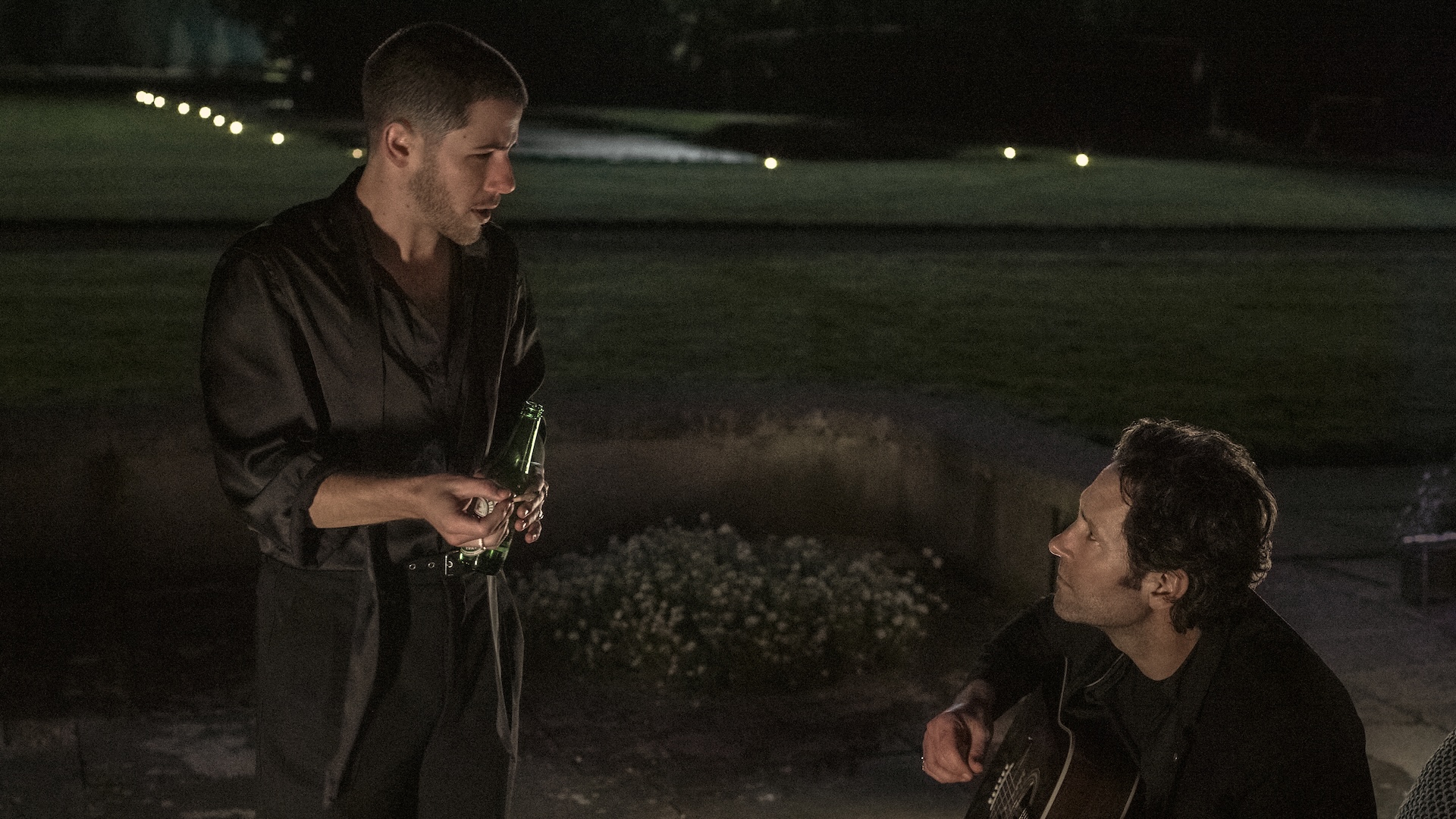
Paul Rudd can sing. Anyone good at picking out folksy harmonies during a throwaway gag in Anchorman might have told you that 20 years ago—or for that matter, if they were among the lucky few to see the severely underrated Friendship last summer. But for everyone else, the opening moments of John Carney’s Power Ballad will be something of a revelation. Standing before a bedecked and beaming wedding party, the three-time Ant-Man star is able to croon and coo like a yesteryear rock god of early ‘90s glory days: back when Rudd himself was a young man rocking out in Halloween 6 or the occasional Nintendo commercial.
Seeing him belt snatches of “Jesse’s Girl,” and bars of “Everything I Do” is to, perhaps, observe a road not taken. One suspects Rudd and Carney are keenly aware of this too. The arbitrary nature of life—the twists of fate that make one man a musician, and another an accountant with a drum set in the garage, or this artist a legend, and that an aging wedding band frontman forced to survive as “a human jukebox”—is very much at the top of mind in Power Ballad.
As with each of Carney’s films set in or just wistfully outside the music industry (where protagonists are condemned to look in, covetously), Power Ballad is full of good cheer and self-awareness. It’s also marked more than any Carney picture since Once in 2007 with an elegiac appreciation for both the hard roads taken and, more crucially, those left untrod. It’s another dramedy about getting older, but this time with a cagier wisdom that comes with reaching a certain age. This last bit can also be gleaned during the aforementioned opening where Rudd’s Rick is the stud of the moment when he’s belting Bon Jovi, but finds himself deserted by the crowd when singing one of his own originals. No one wants to hear it. At least not from him.
The artist’s frustration to not be pigeonholed, from the zenith of the music scene to its bottom, is crystallized by the fateful intersection at the heart of Power Ballad: a serendipitous meet-cute at a particularly posh wedding party between washed-up Rick and a one-time boy band pop star named Danny (Nick Jonas). Like Rick, Danny is frustrated by his lot in life, albeit as a beloved idol who drives BMWs one day, and a Ferrari the next. He was successful, if only insofar as “the boy band” hunk who can still exist as the center of gravity at a friend’s wedding. His 15 minutes in the wider world, however, appear to be up.
Regardless of status, unsatisfied ambition makes all creatives neighbors. And Rick and Danny hit it off fast by rocking the wedding party and then jamming far better into the wee small hours of the morning in Danny’s palatial suite. It’s there that Rick also shares with Danny a few bars of half-written songs he’s never finished. It’s a good time. Danny even abridges a few of the tunes. Yet groovy memories fade fast fast six months later when Rick hears one of those ditties fully produced, finished, and blowing the minds of everyone at a nearby shopping town in his Irish hometown.
By this time, even his teenage daughter Aja (Beth Fallon) knows all the words to the old school ballad climbing the charts. What Aja, wife Rachel (Marcella Plunkett), and even best friend bandmate Sandy (Peter McDonald) cannot so easily recall though is that “How to Write a Song (Without You)” is one of the countless melodies Rick has been noodling on for years. But the American expat does carry on a little like ol’ raving Ben Gunn when he insists it’s his song, despite the rejuvenated Danny Boy claiming sole credit back in the States or the new anthem of a generation.
The act of collaboration, particularly in the artistic context, can always be a nebulous thing. Famously Paul McCartney and John Lennon attempted to prevent such debates when they agreed to sign every Beatles tune they worked on as “Lennon-McCartney.” Yet even then, there was a time in 2002 when McCartney tried to have more than a few switched to “McCartney-Lennon” to clarify credit.
Having come, if ever so briefly, from the Irish and U.K. rock scene of the early ‘90s, Carney knows about how late night inspirations and jamming can yield, or deny, credit for tunes potentially worth millions of dollars. Does adding a bridge qualify as songwriting credit? What about the whole chorus and lyrics too? Power Ballad deliberately wades into murky legal waters, but it’s in a clear-eyed search for transparent waters.
This is a movie about warmly and affectionately dealing with an artist’s disappointment, as well as the simpler joys in that lifestyle, especially when they come outside of the studio or medium. While much of this review is dedicated to the core dynamic between Rick and Danny—and the movie gains much from Jonas’ own history with the boy-band-adjacent act he fronted with his brothers—the movie is really about an artist of a certain age taking stock of dreams that were waylaid. Or, in Rick’s case, outright stolen.
Rudd’s hero is justified in being severely aggrieved as he scurries around Dublin telling anybody who will listen how that’s his song. There’s a faintly pitiful poor Job quality to his suffering. He might fancy himself Cassandra, insisting the world is ending, but the only person affected by the catastrophe is Rick. And his family.
It is indeed this family we learn that Rick stayed in Ireland for. He met Rachel while touring as a young indie artist and never left. So while the song Danny nicked for international fame might be a love ballad, it is more of an understated domestic bliss that Rick truly covets, particularly in wryly written scenes between the aging hipster and his perennially unimpressed teenage daughter.
The writing is universally good in the Irish sequences, though, gifting Rudd with his second great SXSW premiere in as many years, but also in this case a beautifully crafted role that pairs his natural affability with a textured ennui that comes from the “nice guy” not necessarily getting everything he wanted out of life.
There is an authentic sweetness to the film, born from a genuine union between star and filmmaking voice.
The Los Angeles sequences are perhaps a bit thinner, as Danny’s lifestyle as a callow wannabe hungry for a hit is broadly drawn, particularly with the yes-men vipers circling the heavens. However, even then the ultimate confrontation in the City of Angels between the reluctant thief and the half-mad victim takes on an almost biblical schadenfreude. The artist and the ghosts of their inspirations can never have an easy, linear dialogue about their relationship, yet just starting these often long-deferred debates can be its own kind of therapy. Or dramatic harmony.
Power Ballad premiered at SXSW on March 14 and opens nationwide on June 5.
The post Power Ballad Review: Paul Rudd’s Finest appeared first on Den of Geek.