By
By 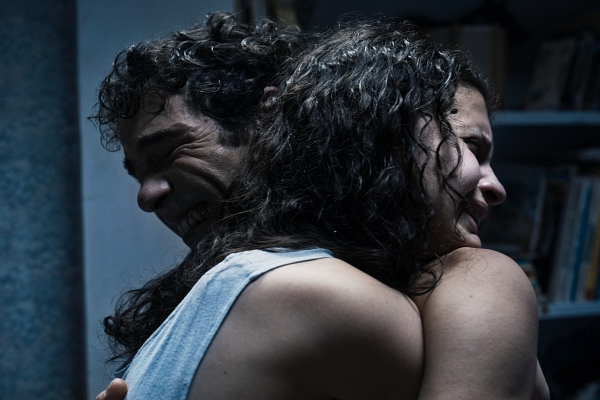
A virus is ravaging the world. No one knows exactly what causes it, and the public’s perception of its transmission is flawed. Certain groups assume themselves immune. Others—like intravenous drug users—are especially vulnerable. Hospitals are overrun with victims, their only recourse being palliative care as they prepare for a somewhat excruciating death. If all of this sounds like the AIDS crisis of the 1980s, that’s because Alpha is, in some respects, a not-so-thinly-veiled metaphor for the societal and emotional turmoil of that time. Although, the third film from French writer-director Julia Ducournau is actually set in the modern day (kind of), and the virus in question turns its victims into stone.
The body horror genre has always capitalized on the inherent human terror of the body becoming something else: something alien, something other. A monster. A tomb. In Alpha, the tether between reality and surreality—the real-world suffering humans endure vs. the imagined suffering of cinema—is palpable. Men turning to stone, coughing dust, becoming heavy, immobile marble statues may not literally mirror the suffering of so many gay men in Reagan’s America, but the hospital wards filled with just-hanging-on detritus certainly do. Ducournau, ever the provocateur, conjures stirring imagery that’s deeply rooted in our collective past, reminders of humanity’s tendency to vilify the suffering of others.
In Alpha, that suffering is viewed largely through the lens of the titular 13-year-old, played by Mélissa Boros. We first meet her zoned out at a party, her skin marked by a stick-and-poke tattoo—an “A” carved into her flesh that might as well be a scarlet letter. When Alpha’s doctor mom, Maman (Golshifteh Farahani), discovers the tattoo, she panics, fearing the needle wasn’t sterile and that her daughter may have contracted the virus that’s turned her hospital into a kind of triage war zone. Her needle-phobia runs deeper, though, rooted in years of trauma thanks to her junkie brother Amin (Tahar Rahim), whose near-fatal overdoses have put her through the emotional wringer.
[READ MORE: Our review of ‘Raw‘ directed by Julia Ducournau and starring Garance Marillier]
As Alpha’s anxiety about possibly contracting a fatal disease begins to interfere with her school life, her long-absent uncle suddenly reappears after eight years, like he time-traveled into her bedroom. With his arrival comes a cascade of choices the family must make to protect themselves, with Maman juggling her roles as mother and sister, trying to safeguard both daughter and addict brother. One thing becomes clear: Alpha goes unseen. At school, she’s first feared, then openly scorned. At home, Maman constantly prioritizes her brother’s needs over her daughter’s, right down to forcing the two to share a room.
As the film moves forward, Ducournau’s script veers back, forth, and sideways through time. It examines not only what came before and what lies ahead, but alternate realities that skirt the edges of possibility. It’s a cascade of what-if tableaus, fragments that don’t quite stitch into a cohesive narrative. Instead, they haunt the film’s trajectory like echoes from parallel lives.
Charging into its increasingly abstract third act, Alpha abandons linear storytelling altogether. There’s no cause-and-effect chain. Past, present, and future blur into an amorphous, dreamlike state. The further we go, the more we realize we’re not watching one life unfold, but a branching decision tree of possible outcomes. It’s trippy, brainy, and yes, a little dense, but the kind of open-ended film that rewards interpretation and invites the viewer to investigate its many realities.
[READ MORE: Our review of ‘Titane‘ directed by Julia Ducournau and starring Agathe Rousselle]
It’s no surprise, then, that Alpha is probably Ducournau’s least accessible film—which is saying something, given her last movie was about a serial killer impregnated by a car. But this is a kind of cinematic Schrödinger’s box, refracting every possible version of a character’s life through the thematic prisms of disease, addiction, and anxiety. While the AIDS crisis metaphor is certainly front and center, the deeper exploration of agency in the face of the unknown gives the film its real power. After all, what’s more existentially terrifying than a deadly diagnosis—a single moment that could unravel your entire future?
And while I didn’t love it quite as much as Raw or Titane—both among my favorite films of their respective years—it’s the kind of movie that gets under your skin. I found myself puzzling over its narrative riddles, chewing on its metaphors. It lacks the gut-punch crescendo of Ducournau’s best, and its experimental nature may alienate some viewers. But Alpha is a formally bold and thematically rich addition to the filmmaker’s oeuvre, one that confirms her as one of the most daring auteurs working today.
CONCLUSION: Julia Ducournau’s third French body horror ‘Alpha’ is a concussive portrait of a family strained by the specter of a deadly virus, equal parts formally ambitious and puzzle-box cerebral mania. It’s not her strongest film, but it continues her tradition of bold, esoteric art.
B
For other reviews, interviews, and featured articles, be sure to:
Follow Silver Screen Riot on Letterboxd
Follow Silver Screen Riot on Facebook
Follow Silver Screen Riot on Twitter
Follow Silver Screen Riot on BlueSky
Follow Silver Screen Riot on Substack
The post Challenging ‘ALPHA’ Peers into the Schrödinger’s Box of a Deadly Diagnosis appeared first on Silver Screen Riot.