By
By 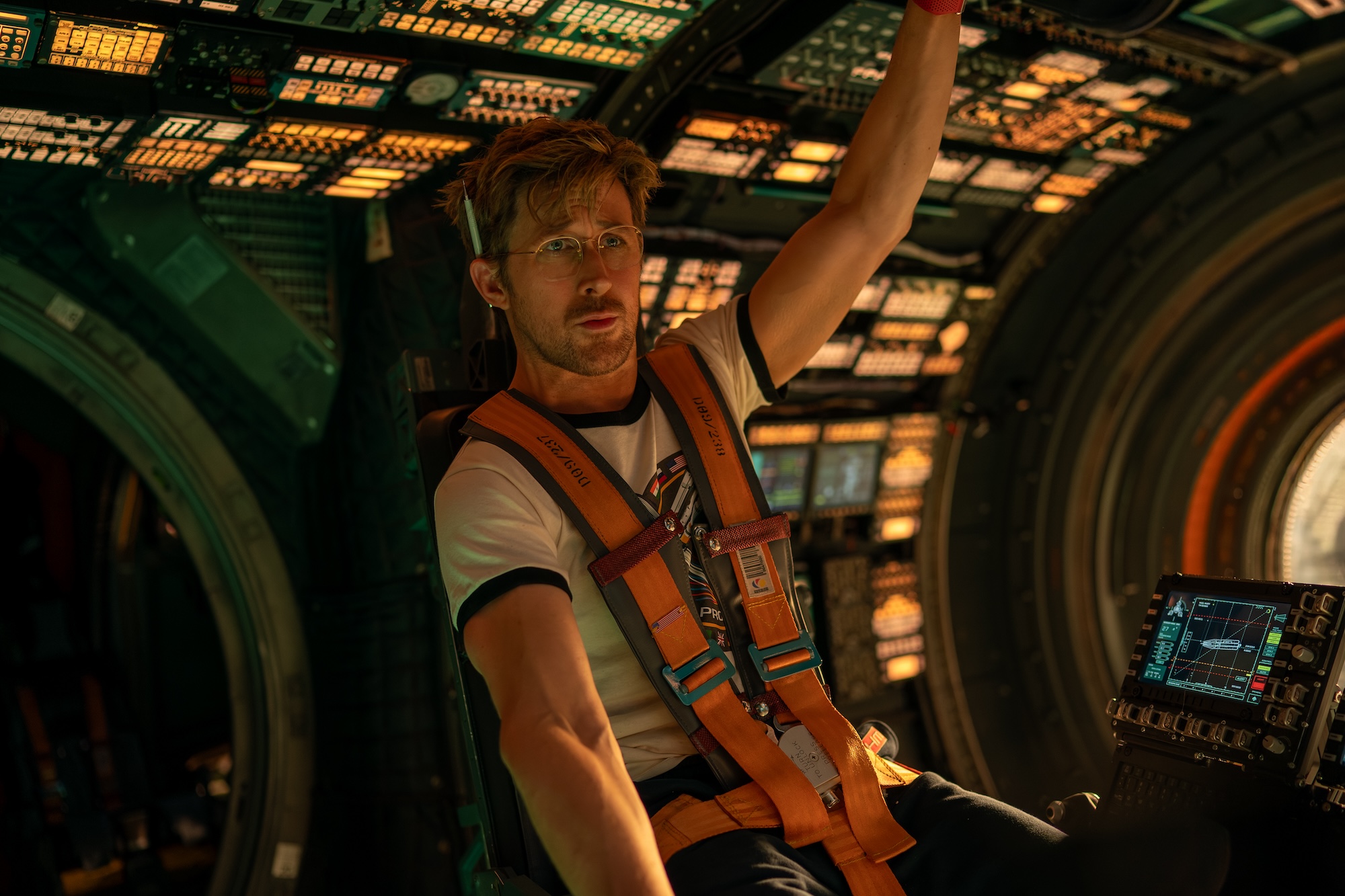
Too often storytelling treats science like magic, a hand-waving variation of “abracadabra” for the modern world. This might be one of the reasons Andy Weir’s novels have proven such fertile ground at the movies. Despite penning wildly outlandish scenarios set almost entirely in space, the one-time video game programmer drills down into the nuts and bolts of his flights of fancy in a way that makes nerds swoon at the page. And even on a screen, where Weir’s zippy first-person narration is generally absent, it can still provide enough wonk fuel for a genuine movie star to cross the celestial heavens.
In 2015 that star was Matt Damon, and the adaptation, Ridley Scott’s light-footed The Martian. Eleven years later, it works almost as well for Ryan Gosling in Phil Lord and Chris Miller’s similarly charming Project Hail Mary. Despite Gosling playing largely the same character as Damon’s Mark Watney—except that Gosling’s even more bookish Ryland Grace cannot remember why he’s alone in space when he wakes aboard a spaceship, five years from earth and traveling in the wrong direction—the page-turner premise remains a winner. It’s a showcase for an actor who can hold the camera without another soul in sight (at least of the human variety); and it’s an opportunity for filmmakers who enjoy breaking the abstract and erudite down into addictive popcorn entertainment.
That ability of transforming the complex into the accessible is doubly appropriate here since we learn in flashback that Gosling’s Grace was a schoolteacher back on Earth, a gregarious big kid geek who just happens to wear a tie and facial hair while excitedly explaining the way the world works to younger curious minds. He also reveals how it doesn’t when Grace is forced to exposit for his class the chillingly ingenious villain of the film: astrophage, or “dots” as the kids (and most assuredly the viewers) will call them. These are microscopic alien lifeforms that travel the cosmos in search of stars’ heat. When they find one, they feast on the gas giants until their light is put on a proverbial dimmer.
These little space bastards have apparently made our sun their next meal, and while only a faint problem right now, in about 30 years, the temperatures of the Earth will drop a clean 15-20 degrees, ushering in a new ice age. Hence the Hail Mary, Grace’s rocketship which was designed to send three scientists out to the only verifiable star the astrophage has visited but didn’t dim. The goal is to learn what makes that sun special and discover a way to replicate the trick back home.
Yet by virtue of the movie’s setup, something transparently went wrong between the flashbacks and the present. Grace is alone when he wakes up with only a groggy notion of who he is, and his mission seems close to hopeless in the present tense. And all of that is before the movie’s real penny drops with Grace learning this isn’t a solo act; it’s a two-hander, and an alien ship from another solar system is right outside the Hail Mary’s hull.
When I read Project Hail Mary in 2021, the publisher had concealed the fact that this save-the-world premise was secretly a launch pad for a first-contact yarn. Amazon MGM has been more forthcoming in their marketing. That’s liberating for lowly film critics who like to convey what a movie is about without speaking only in euphemisms and riddles. And indeed, the sheer pleasure of Project Hail Mary as a moviegoing experience derives from its “when worlds collide” meet-cute. Rather than the twist transitioning the story into the realm of the fantastical, it creates cosmic real estate for first Weir, and now Lord and Miller, to brazenly replicate the hard science fiction that made The Martian a feast for wonks in the most outlandish context imaginable. The results elevate the inherent optimism of Weir’s storytelling to an interspecies degree.
Beyond all the science jargon and merits of theoretical soundness in the author’s books, there remains his clear-eyed and unapologetic celebration of expertise and hard-earned wisdom saving the day. He envisions futures where rationality and the universal language of math, or at least respect for those who speak it by running the numbers, triumphs over fear, division, and selfishness. And in spite of such musings seeming increasingly remote from our daily reality in the decade since The Martian, that rosy belief in the scientific method has not faded. It’s just pivoted to the stars in what becomes the most unlikely buddy comedy this side of Turner and Hooch.
Without giving away what the extraterrestrial looks like here, or how exactly its relationship with Grace plays out, the creature is a visual coup of puppeteering and discreet digital add-ons for Lord and Miller, who create a sheltie-sized sidekick that is equal parts pupil and the unknowable heptapod from Arrival. Its dynamic with Grace is the heart of the movie, providing a parable about the benefits of cooperation trumping cynical self-interest.
The high-concept beguiles, but the human element remains present since Project Hail Mary continuously fixates on Grace’s sense of dread from being alone amongst the stars, as well as his dawning memory of how he got there being revealed by numerous flashbacks that introduce us to the people who put him onboard this vessel, including a coolly practical German project leader (Sandra Hüller). Hüller’s Eva sees the potential in Grace’s school teacher and is given just enough humanity to echo the canny political players and public servants of The Martian, but the chilliness of her utilitarian logic is never really developed beyond the familiar German efficiency stereotype that the movie leans heavily on.
It is these same flashbacks that ultimately overpack Gosling’s space odyssey. Running at a healthy 156 minutes, Project Hail Mary is not a short film. Before it is over, you will get the sensation you’ve been up there too long as well. And yet, despite the indulgent running time, Lord and Miller never let the pace lag or dither. The movie is just as propulsive and engaging as their best animated films—including Spider-Man: Into the Spider-Verse and The Lego Movie—and gets a lot of mileage out of playing with aspect ratios and filming techniques, with cinematographer Greg Fraser (Dune, The Batman) shooting the digital photography in the space scenes on a 1.43:1 frame, which is designed for the verticality of IMAX. Conversely, the earthbound flashbacks are presented in a more traditional 2.39:1 widescreen aspect ratio.
The film is, in other words, as visually thoughtful and pleasing in its imagery as Gosling’s many monologues about solar luminescence and selective microbiological breeding tend to be. So it is hard to ever be overwhelmed when there is always something engaging to reel you back into orbit, be it the aesthetic or extraterrestrial. It’s hard science fiction that goes down easy. So you can even forgive it when the picture over-imbibes on its vices, because even those are covertly its virtues.
Project Hail Mary opens only in theaters on March 20.
The post Project Hail Mary Review: Hard Sci-Fi That Goes Down Easy appeared first on Den of Geek.