By
By 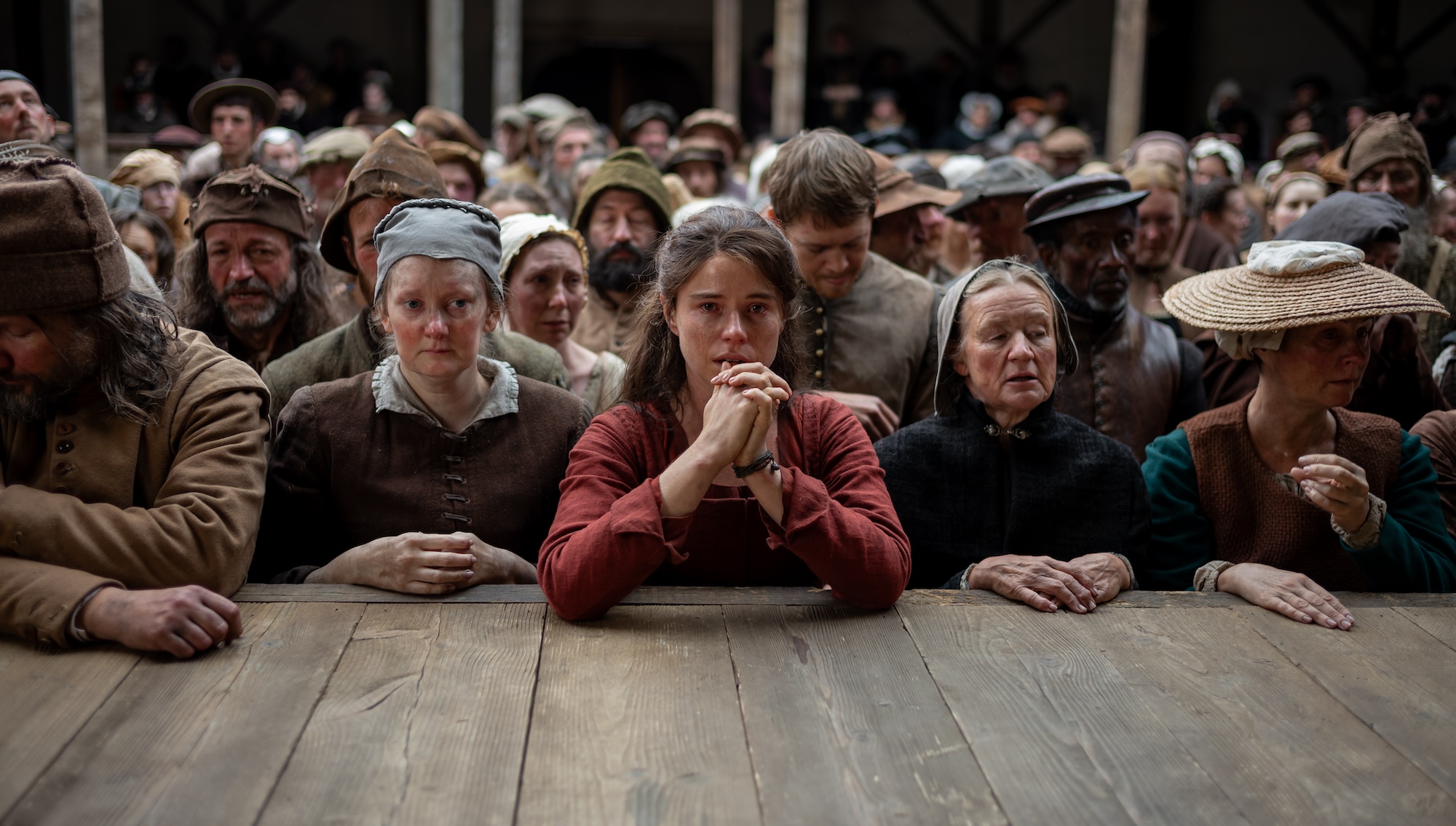
As we head into the climax of Oscar season, the charges against Hamnet only seem to intensify. Detractors have called Chloé Zhao’s adaptation of the 2020 novel by Maggie O’Farrell “Shakespeare fan fiction,” decrying everything from its imposition of modern marital roles onto 16th century England to the design of playbills to Paul Mescal as a handsome Shakespeare.
Each of these complaints has merit. Any viewer who finds themselves distracted by historical inaccuracies should take that into account when discussing their reception of the film. However, there are many other viewers who do not come to Hamnet looking for an accurate representation of the past. Rather, they enjoy the movie for the way it makes them feel, for the immediacy and depth of emotion on display. In that regard, Hamnet succeeds better than any other film in recent memory.
The Bard, Barely
Hamnet irritates the history nitpickers right away, opening with a title card that seems to state the obvious. “Hamnet and Hamlet are in fact the same name, interchangeable in Stratford records in the late sixteenth and early seventeenth centuries,” it declares, citing the 2004 article “The Death of Hamnet and the Making of Hamlet,” but not, strangely, its author Stephen Greenblatt.
Even those who haven’t Greenblatt or any other work of new historicist literary criticism could probably guess that Hamnet and Hamlet are pretty much the same name. And they could have guessed that the death of young Hamnet affected the creation of Hamlet as much as Danish politics, Thomas Kyd’s The Spanish Tragedy, or anything else that influenced Shakespeare.
Rather than act as a statement of purpose, however, the title card acts as a lightning rod. It gathers all the expectations for historical accuracy that its viewers might have and dissolves them by stating the obvious. It gets those expectations out of the way, so that Zhao—who co-wrote the script with O’Farrell—can move onto the cathartic purging that she really wants to do.
Big explosions of feeling begin immediately afterward. There’s Will firing back at his father (David Wilmot) for failing to take glove-making seriously, followed by him shouting at his mother (Emily Watson) over his relationship with Agnes. There’s the courtship of Agnes and William, which consists of one quick flirtation followed by a retelling of the myth of Orpheus, leading to a pagan tryst in the woods. There’s the couple’s first argument, a typical artist breakdown and Will shouts about his inability to finish his play. And all that in the first twenty minutes.
Were the scenes nothing but characters shouting about their passions, then Hamnet would not receive the criticism leveled against it because it wouldn’t be successful enough to warrant much attention. But the film does resonate with viewers, and not just because they’re easily manipulated. Rather, they are affected by the unique way Zhao presents the film’s big emotional moments.
Artificial Scene, Real Catharsis
The standout scene in Hamnet occurs in the final ten minutes, when Agnes attends a performance of Hamlet. By this point in the movie, Hamnet (Jacobi Jupe) has died, in a surreal sequence that sees him apparently trade his life for that of his twin sister Judith (Olivia Lynes). The death leaves Anges wracked with guilt, but Will spends his time in London, working on his plays and apparently refusing to acknowledge his wife or what happened to their son.
Upon learning that Will is mounting a play named after Hamnet, Agnes travels to London and pushes her way to the front of the Globe’s stage, where she watches the play unfold. At first, Agnes refuses to engage with the play, asking aloud obvious questions to her brother Bartholomew (Joe Alwyn) obvious questions about the staging and paying no attention to the annoyed hushes of those around her. But as soon as the actor playing Hamlet (Noah Jupe, older brother of Jacobi) takes the stage, Agnes becomes transfixed.
She watches the story about death, about madness in indecision, about a father who leaves the afterlife to speak to his son, about the tragedy that ends with so many corpses, and she interprets it all as Will finally acknowledging the grief he could not speak directly. And through his art, he allows her to find meaning and peace, helping her make sense of a senseless loss.
Of course, the thousands of essays written on Hamlet demonstrate that there are many, many other ways to read the tragedy. But that’s not the point of the scene. Instead, Zhao focuses on Agnes’s specific experiences, showing how her feelings override everything: the words, the actors, even the other viewers. Cinematographer Łukasz Żal shoots the scene in hand-held, almost entirely in close up on Buckley’s face, breaking occasionally to let us see what she’s watching. Zhao and sound designer Maximilian Behrens give equal attention to almost everything in the mix, making the shuffling of feet and the shushes of audience members as loud as anything spoken by the actors. Max Richter’s score stays silent until the play nears its end, entering as a low rumble as Hamlet fights Laertes.
That approach changes at the moment that Hamlet succumbs to poison and injury and collapses onto the stage, right in front of Agnes. After screaming, “I die!” Agnes reaches out into the stage area and grasps the actor’s hand, which the actor accepts and holds. At that point, the music grows louder, with Richter’s score becoming rich and sumptuous, drowning out almost all other sounds. The audience follows Agnes’s lead, and they all reach out for the boy too, an image that Zhao captures with an overhead shot.
Nothing about that moment is subtle or real or historically accurate. It’s all artifice, downplaying the demands of reality to celebrate the power of false and the pretend. With the shift comes an invitation for the movie-watching audience to join with Agnes and let themselves cry, if only because the movie demands that we cry. And if reports from theaters across the country are to be believed, viewers answered that demand.
For Crying Out Loud
Hamnet has one goal. It exists to make the audience cry, and every line, performance, image, and sound works to that end. For some critics, this single-minded pursuit of a particular response is even worse than its disregard for historical accuracy, as if making people cry is useless.
For some, it certainly is. They come to art for some other form of experience, and that’s certainly valid. But Hamnet is adamant that art has the ability to create catharsis, to move the audience beyond words, to help them make sense of emotions that escape expression in every other form. Moreover, Hamnet insists that art’s ability to make us cry matters.
Some will disagree with that claim, just as they dismiss Hamnet as a film. And that’s fine, not every movie works for every person. But the powerful reactions to Hamnet demonstrate that many others disagree, proving that the film’s ability to reduce viewers to tears is not a drawback; rather, it’s proof of the movie’s claim that strong feelings matter.
Hamnet is now streaming on Peacock.
The post Hamnet’s Power is in Its Emotional Immediacy, Not Historical Accuracy appeared first on Den of Geek.