By
By 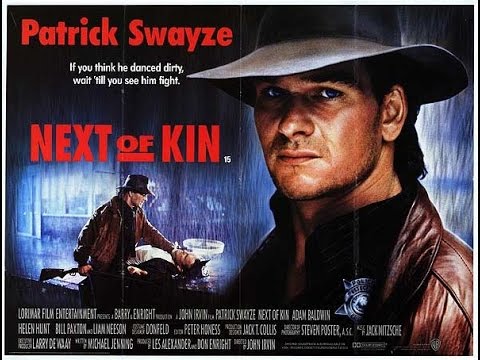
Last week, when writing up my newfound appreciation for Patrick Swayze, I was reminded of a movie of his that everyone seems to have vaguely remembered seeing, but couldn’t tell you much about it – Next Of Kin. It’s been a while, so it was clearly time to revisit this movie that felt perhaps slightly lost to the mists of time.
It is a movie that can only have come from a certain moment. A period in movie history, as the decades turned, and a new era approached. A very specific, very beautiful moment in the year of 1989 when Hollywood executives looked at a whiteboard and, after a moment of silence, said:
“What if hillbillies… but heroes?”
Thus, we received Next of Kin, the glorious culture-clash action opera where the Mob wears tailored suits and the good guys wear denim so thick it could stop a .45 round.
Next Of Kin
Directed by John Irvin and released into the late-80s testosterone ecosystem, this movie actually, in hindsight, arrived at exactly the right time when audiences were ready for one last blast of regional macho nonsense before the 90s showed up with its irony.
And who better to lead the moonshine militia than Patrick Swayze. Despite it being something of a forgotten entry in the Swayze filmography, somehow this is Peak Swayze.
The Premise is simple. Hillbillies vs. The Mob. Somehow it just works. The setup is so gloriously dumb it feels like it was brainstormed during a bourbon tasting.
Chicago cop Truman Gates (Swayze) left the Appalachian hills of Kentucky to become civilized. He traded in moonshine for badge shine. He learned how to say “coffee” without chewing tobacco in his lip.
But when his younger brother (Bill Paxton) gets himself murdered, the mountains come calling. And by “calling,” I mean they send Liam Neeson with a shotgun.
The Mob in this film is personalised by the impeccably coiffed and deeply irritated Adam Baldwin, plus there is patriarchal mob boss energy courtesy of Andreas Katsulas. They are positioned as smooth, arrogant city slickers who have never once had to wrestle a pig before breakfast.
They made a fatal mistake: they underestimated the power of kin. Into this mess steps Swayze’s cop, accused of turning his back on his mountain man roots.
In 1989, there was no stopping Swayze. His strong turn in Red Dawn was eclipsed by Dirty Dancing, he had roundhouse kicked his way into Outposter immortality with Road House, and was yet to make a million girls cry in movie theaters in Ghost. So Next Of Kin kinda gets lost in the mix, a revenge movie where he wears cowboy boots and broods about family honor.
This is Swayze at his most paradoxical: gentle eyes, but absolutely willing to spear you with a fireplace poker.
He plays Truman as a man caught between two worlds: the polished cop world and the “we settle this with guns and hide the bodies” world of his ancestors. It’s Shakespeare, if Shakespeare had access to pickup trucks and dynamite.
Liam Neeson is the main co-star, and here, pre-Schindler, and pre-Taken, he’s all intensity. At first, seeing Neeson here is like spotting a future Oscar nominee working the grill at Applebee’s, but he just makes it work. He plays Briar Gates, the brother who stays in Kentucky and keeps things authentic. In this movie, it means brooding, drinking, and getting in way over his head with Chicago criminals.
He will kick off a second revenge spiral, and even in limited screen time, you can see Neeson’s trademark intensity simmering. This man was born to glare at villains and promise retribution in a low, rumbling tone. He just hadn’t perfected the “I will find you” cadence yet.
Just when the mob thinks the problem is solved, the mountains send reinforcements, and what reinforcements they are. Rugged individuals straight from a survivalist convention, with sentient beards and shotguns that appear as casually as coffee mugs.
The idea that Appalachian mountain men are secretly some kind of mountain-trained (by birth) elite tactical strike force is both absurd and delightful. They don’t do undercover. They don’t negotiate. They just show up with hunting rifles and want to know who touched their cousin.
And somehow, it all just works.
The film leans into the “clan loyalty” angle hard. These aren’t caricatures. Okay, they are caricatures, but they’re noble caricatures. Proud. Fierce. Wearing denim like armor.
The Mob as the enemy just deserves what is coming. The Chicago mobsters are portrayed as smug, entitled, and criminally underprepared for a feud with people who grew up skinning deer. Andreas Katsulas plays the mob patriarch with oily menace. He’s old-school organized crime: suits, cigars, and the unwavering belief that intimidation is a lifestyle.
But the brilliance of Next of Kin is that it flips the traditional action-movie script. Normally, the rural folks are the threat. Here, they’re the heroes.
The villains are urban, corporate, and dismissive of “backwoods idiots.” Oops.
For a movie with such a goofy premise, the action scenes hit hard. There’s a warehouse confrontation that escalates quickly from “tense negotiation” to “someone just got impaled.” Gunfights feel chaotic and dangerous, not polished and superheroic. The killings are messy. Personal. Vengeful.
At one point, a mobster learns the hard way that you should not underestimate someone raised around livestock tools. And the final shootout? Oh, we will come to that.
Wait, Is That Who I Think It Is?
Part of the fun I had revisiting Next of Kin is spotting the faces in the cast. It really is quite incredible. Alongside Swayze, Neeson, Katsulas, and Baldwin are Bill Paxton, Helen Hunt, even Ben Stiller. It’s an incredible cast if, as we do when watching it now, you have arrived from the future.
It’s like a time capsule of future stars wandering through a revenge western set in Chicago, a revenge western that is having such a good time it can’t even be bothered to make itself dull by trying to be all neo-western. Next of Kin just… is!
The surviving cast propel this movie inexorably towards the finale. The denim apocalypse.
The climax is everything you want from a late-80s action film. Guns blaze. Shotguns pump. Mobsters scream. Swayze glowers with righteous fury. It’s loud. It’s excessive. It’s deeply committed to the bit. Does it make sense? Mostly. Does it matter? Absolutely. This is 1989. We are here for catharsis.
John Irvin aimed to blend gritty urban crime drama with rural revenge western. It was shot largely in Chicago, with Appalachian sequences capturing that misty, mythic mountain vibe. The script does make the effort to try and ground the cultural clash in authenticity, highlighting tensions between Truman’s cop identity and his heritage. In lesser hands, this could’ve been parody. Instead, it lands somewhere between earnest and operatic.
Behind the scenes, Swayze pushed for emotional weight to balance the gunplay. And you can feel it. The movie believes in family bonds with almost mythic sincerity. Which makes the gunfights feel… weirdly wholesome?
The result is one of the last great 80s action oddities, and there is something about Next of Kin that, revisited today, screams “end of an era.” The 80s action genre was about excess, masculinity, and regional pride. The 90s would bring sleeker thrillers, ironic detachment, and eventually bullet-time trench coats.
But this? This is the final roar of a decade that thought:
“What if your cousins could overthrow organized crime?”
It’s not cynical. It’s not meta. It’s not a gag. It means every shotgun blast.
So does it hold up? Strangely, yes. It is silly. It has a hilarious concept. But it is executed with full-throttle sincerity and surprisingly effective action choreography. Swayze anchors it. Neeson smolders. The mob underestimates the wrong family. We get a revenge saga where the heroes drive pickup trucks instead of Ferraris.
Next of Kin is what happens when Hollywood decides the Hatfields could defeat the Mafia and then actually commits to the idea. It’s sweaty. It’s earnest. I have already mentioned the denim. So much denim. Swayze commits, so he makes it feel that it is OK for you to commit. This was action thrillers before grunge soundtracks.
Moonshine mythology meets urban criminals. Extremely painful lessons are learned about Appalachian loyalty. If you can take one thing away from this movie, let it be this:
Never underestimate a man whose backup arrives in a pickup truck.
The post Retro Review: NEXT OF KIN (1989) appeared first on Last Movie Outpost.